Bushrangers today, eh?

hero media
Over a friendly meal with a wandering yarn-spinner, Peter Russell-Clarke learns that the days of the outback outlaw are far from over. They’ve just lowered their sights a little.

I often think about Mad Mac. Sean Macintosh of the Outback was one of those unforgettable rogues. Loveable, but . . . well, different. But then again so were (and still are) quite a few of the outback characters.

Bobby One Leg for instance. He couldn’t read, yet could recite the poem The Highwayman flawlessly. “The road was a ribbon of moonlight across the purple moor," he’d intone like an Aussie Laurence Olivier. “The highwayman came riding, riding up to the old inn door."

Then there was Charlie Chop Chop, the Chinese cook who could disguise anything under a wok full of cabbage and water chestnuts. There was Ron the Roo Shooter, who compiled an Aussie Outback Dictionary that he tried to have translated into Japanese in case the lads from Nippon decided to have another crack at taking over the joint. And there was Shirley Temple, the horse breaker. And Jumping Jill, the highway prostitute. They all have fascinating yarns to tell but, in truth, their stories pale into insignificance compared to the stories of their own lives.

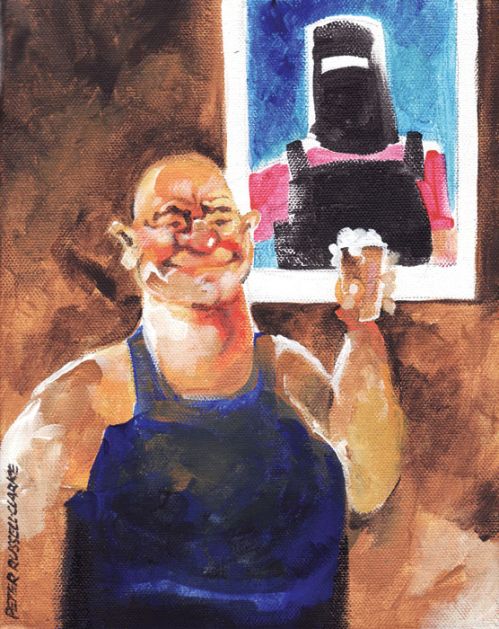
But one of the most interesting characters I’ve ever come across was Perc. I didn’t believe the old bushy for a moment, but I had to admit he was entertaining. “My Dad’s great uncle was Ned Kelly’s cook," he once told me, nodding solemnly. “He was never given credit for keeping the Kelly boys healthy, but without old Claude keeping them regular, goodness knows what sort of mess they would’ve been in.

“Ya see, Ned and his gang couldn’t be stopping any old time for nature’s call, could they?" I nodded that I indeed agreed that they couldn’t. But I confess I wasn’t sure what he meant. “Imagine trying to squat with the weight of that armour draped over ya," Perc continued. I hoped he wasn’t going to detail what I now perceived were the regular functions he was alluding to.

“Of course, Claude the cook had designed his armour to be more functional than Ned’s," said Perc. “Instead of plough shields, his armour was his woodfired stove – one of them ones with doors for the ovens and firebox and such. He’d put his stove on whenever armour was needed, an’ when he wanted a pee he’d simply open the appropriate door and he was away. At mealtimes he discarded the stove, reassembled it, lit the fire and cooked their grub. As long as they didn’t have to move quickly, everything was hunky-dory."


I met Perc at a stopover on the Hume Highway just up the road from Holbrook in south central NSW. I was travelling through to Wagga, then planned to drive across to the Alice and up to Tennant Creek in my trusty motorhome. Perc was towing one of those collapsible tent-trailers with the bed that pops out the back. I’d stopped for a cup of green tea. Perc had stopped because he wanted to stop.

“I often drive around Ned’s old territory," Perc confided. “Even cook some of old Claude’s recipes. Ya know, Ned Kelly was a beekeeper at one stage. That’s why he moved around a lot. And, of course, why Claude used honey so much."

I confessed that I hadn’t known, but was intrigued – why did it mean Ned had to move from place to place?

“Well, he had to follow the honey flow, mate. Wherever the blossom was flowering, the bees needed to be right there and right on time, otherwise the bees starved and Ned got no honey."

“Okay," I said, pouring Perc a beer. “But if Claude wore his stove, surely all the doors were in the front. Which might be all right for No.1s, but what about No.2s? And what about his helmet? Don’t tell me he wore a saucepan; how would he see? If he’d had eyeholes, the saucepan would leak when being used for more conventional purposes."

“Claude’s cooking wasn’t conventional, mate," laughed Perc. “Far bloody from it. An’ ya see, Claude was always running away from danger, so the front of the stove was on his back region. He peed through the flu, which is at the back of the stove. An’ he didn’t need eyeholes in his helmet because, if any threat presented itself, he shut his eyes tight and took off."

I thought all that through as I poured us both another beer. “Have ya got a red?" asked Perc shyly. “Shiraz f’preference. I’m not big on Pinot Noir. More a sheilas’ drink, eh?"

By now the sun had danced down behind red river gums, which stood sentinel at the end of a billabong in a paddock between us and the river. I’d made some tabouli, which I was thinking of having with a few falafel and hummus. “Would you like to join me?" I asked Perc.

“Bloody oath, mate, whatever it is. An’ I’ve got a coupla chops and some spuds. Ned loved lamb – it was plentiful from over any fence – and spuds were a must for a growing Irish lad."

And so it happened. The next day we parted after muesli for me and bacon and eggs for Perc. I took my time tidying and stowing away, all the while grinning over Perc and his Kelly yarns. But as I pulled out of the stopover, a police car drew alongside and indicated that I stop. I did.

“G’day, mate," growled a broad-shouldered copper. “Have you seen a little bloke driving an old Holden Ute towing a campervan?"

“What’s he done?" I asked.

“He’s like a bloody gypsy, the little bugger. Nicks hubcaps and spare wheels and anything else not tied down. I see you’ve got no hubcaps, so I thought you might’ve met up with him."


It was years later that I read about Perc’s death. I was camping by a billabong at Talmalmo, just down from Jingellic. I was reading the local paper. Perc had been arrested for robbery – convicted – but died of a heart attack on his way to the lock-up. Unlike Ned, he beat the gallows.

Australian Traveller

Australian Traveller

View profile and articles
hero media

The road trips and trails you need to experience in Victoria now

    Kellie Floyd Kellie Floyd
    Wind through fern tunnels, stop for a wine in a tram bar, or chase giant murals across the wheatbelt. These drives and rides prove Victoria’s best stories are found off the straight and narrow. 

    There’s something unmistakably Australian about a road trip: car packed, playlist on, landscapes shifting. Travelling down the highway toward Healesville, in Victoria’s Yarra Valley, the mountains rise, flanking me on both sides. I feel its embrace, a silent invitation to explore what lies beyond.  

    Moss-covered embankments rise on either side, and towering mountain ash trees form a green tunnel overhead. Road signs warn of wombats and cyclists but with giant ferns lining the roadside, the landscape feels prehistoric, as if a dinosaur might suddenly emerge. This, the Black Spur, is one of my favourite road trips. 

    The Black Spur 

    The Black Spur drive
    Through the forested canopy of The Black Spur drive that winds from Healesville to Narbethong. (Image: Neisha Breen)

    Location: Yarra Ranges
    Duration: 30 kilometres / 30 minutes 

    The Black Spur is short compared to other Victorian road trips, just 30 kilometres, stretching from Healesville to Narbethong. But what it lacks in distance, it makes up for in scenery. Just outside Healesville, Maroondah Dam offers bushwalks and scenic views. However, if pressed for time, Selover’s Lookout is an easy roadside stop offering uninterrupted views of the dam.  

    In Narbethong, close to the Marysville’s snowfield, is the Black Spur Inn, a charming double-storey brick hotel that’s been welcoming travellers since 1863. Here, diners cosy up by the roaring fire or gaze through the floor-to-ceiling windows, imagining horse-drawn coaches carrying hopeful gold seekers to the eastern goldfields.   

    Victoria’s Silo Art Trail 

    Silo Art Trail
    The Silo Art Trail in the Wimmera Mallee region. (Image: Visit Victoria/Anne Morely)

    Location: Various towns across the Wimmera Mallee region
    Duration: More than 200 kilometres / 4–5 hours but best over a minimum of three days  

    What began as a way to draw travellers back into town bypassed by highways – places such as Nullawil, Sea Lake and Patchewollock – has grown into a celebrated outdoor art movement. The Silo Art Trail now includes 23 silos, each transformed with large-scale mural portraits sharing local stories, celebrating community heroes, Indigenous history, farming life, or regional identity.  

    The Nullawil silo, for example, is a portrait of a local farmer in a chequered flannelette shirt alongside his loyal kelpie, painted by artist Sam Bates (AKA Smug). And the silos at Albacutya in the Grampians, painted by artist Kitt Bennett, depict her joyful memories of growing up in the countryside. Many of the murals sit right in the heart of small towns, such as Rochester and St Arnaud, making them perfect spots to pause for a country pub meal or something sweet from a local bakery.   

    Metung to Mallacoota  

    Gippsland lakes
    Gippsland Lakes. (Image: Visit Victoria/Josie Withers)

    Location: Gippsland
    Duration: Approximately 220 kilometres / 4 hours  

    The Gippsland Lakes are a much-loved holiday spot in Victoria, but road-tripping further east reveals much more. Begin in Metung and time your visit with the monthly farmers’ market, or simply linger over lunch on the lawn of the Metung Hotel. Twenty minutes away is Lakes Entrance, where you can watch the fishing boats return with their catch. 

    Lakes Entrance
    Lakes Entrance. (Image: Visit Victoria/Iluminaire Pictures)

    Continue to Marlo, where the Snowy River spills into the sea, and Cape Conran for its many beaches and walks. If needing to stretch your legs, Croajingolong National Park is home to the historic Point Hicks Lighthouse and the Wilderness Coast Walk. Birdwatching and rainforest trails near Bemm River are worth a pit stop before arriving in Mallacoota, where the forest meets the sea. 

    Great Ocean Road 

    12 Apostles on the Great Ocean Road
    The 12 Apostles on the Great Ocean Road. (Image: Tourism Australia/Two Palms/Harry Pope)

    Location: South-west Victoria, from Torquay to Allansford
    Duration: Approximately 250 kilometres / 4–5 hours but best over a minimum of three days  

    Victoria’s most famous road trip delivers it all: world-class surf breaks, rainforest walks, clifftop lookouts and wildlife encounters. The journey begins in Torquay, the state’s surf capital, then hugs the coast past Anglesea and Lorne to Apollo Bay, before curving inland through the lush rainforest of the Otways. Stop at Cape Otway Lightstation or take to the treetops at Otway Fly.  

    Between Cape Otway and Port Campbell lies the most photographed stretch – seven of the Twelve Apostles still standing, alongside the golden cliffs of Loch Ard Gorge. Further west, Warrnambool is a winter whale-watching hotspot, before the road winds to Port Fairy, a charming fishing village of whalers’ cottages, walking trails and offshore seal colonies further along the coast. 

    Bellarine Taste Trail 

    Terindah Estate
    Terindah Estate. (Image: Visit Victoria/Emily Godfrey)

    Location: Bellarine Peninsula
    Duration: Approximately 80 kilometres / 2–3 hours  

    The Bellarine Taste Trail is a feast for the senses, winding through coastal towns, past boutique wineries and artisan producers. It’s a choose-your-own-adventure style trail – simply grab a map and build your own delicious journey.  

    You might wander historic, seafront Queenscliff, sip wine in a converted tram bar at Terindah Estate, sample a locally distilled whisky at The Whiskery in Drydale or pick up a jar of honey at Wattle Grove in Wallington. Seafood lovers can head to Portarlington, famous for its mussels. Eat them fresh at local restaurants or head out on the water with Portarlington Mussel Tours. 

    O’Keefe Rail Trail – Bendigo to Heathcote 

    Pink Cliffs Reserve
    Pink Cliffs Reserve in Heathcote can be seen on the O’Keefe Rail Trail. (Image: Visit Victoria/Emily Godfrey)

    Location: Central Victoria
    Duration: Approximately 50 kilometres / 4 hours cycling 

    Travellers first journeyed between Heathcote and Bendigo in 1888, when the railway line was built to link the towns. Trains stopped running in 1956, but today the route has a new life as the O’Keefe Rail Trail. The path is mostly level for easy riding, and along the way you’ll cycle past bushland, waterways and reserves. There are plenty of places to picnic, birdwatch, and if you’re lucky, spot a platypus.  

    The trail is well supported with water stations, bike repair points, shelters, and signage. Axedale makes a great halfway stop, with the pretty Campaspe River Reserve for a rest and local cafes for refuelling. Begin in Heathcote, known for its wineries and cafes, or in Bendigo, which is easily reached by train from Melbourne/Naarm. Shorter sections, such as Heathcote to Axedale, are also popular. 

    Goldfields Track – Ballarat to Bendigo 

    Location: Central Victoria
    Duration: Approximately 210 kilometres / 2–3 days cycling  

    The Goldfields Track traces a route once so rich in gold it made Melbourne one of the wealthiest cities in the world. Starting at Mt Buninyong, south of Ballarat, the trail leads mountain cyclists and walkers north through Creswick, Daylesford and Castlemaine before finishing in Bendigo. Along the way, you’ll encounter granite outcrops, eucalypt forests, rolling farmland and remnants of the region’s mining past.  

    As it passes through the lands of the Dja Dja Wurrung and Wadawurrung people, the track shares gold rush history and Indigenous stories brought to life by interpretive signs. Walk or ride the full trail or choose from one of its three distinct sections. With cosy stays, cafes and pubs, it’s easy to mix wilderness with comfort.