Business class v economy: Is it worth the extra cash?

hero media
Like any economy-class flyer will tell you, boarding a large plane is a bit like taking a pauper to Fifth Avenue – an insight into the luxuries money could buy, if only you had it.

The first time I boarded a plane I couldn’t understand why people complained about long haul flights, I walked in to find rows of roomy seats that could double as single beds, mini televisions and more buttons and gadgets than a Transformer. This is was going to be all kinds of fun! Then I realised I was walking through business…

As I walked down the aisle the seats suddenly became cramped into rows of eight, not six, the cry of babies became louder and overhead storage compartments were already so packed the doors couldn’t close, let alone fit my items.

Qantas has unveiled its first Business Lounge in Adelaide. Designed in collaboration with architecture firm Architectus, this elegant space celebrates the flavours and landscapes of South Australia.

Oh, so this is why they call it cattle class.

Over the years I’ve since learned to look straight ahead and ignore the lushness of business en route to my seat at the rear. In fact, on occasion I have secretly scoffed at business customers – clearly with more money than sense.

But when I was recently offered a business seat with Qantas on a return flight from Western Australia, I wasn’t quite so unaffected. Alright, guilty – I did a Lleyton Hewitt-esque “come on!", marked it down in my diary, then counted down the days. Having only ever flown economy, just what was so good about business that warranted the quadrupled price tag?

I arrive at Perth’s airport, fresh off a connecting flight, and have 15 minutes to enjoy the glory of the business lounge. So condensing the experience which any sophisticated traveller would typically enjoy over an hour, my travel companions and I race in, peruse one of the many magazine and newspaper stands, scoff down a complimentary bowl of crispy snacks from the bar and a glass of champagne, all before darting to the boarding gates. Moral of the story – arrive at the airport early so you have time to actually enjoy the lounge at leisure.

As we board the plane, it feels quite alien taking only a couple steps before the stewardess says “Right here, Miss Jenkins".

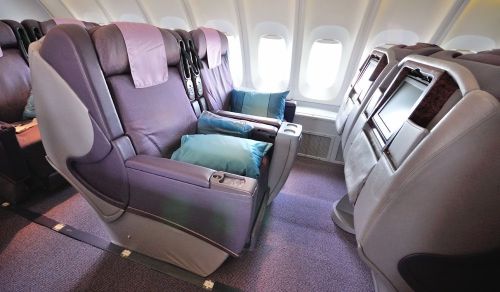
Ah, my seat. My beautiful, spacious seat. Pillowy and wide, and with more leg room than I know what to do with. I test out every way I can maneovour my lair for the next five hours, flick almost every switch I can find (which the old-hand business traveller next to me isn’t quite so excited by), and read over the menu at least nine times before takeoff. I am a child on a sugar high.

During the safety briefing, I’m even excited when the voiceover announces “emergency life jackets in business are found under your leg rest" – yes, leg rest!

But it’s not just the almighty seats that make the business experience. The differences between it and economy vary in obviousness, but they all add up. The aisles are wider, the bathrooms are lovelier, the blankets are softer and thicker and the menu, oh now that’s something special.

Don’t get me wrong, the food in economy is far from substandard, but it certainly doesn’t match menu offerings like pistachio-encrusted salmon fillet, slow-cooked braised beef cheeks, passionfruit panna cotta or crème brulee. Even the faultless staff seem happier.

There’s the larger in-built flat-screen television for every seat too – with an extended range of entertainment options no less – and even the head phones are of higher quality.

But back to the seat – the fact that you can lie completely flat in the seats for a proper mid-flight nap alone almost justifies the inflated price tag.

So is it worth it? If it’s a long-haul flight and you genuinely have the disposable income – absolutely. Even if it’s just once if your life that you splurge.

I was almost disappointed when we landed. It’s going to be tough going back to economy.

Need tips, more detail or itinerary ideas tailored to you? Ask AT.

AI Prompt

hero media

The iconic Victorian beach where true Aussie surf culture was born

    Craig Tansley Craig Tansley
    Torquay’s Bells Beach is considered one of the best surf beaches in the world.

    It’d be easy to think Australian surf culture was born around the right-hand point breaks of the Gold Coast and Byron Bay. These regions seem the epitome of how the world views Aussie surfers – bronzed (or burnt), languishing in warm water and sunshine. The reality is a lot different.

    The rise of surf culture along Victoria’s coastline

    surfers at Bells Beach in Australia
    Surfers stand on the shore at Bells Beach, where the country’s biggest surfing competition is held each year. (Image: Getty/Filed Image)

    True Aussie surf culture was born on the chilly waves of Victoria’s winters, when huge swells from the Great Southern Ocean hit cliff-lined beaches along the Great Ocean Road. These beaches were the ultimate proving ground – surfers from all over Australia arrived in panel vans and VWs to do battle with the biggest waves they could find.

    huge swells from the Great Southern Ocean at Bells Beach
    Surfers take advantage of the huge swells from the Great Southern Ocean at Bells Beach. (Image: Tourism Australia/Cameron Murray)

    There are surf breaks all along this very picturesque coast – but those around Torquay were most revered. The ultimate test of a surfer’s ability – and durability – however, was Bells Beach: Australia’s answer to Hawai‘i’s Pipeline. Just beyond, the breaks at Jan Juc and Winkipop beckoned.

    an aerial view of surfers at Bells Beach
    Hit the waves along the picturesque coast. (Image: Tourism Australia)

    Torquay became surfing’s Silicon Valley: HQ for the entire Australian surf culture revolution. Four young locals worked out of their backyards in Torquay to create two of the world’s biggest surf labels – Rip Curl and Quiksilver, which soon became the region’s biggest employers.

    surfers out at Bells Beach
    Surfers out at Bells Beach, Victoria’s most famous beach. (Image: Tourism Australia/Cameron Murray)

    Rip Curl started sponsoring the Bells Beach Pro in 1973 – and have done ever since. It’s been going since 1962 – making it the world’s longest continually run surfing contest. Held every Easter, it’s part of the world surfing tour. Spectators line its 30-metre-high cliffs to watch the world’s best take on enormous waves – it’s the ultimate coliseum for the sport and has inspired generations of Aussie surfers to join the list of heroes whose names are on its iconic bell.

    Follow the waves through Victoria’s surfing heartland

    Australian National Surfing Museum, Torquay
    The Australian National Surfing Museum in Torquay. (Image: Tourism Australia)

    Just behind Torquay’s main drag, you can see all that history on display at the world’s best surf museum – the Australian National Surfing Museum. Here you can take your time absorbing the 100-year-or-so history of Australian surfing and check out the 150-strong surfboard collection.

    surfboards on display at Australian National Surfing Museum
    The museum holds surfing memorabilia, including a room dedicated to the history of boards. (Image: Tourism Australia)

    But classic Aussie surf culture can be observed in everyday life all over the Great Ocean Road and Torquay. Surfing dictates life here; no work is done until the big swells have come and gone. Just being here provides a window into 60-odd years of rebellion against convention; for no-one likes nine-to-five living on the Great Ocean Road.

    surfing memorabilia at Australian National Surfing Museum
    The varied displays celebrate the Bells Beach competition, surfing legends and Aussie surf culture. (Image: Tourism Australia)

    There’s less panel vans and VW Beetles these days, but surf culture still rules life. Surfers run this coast; you’re better off keeping out of their way when they’re running down past you to face the biggest swells – then hear them swap stories at cafes, restaurants and bars all around you.

    surfing at Bells Beach
    The beach near Torquay is Australia’s answer to Hawai‘i’s Pipeline. (Image: Visit Victoria/William Watt)