Ferrari Drive Day

hero media
We invite non car nut Zoe Naylor to review the Prancing Horse Ferrari Drive Day.

I decided to invite my dad to join me. Dad’s a vet and has never had the chance to drive a Ferrari. A little father-daughter bonding time over an experience that doesn’t come along every day seemed like a special opportunity. We each forked out $990, and as our chosen day approached we felt like two kids who’d won the golden ticket to Willy Wonker’s private garage.


When Australian Traveller asked me to review Prancing Horse I imagined I’d be riding a beautifully trained stallion through the Snowy Mountains, mimicking some romantic fairytale. I was unaware that Prancing Horse’s company name refers to the Ferrari emblem, and that I was in fact to be at the helm of a machine with more horsepower than any animal I could ever dream of riding.


When I think of Italy, I think of George Clooney’s house, Dolce & Gabbana and Napoletana sauce. Let’s face it, knowledge about cars is not part of the average woman’s education. This is not to say I wouldn’t like to learn more. Over the years I’ve watched a couple of episodes of Top Gear, usually by default after relinquishing the remote control, and actually enjoyed them.


Since becoming a Ducati rider I appreciate the feeling of having a powerful engine vibrating between my thighs. It makes you feel alive – yes indeed, ladies! But the closest I’ve come to driving a Ferrari is playing Need for Speed on an Xbox and crashing hopelessly every five seconds.


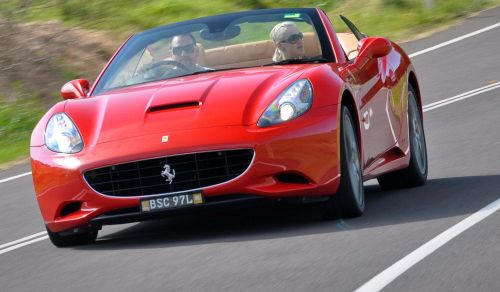
Prancing Horse runs a Ferrari Drive Experience, where you drive four different Ferraris over 350km along Grand Pacific Drive south of Sydney, through the Royal National Park and into the hinterland. You get behind the wheel of Ferraris such as an F430, a 360 F1 Spider, an F355 Spider and a 328 GTS. Whatever that all means!


The day starts at 7.30am, and as soon as we pull up outside Prancing Horse headquarters in Marrickville, in Sydney’s Inner West, our hearts start beating with excitement. The shiny red Ferraris are all lined up outside like freshly primped children ready for their first day of high school. Inside, we are casually greeted by our hosts, Matt and Robert, and handed a freshly brewed latte. We look round the impressively large garage full of Ferraris of all models and colours – an experience in itself. Then we head upstairs for a briefing and meet our fellow drivers. It’s an intimate affair, with just eight participants on any day. There’s two drivers per car and you rotate drivers, then cars, every 45 minutes.


One of our fellow guests, Geoff, is here for a second time. He did the first drive day with his wife and had such a great time he booked again – this time bringing his son. Garry has flown up from Melbourne after receiving the drive day as a gift from his wife. Vince is quite simply a car nut.


After a quick practice run up and down the street to calm the nerves and sweaty palms, it’s time to start our engines. And I thought the Ducati sounded good.


Winding through city traffic in a Ferrari is exhausting. It’s like trying to ride a wild brumby, or navigate a small child through a shopping centre on a restrainer. It feels like it wants to bolt, and holding it back requires effort and concentration. The car’s power is confronting.


Once we turn onto the freeway to Wollongong, however, everything changes. Oh my God! I haven’t felt this rebellious since wagging school. You can’t help but put your foot down, even just a little, and relish the experience of a vehicle that feels like it could take off from the ground at any moment. Even my Dad yells “woohooooo!" at the top of his lungs – and I’m the one driving!


Driving through the Royal National Park is divine. We chat and laugh as our car effortlessly hugs the winding roads at speed. Although we’re travelling as a group, following a lead car, it’s fun to slow right down then put the pedal to the metal, taking the car to 100km/h in about two seconds. Obeying the speed limits, of course.


We stop for a delicious three-course lunch at SeaBreeze, a restaurant by the water in Kiama. (Salt ’n’ pepper squid is a highlight.) Along the way, people’s fascination with the car is astounding. Perhaps it’s the impressive convoy of red Ferraris as we pull up at traffic lights, engines purring loudly. Or perhaps it’s curiosity about how the other half lives. I know we often turn up our noses at Ferrari drivers, judging them as w**kers with too much money, but maybe it’s just jealousy.


I’m sure many passers-by think I’m the younger girlfriend of some obscenely wealthy middle-aged man as Dad and I pass by. But Dad and I revel in the humour of it all.
We pull into a lookout for an afternoon tea stop. A busload of Japanese tourists immediately turn their attention from the view and furiously start taking our picture – pointing at us like we’re rock stars. And for a day, we feel like we are.

Need tips, more detail or itinerary ideas tailored to you? Ask AT.

AI Prompt

DETAILS: Prancing Horse Ferrari Drive Day

Where: The trip cruises south of Sydney, through the Royal National Park, across the new Sea Cliff Bridge and along the Grand Pacific Drive.


Notes: A Ferrari Drive Day costs $990 per person including lunch, refreshments, fuel and insurance. An Overnight Escape package is also available that adds boutique accommodation, dinner at 1871, a massage and spa package for two and an extended driving route.


Contact: 1300 30 70 50; www.prancinghorse.com.au

hero media

Discovering East Arnhem: Australia’s most unique and rewarding corner

    Joanne Millares Joanne Millares

    Hard to reach and harder to forget, East Arnhem offers something rare in modern travel: the chance to slow down and experience Country on its own terms.

    The sky feels bigger in East Arnhem. It stretches wide and uninterrupted above rouged earth, stringybark woodland and beaches so empty they seem to belong to another era. The coastline curves for kilometres without a footprint and the horizon runs on forever.

    For comedian Lou Wall, the scale of the place was the first thing that hit them.

    “The sheer openness,” they say. “The sky feels infinite and the land stretches out endlessly. It’s pretty breathtaking visually.”

    But the physical landscape is only part of the story. The real reward isn’t only the scenery but the shift in perspective the journey brings. Visitors stop trying to tick off the destination and a real engagement takes over.

    “It made me never want to travel again,” Wall jokes. “In that I never wanted to leave East Arnhem.”

    Getting there

    Aerial shot of East Arnhem’s coastline as cars trace the curve of the shore.
    Sail along the remote coastline on an expedition cruise.

    Reaching East Arnhem is part of the adventure. Travellers typically fly into Gove Airport near Nhulunbuy via Darwin or Cairns, or arrive by expedition cruise along the remote coastline. Others make the journey overland along rutted dirt roads that cut through East Arnhem’s small pockets of monsoon forest.

    However you arrive, there’s a distinct feeling of crossing into somewhere different. Permits are required to visit the region, reflecting the fact that this is Yolŋu land where communities and traditional owners maintain deep cultural connections to Country.

    The extra planning becomes part of the experience. By the time visitors arrive, they understand they’re entering a place not just of respect, but also patience and curiosity.

    At one with nature

    East Arnhem’s  landscapes leave a strong imprint. For Wall, one place in particular still lingers in their memory: Ngalarrkpuy, also known as Lonely Beach, near Bawaka Homeland.

    “I genuinely felt like I was living inside an Instagram filter,” they say. “One of the most stunning feats of nature I’ve ever seen. The water was so clear I swear I could see even the fish smiling.”

    Across the region, natural experiences unfold at a slower pace. Fishing, beachcombing and island hopping reveal the rhythm of the coastline. The tides shape daily life and the vastness of the landscape makes even simple moments feel downright cinematic.

    For visitors with limited time, Wall says the Bawaka Homeland experience is unmissable.

    “I just left and I’m already planning when I can get back there.”

    The sense of remoteness is part of the appeal. In a country where many beaches are crowded and well-trodden, East Arnhem’s coastline still feels wonderfully wild.

    Immersing in local culture

    A visitor spends a meaningful moment alongside Yolŋu guides, gaining insight into their deep cultural knowledge and connection to the land.
    Experience authentic moments with the locals.

    Culture is woven through every experience in East Arnhem. Visitors have the opportunity to spend time on Country with Yolŋu guides and knowledge holders who share stories and traditions that have been passed down for generations.

    For Wall, one of the most powerful moments came during a conversation with a Yolŋu elder.

    “I got to meet a traditional elder, Mayalil, in Nhulunbuy,” they say. “Listening to her talk about her home made the land feel alive in ways I couldn’t have imagined.”

    The region is also home to internationally recognised Aboriginal art centres where artists shape works deeply connected to land and family knowledge.

    Music carries the same cultural energy. East Arnhem has produced globally recognised artists such as King Stingray and Baker Boy, blending Yolŋu language, storytelling and contemporary sound.

    Wall experienced this musical spirit first-hand.

    “A jam session around the fire was it for me,” they say. “Letting the deep joy and history of their music wash over me…  and meeting a few of the King Stingray musicians was unreal.”

    These moments of human connection often become the most memorable part of a visit.

    Spotting local wildlife

    An aerial view of the beach shows tiny figures lined up across the white sand, moving as if in a rhythmic dance.
    Step into a world where nature reigns.

    The wildlife of East Arnhem adds another layer to the experience. The region is home to an extraordinary range of animals, from waterbirds and turtles to dugongs, dolphins and the formidable saltwater crocodile.

    Wall admits they didn’t actually spot a croc during their visit.

    “Devastatingly, I didn’t see one,” they laugh. “But with all the stories from the locals I definitely gained a healthy respect for caution.”

    Some of the most memorable wildlife encounters can be surprisingly small., At Banubanu Beach Retreat on Bremer Island, Wall remembers walking along the beach one morning and watching it come alive.

    “As you walk through the sand you see hundreds of crabs scurrying into their holes as you pass by,” they say. “Such a small thing, but it was completely magical.”

    Moments like this reveal the quieter rhythms of East Arnhem, where even the smallest creatures seem to play a part in the landscape.

    Visitors who make the journey soon learn the most important travel tip of all.

    “Go in open-minded with a sense of curiosity,” Wall says. “Be prepared to ditch your plans. The land and the locals will guide you on an adventure no spreadsheets could ever compete with.”

    And most importantly, they add, don’t rush.

    “The land and people deserve your time and attention. You’ll be all the better for slowing down.”

    For more information on visiting East Arnhem, head to eastarnhem.com.au.