Travelling solo is a unique experience that forces you to put down the phone and embrace a new confidence. Here’s how to be your own best travel partner.
I’m trying to stop my fingers from walking onto my phone screen. I know there are no more emails, new messages, or fresh Instagram posts to double tap. I know my compulsion to check in with the world is just symptomatic of being alone in 2016.
Lunch for one arrives to my white-clothed table as I fight the urge to relate to something. It’s a sunny Friday and I’m alone in a new town. I’m here to enjoy myself, have a little break and explore; all the things I love about travel. But this time, I’m flying solo and I’m struggling to embrace it.
The phone wins out. I pick it up and move my plate into position for its close-up.
“What’s she doing? Is she taking a photo?" I hear a woman at the next table loudly whisper to her friends with bemused judgement. She throws back a coiffed head and pours Champagne down her gullet, as if my actions necessitated her drinking.
My unaccompanied presence at a fancy restaurant hasn’t gone unnoticed by the lunching ladies. I self-consciously take a few snaps until it dawns on me that allowing yourself to enjoy moments like this is simply down to embracing it. So I precede with my little Instagram shoot as if I was Mario Testino and my spicy curry was Kate Moss.
There is something incredibly self-affirming about doing things alone. Once you realise you’re perfectly capable of conversing with yourself (silently, I would recommend), and that the worst that can happen is some banal judgement from people irrelevant to your life, there’s simply nothing left to agonise about.
By the time my coffee arrived, I felt entirely empowered and my solo weekend became pure perfection. I could do what I liked with absolute freedom. I also discovered so much more about the places I visited. Instead of hurrying in and out of shops with the usual perfunctory niceties, I stopped and chatted. I listened, I followed advice, which ultimately meant I was able to flesh out the town more.
Every now and then, we need to step out of our comfort zone to force a little self-growth, and travelling alone is an enjoyable way to do that. Here are some practical tips for one.
6 tip and tricks for solo travel
1. Don’t give yourself a chance to back out
You don’t have to go far to reap the benefits of alone time. You need only go to the next city, but the best way to make it happen is to book a flight so you can’t worm your way out. You’ve got a ticket for one, you gotta go. Keep an eye on flight deals and grab one on a whim.
2. Schedule a couple of activities
A few days with yourself for company can be a terrifying prospect. There’s always a risk that ping-ponging ideas between Me, Myself and I will turn minor issues into full-blown panic attacks, so schedule a few activities, such as a spa day, a tour or taking a class.
3. Embrace dining alone
Don’t hide in your hotel room like the paparazzi are waiting in the lobby. If there’s a restaurant you’d love to try, ask for a seat at the bar or the pass, so you can watch the chefs at work. It’ll keep you entertained and it’s a social position for striking up conversations.
4. Ask questions
Local knowledge is a resource to exploit whenever you have the opportunity. Mine those gems out in casual conversation and you could find yourself joining a sunrise yoga class, finding a market just out of town, or sun-bathing on a hidden beach.
5. Be confident
My dependence on my phone came from feeling like an imposter. I thought someone might tap me on the shoulder and politely ask me to leave. But once you decide that you belong, there’s no problem. Like most things, simply backing yourself is the answer.
6. Know why you’re doing it
No matter your motivation for travelling solo, you’ll get more out of it if you remind yourself of the reason you chose to go in the first place. Set some manageable goals to keep your purpose on track, such as finishing a book, listening to that life-changing podcast, or making sure you sleep in. And enjoy it!
Working for many of Australia’s top publications, Lara Picone has had the distinct pleasure of writing, editing and curating content about the finer things in life for more than 15 years. Graduating from Macquarie University with a Bachelor of Arts in Communication, her editorial foundation began at Qantas: The Australian Way magazine, before moving on to learn the fast-paced ropes of a weekly magazine at Sunday Magazine and picking up the art of brand curation at donna hay magazine. Pivoting a near-problematic travel lust into a career move by combining it with storytelling and a curious appetite, her next role was as Deputy Editor of SBS Feast magazine and later Online Editor of SBS Food online. She then stepped into her dream job as Editor of Australian Traveller before becoming Online Editor for both International Traveller and Australian Traveller. Now as a freelancer, Lara always has her passport at-the-ready to take flight on assignment for the Australian Traveller team, as well as for publications such as Qantas Magazine, Escape and The Weekend Australian. As ever, her appetite is the first thing she packs.
The Grampians just might be the ultimate antidote for the metropolis, writes one returning Aussie ready to disconnect from the modern world and reconnect to the Great outdoors.
There are no kangaroos back in Chicago: they’re all here in the Grampians/Gariwerd . In the heart of the Grampians National Park’s main gateway town, Halls Gap, pods of eastern greys are eating grass beside my parked rental car beneath the stars. Next morning, when I see the backyard of my rented villa on the edge of town for the first time, there are kangaroos feeding beside a slow-moving creek, lined with river red gums.
Five hundred metres up the road, 50 or so of them are eating by the side of the road in a paddock. I pull over to watch and spot three emus. Yellow-tailed black cockatoos fly overhead towards the tall green mountains just beyond town.
‘Kee-ow, keee-oww’… their calls fuse with the maniacal cackle of a kookaburra (or 10). Gawd, how I’ve missed the sound of them. Far above, a wedge-tailed eagle watches, and there you go: the ‘great birds of Australia’ trifecta, all half a kay from the town limits.
Exchanging city chaos for country calm
The park is renowned for its significant diversity of native fauna species. (Image: Visit Victoria/Robert Blackburn)
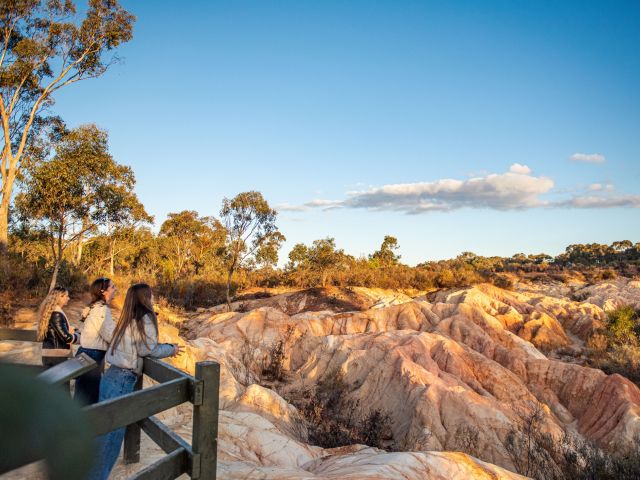
I’ve come to the Grampians to disconnect, but the bush offers a connection of its own. This isn’t just any bush, mind you. The Grampians National Park is iconic for many reasons, mostly for its striking sandstone mountains – five ridges run north to south, with abrupt, orange slopes which tumble right into Halls Gap – and for the fact there’s 20,000 years of traditional rock art. Across these mountains there are more than 200 recorded sites to see, created by the Djab Wurrung, Jardwadjali and Gunditjmara peoples. It’s just like our outback… but three hours from Melbourne.
I’ve come here for a chance at renewal after the chaos of my life in America’s third-largest city, Chicago, where I live for now, at the whim of a relative’s cancer journey. Flying into Melbourne’s airport, it only takes an hour’s drive to feel far away from any concept of suburbia. When I arrive in Halls Gap two hours later, the restaurant I’m eating at clears out entirely by 7:45pm; Chicago already feels a lifetime ago.
The trails and treasures of the Grampians
Grampians National Park /Gariwerd covers almost 2000 square kilometres. (Image: Ben Savage)
Though the national park covers almost 2000 square kilometres, its best-known landmarks are remarkably easy to access. From my carpark here, among the cockatoos and kangaroos on the fringe of Halls Gap, it only takes 60 seconds’ driving time before I’m winding my way up a steep road through rainforest, deep into the mountains.
Then it’s five minutes more to a carpark that serves as a trailhead for a hike to one of the park’s best vantage points, The Pinnacles . I walk for an hour or so, reacquainting myself with the smells and the sounds of the Aussie bush, before I reach it: a sheer cliff’s edge lookout 500 metres up above Halls Gap.
Overlooking the vast Grampians landscape from Hollow Mountain. (Image: Robert Blackburn)
There are hikes and there are lookouts and waterfalls all across this part of the park near town. Some are a short stroll from a carpark; others involve long, arduous hikes through forest. The longest is the Grampians Peaks Trail , Victoria’s newest and longest iconic walk, which runs 160 kilometres – the entire length of Grampians National Park.
Local activities operator Absolute Outdoors shows me glimpses of the trail. The company’s owner, Adrian Manikas, says it’s the best walk he’s done in Australia. He says he’s worked in national parks across the world, but this was the one he wanted to bring his children up in.
“There’s something about the Grampians,” he says, as he leads me up a path to where there’s wooden platforms for tents, beside a hut looking straight out across western Victoria from a kilometre up in the sky (these are part of the guided hiking options for the trail). “There are things out here that you won’t see anywhere else in Australia.” Last summer, 80 per cent of the park was damaged by bushfire, but Manikas shows me its regrowth, and tells me of the manic effort put in by volunteers from town – with firefighters from all over Australia – to help save Halls Gap.
Spot wildflowers. (Image: Visit Victoria)
We drive back down to Halls Gap at dusk to abseil down a mountain under the stars, a few minutes’ walk off the main road into town. We have headlamps, but a full moon is enough to light my way down. It takes blind faith to walk backwards down a mountain into a black void, though the upside is I can’t see the extent of my descent.
Grampians National Park at sunset. (Image: Wine Australian)
The stargazing is ruined by the moon, of course, but you should see how its glow lights up the orange of the sandstone, like in a theme park. When I’m done, I stand on a rocky plateau drinking hot chocolate and listening to the Aussie animals who prefer nighttime. I can see the streets of Halls Gap off in the distance on this Friday night. The restaurants may stay open until 8pm tonight.
What else is on offer in The Grampians?
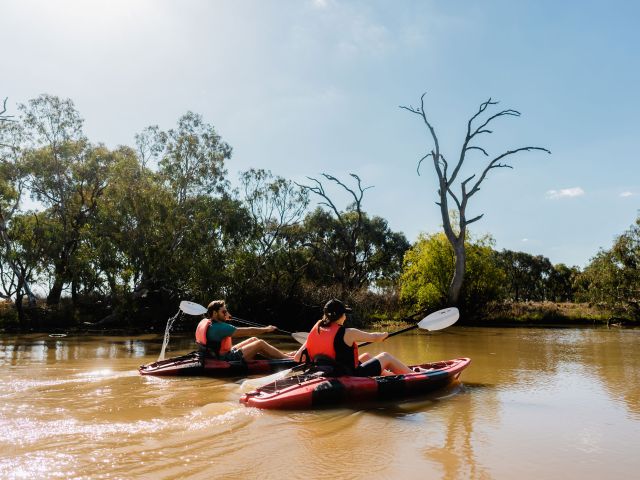
Travelling along the Wimmera River in Dimboola. (Image: Chris McConville)
You’ll find all sorts of adventures out here – from rock climbing to canoeing to hiking – but there’s more to the Grampians than a couple of thousand square kilometres of trees and mountains. Halls Gap may be known to most people, but what of Pomonal, and Dimboola, and Horsham? Here in the shadow of those big sandstone mountains there are towns and communities most of us don’t know to visit.
And who knew that the Grampians is home to Victoria’s most underrated wine region ? My disconnection this morning comes not in a forest, but in the tasting rooms and winery restaurants of the district. Like Pomonal Estate, barely 10 minutes’ drive east of Halls Gap, where UK-born chef Dean Sibthorp prepares a locally caught barramundi with lentil, pumpkin and finger lime in a restaurant beside the vines at the base of the Grampians. Husband-and-wife team Pep and Adam Atchison tell me stories as they pour their prize wines (shiraz is the hero in these parts).
Dine in a restaurant beside vines at Pomonal Estate. (Image: Tourism Australia)
Three minutes’ drive back down the road, long-time mates Hadyn Black and Darcy Naunton run an eclectic cellar door out of a corrugated iron shed, near downtown Pomonal. The Christmas before last, half the houses in Pomonal burnt down in a bushfire, but these locals are a resilient lot.
The fires also didn’t stop the construction of the first art centre in Australia dedicated to environmental art in a nature-based precinct a little further down the road (that’s Wama – the National Centre for Environmental Arts), which opened in July. And some of the world’s oldest and rarest grape vines have survived 160 years at Best’s Wines, outside the heritage town of Great Western. There’s plantings here from the year 1868, and there’s wines stored in century-old barrels within 150-year-old tunnels beneath the tasting room. On the other side of town, Seppelt Wines’ roots go back to 1865. They’re both only a 30-minute drive from Halls Gap.
Great Western is a charming heritage town. (Image: Griffin Simm)
There’s more to explore yet; I drive through tiny historic towns that barely make the map. Still part of the Grampians, they’re as pretty as the mountains behind them: full of late 19th-century/early 20th-century post offices, government offices and bank buildings, converted now to all manner of bric-a-brac stores and cafes.
The Imaginarium is one, in quirky Dimboola, where I sleep in the manager’s residence of an old National Australia Bank after a gourmet dinner at the local golf club, run by noted chef and teacher, Cat Clarke – a pioneer of modern Indigenous Australian cooking. Just south, I spend an entire afternoon at a winery, Norton Estate Wines, set on rolling calico-coloured hills that make me think of Tuscany, chit-chatting with owners Chris and Sam Spence.
Being here takes me back two decades, when I lived here for a time. It had all seemed as foreign as if I’d driven to another planet back then (from Sydney/Warrane), but there seemed something inherently and immediately good about this place, like I’d lived here before.
And it’s the Australian small-town familiarity of the Grampians that offers me connection back to my own country. Even in the better-known Halls Gap, Liz from Kerrie’s Creations knows I like my lattes with soy milk and one sugar. And while I never do get the name of the lady at the local Ampol station, I sure know a lot about her life.
Kookaburras are one of some 230 bird species. (Image: Darren Donlen)
You can be a local here in a day; how good is that? In Chicago, I don’t even know who my neighbour is. Though each day at dusk – when the kangaroos gather outside my villa, and the kookaburras and the black cockatoos shout out loud before settling in to sleep – I prefer the quieter connection I get out there in the bush, beneath these orange mountains.
A traveller’s checklist
Staying there
Sleep beside the wildlife on the edge of Halls Gap at Serenity .