An epic journey across three states onboard the Indian Pacific train

hero media
Travel on a train that does triple duty as a classroom, a fine-dining restaurant and a window into Australia’s soul on an epic journey between the east and west coasts.

The fierce sun beats down mercilessly as a dry wind blows across a near-featureless plain, the heat building until I feel like I’m trapped inside a giant hair dryer. A sheet of loose metal bangs against the verandah of an abandoned school where a thick layer of dust is broken only by the scrawled names of previous visitors.

There’s also a metre-wide cube nearby, which is painted with slogans that are drier than the surrounding outback. “Our hospital needs your help – get sick," reads one side. Suddenly, a siren rings out. I look up to see several hundred figures shuffling in the same direction… but this is no zombie apocalypse. Instead, my fellow passengers are being called back to the Indian Pacific and, in a few minutes, I’ll have swapped the oppressive heat for an ice-cold gin and tonic.

Venturing across the country by train

The abandoned railway town of Cook is one of several stops on a journey that will take us 4352 kilometres across the entire continent of Australia. I’m not sure there’s a single spot along the way that’s flatter or drier, so it seems a fitting memorial for Joseph Cook, our sixth (and ‘most humourless’) prime minister.
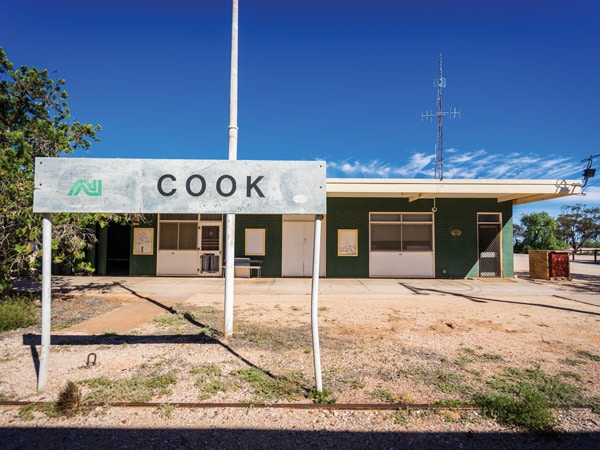
an abandoned railway town in Cook
Alight the Indian Pacific in Cook for a glimpse of an abandoned railway town. (Image: Journey Beyond)

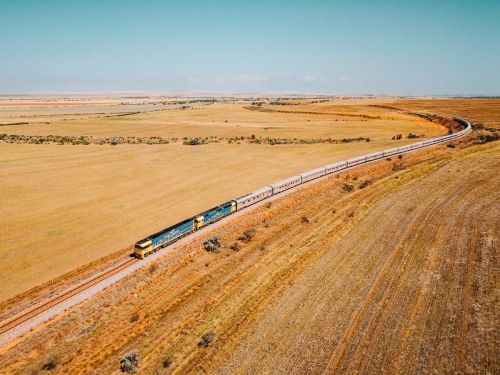
The 808-metre-long train extends past the desiccated buildings in either direction, but the endless plain beyond stretches out to the horizon like a vast ocean of sun-baked orange dirt. Astronaut Andy Thomas could see the gun-barrel-straight train tracks cutting across the Nullarbor like a fine pencil line when he gazed down from Mir space station, and that tenuous link connecting the coasts was one of the key factors that encouraged Western Australia to join the Commonwealth of Australia.
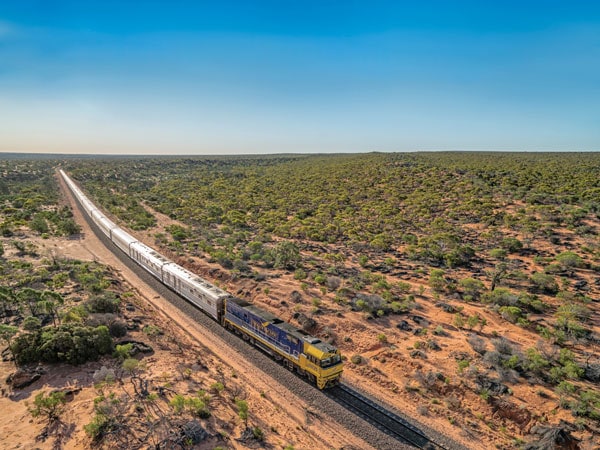
the vast rugged landscape across Nullarbor Plain
The Indian Pacific makes tracks through the Nullarbor Plain. (Image: Journey Beyond)

Now, in a world where travel times have contracted and overseas travel feels routine, venturing across the country by train feels like a trip back in time. “My goodness," Frank exclaims, “will you look at that! What a classic Aussie landscape." The garrulous Englishman with a heavy tan and blindingly white teeth is staring out the window, and when I follow his gaze, I have to agree.

The hard-packed red dirt studded with ankle-high saltbush is as iconically Australian as it is forbidding. But what makes this trip remarkable is that he could have made that comment at just about any moment of our four-day journey.
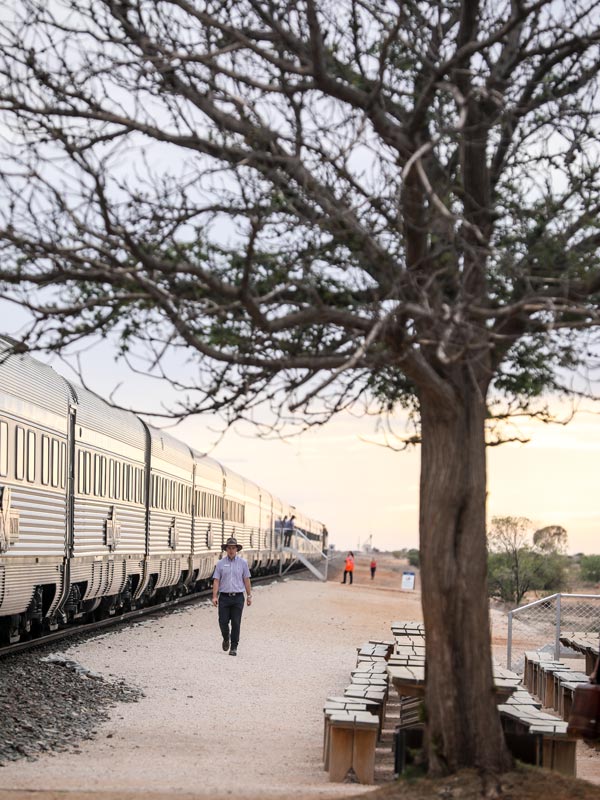
a man standing outside Indian Pacific train in Rawlinna outpost
Rawlinna, like Cook, is an outpost on the Nullarbor Plain. (Image: Journey Beyond)

Day one

With so many things that unite us, it’s easy to forget the sheer variety that exists across this country. But aboard the Indian Pacific, I’m constantly reminded of that rich diversity as we travel from Eora to Whadjuk Country, across the lands of the Wiradjuri, Kaurna, Barngarla, Wirangu and Nyanganyatjara peoples, among many others.

What could be more Australian than pincushions of spinifex stretching out as far as the eye can see and transforming the landscape into a canvas for a giant dot painting flecked with crimson Sturt’s desert peas? Or a vast salt pan holding a pool of water that mirrors the pale blue sky above and makes the horizon disappear entirely?
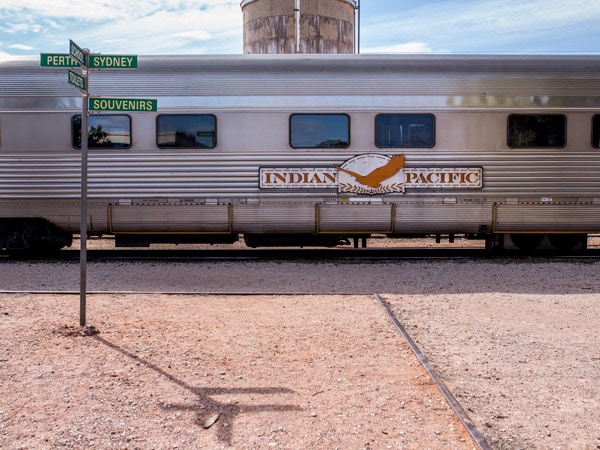
the Indian Pacific train stopping over the Cook Station
Travel to Sydney and Perth aboard the Indian Pacific train. (Image: Journey Beyond)

Endless oceans of golden stubble stretch out in every direction across Western Australia’s Wheatbelt, broken only by tired-looking gums that create tiny islands of shade. Further west, a glittering creek cascades over boulders as it winds between the rocky banks of a gum-lined gorge.

Each scene is unmistakably Australian, and these glimpses of the vast country are enhanced by the fact that I can dip in and out at will. When the surrounding scenery is too quiet for tumbleweed, the Outback Explorer Lounge is a prime spot to crack open a book or get to know my fellow guests.
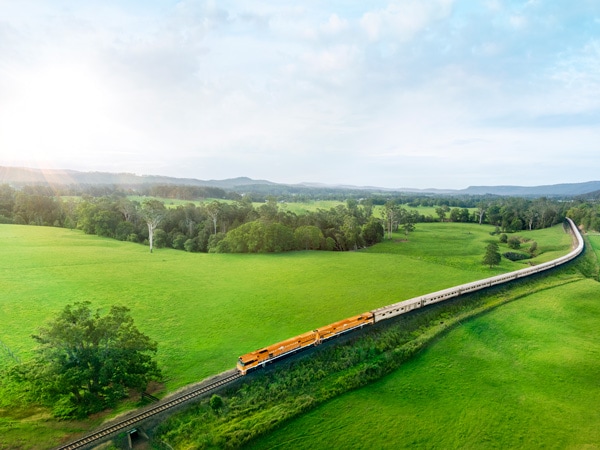
the Great Southern train passing through lush greenery over Victoria and NSW
The Great Southern is Australia’s long-distance rail passing through Victoria and NSW. (Image: Journey Beyond)

Day two

By day two, multiple games of Scrabble and cards have broken out and Frank is joined by Paul, a widower whose son has joined him for the ride, and Leon, who is celebrating his Masters degree with a cross-country trip before returning to China.

In the adjoining Queen Adelaide Restaurant car, it’s easy to let a hundred kilometres zip past while lingering over a three-course meal and several glasses of wine. It’s a far cry from the stultifying boredom I felt behind the wheel on a road trip across the Nullarbor.
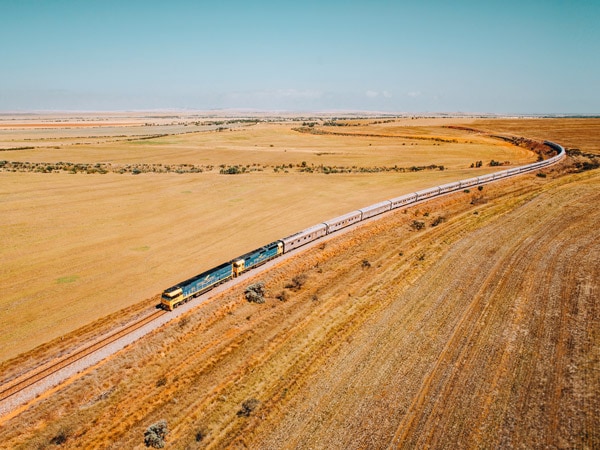
the Indian Pacific train traversing the vast dry landscape
A journey aboard the iconic Indian Pacific will whisk you between Perth, Adelaide and Sydney in comfort and style. (Image: Journey Beyond)

Instead of optimistically checking the radio and deciding how long to keep driving before setting up camp, here my toughest choice is which cabernet sauvignon to go for – Vasse Felix or Black Duck? And when even that decision is too much, I retire to a compact cabin with a bed that disappears each morning during breakfast to reveal a comfortable seat and fold-out desk by the window.

As we head west, the menu slowly evolves to reflect the environments we’re passing through. Grilled Pacific Ocean swordfish steak doused in lemon myrtle sauce gives way to slow-cooked camel curry and Caesar salad with Freo sardines and truffle-spiked aioli. And when the train stops, the bar is raised even further.
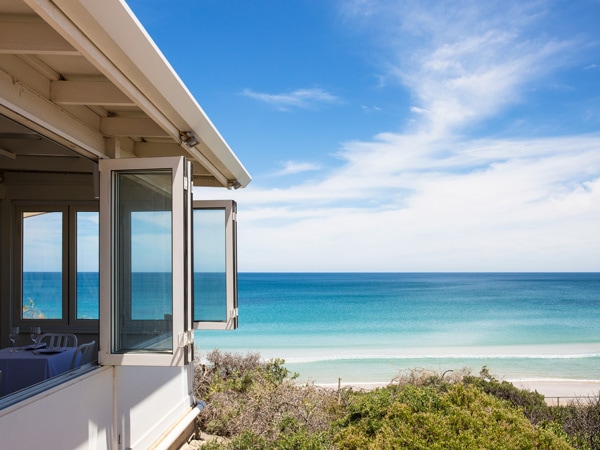
a restaurant facing stunning sea views views over Gulf St Vincent
The restaurant in Port Willunga, SA, offers expansive views over Gulf St Vincent. (Image: South Australian Tourism Commission/Josie Withers)

We feast on roast lamb beneath a star-filled sky on the Nullarbor, while the Adelaide stop includes a McLaren Vale excursion where the wine list expands to include juicy negroamaro and montepulciano. Lush vines and olive trees flutter in a gentle sea breeze beside us, and after seeing the landscape flash past at 80 kilometres an hour, it feels as if I’ve stepped into a romantic painting. Even better is to follow, as we take a coach down to Port Willunga for dinner.
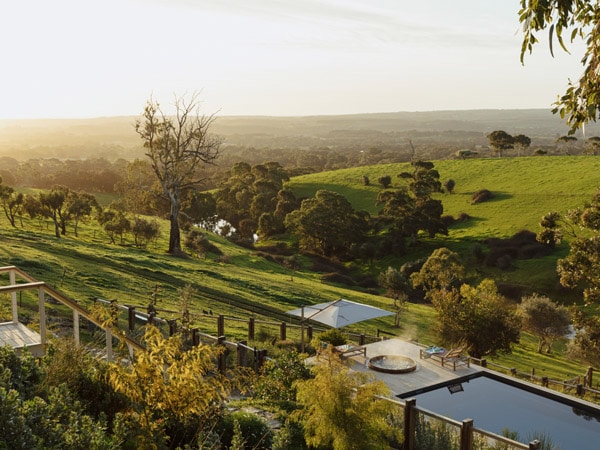
the verdant landscape surrounding McLaren Vale wineries
Stop off at McLaren Vale wineries such as Coriole Vineyards. (Image: Journey Beyond)

Day three

Rocky fingers of limestone glow in the evening sun and turquoise waters lap at the skeleton of a ruined jetty below the clifftop Star of Greece restaurant . A zephyr of breeze wafts in through the open windows while the sun slowly dips towards the horizon, leaving a blazing apricot trail as we tuck into crispy salt and Szechuan pepper squid and sweet sugar and gin-cured ocean trout with shiso leaf.
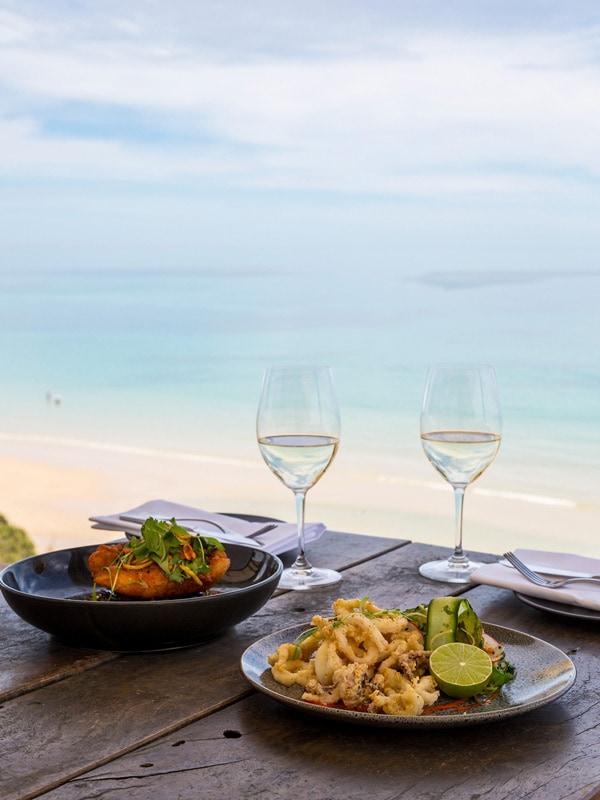
lunch is served on the beach at Star of Greece
Enjoy a sumptuous meal and McLaren Vale wines at the Star of Greece. (Image: South Australian Tourism Commission/ Josie Withers)

And every time we hop back onboard, there’s a buzzing school camp atmosphere – with the added excitement of an open bar. Some passengers stick dutifully to their shiraz while others work their way methodically through the wine list as a small party breaks out in the bar carriage each evening. During a particularly rowdy session, our bartender Daniel introduces one octogenarian to espresso martinis.
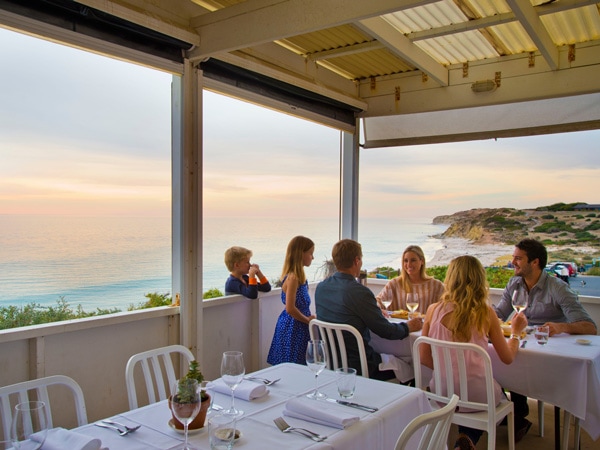
a family dining at a seaside restaurant
Dine while overlooking breathtaking sea views at the Star of Greece. (Image: South Australian Tourism Commission/Adam Bruzzone)

While we eat, sleep and play, the gleaming silver snake carries us inexorably west over days that are as spread out as the landscapes it’s passing through. And in fact, they are longer than usual; chasing the sun for four days means that by the time we reach Perth, we’ve gained three hours on our east coast counterparts.
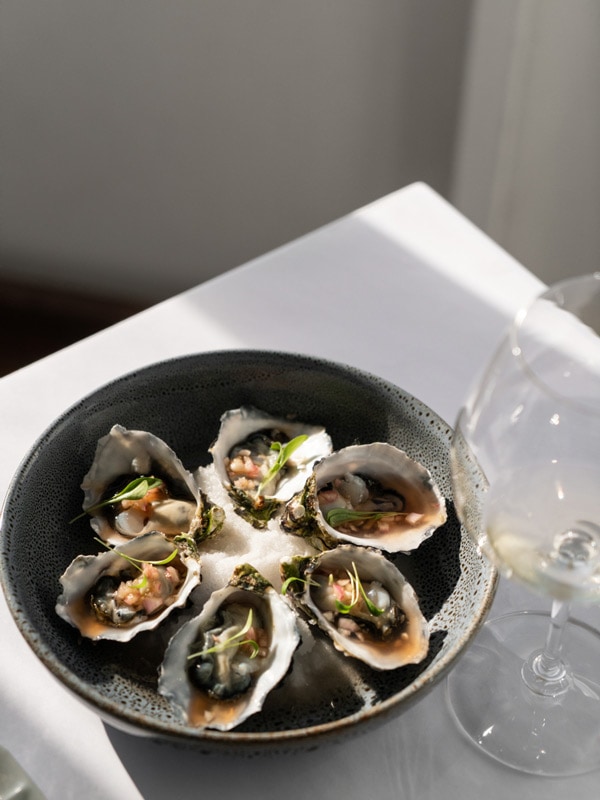
fresh oysters on a bowl
Chow down on fresh oysters. (Image: HEY GENTS)

Day four

After such a leisurely trip, it’s a mild shock to return to an environment shaped by the straight lines of fences on day four. First hills, then paved roads and finally houses begin appearing with regularity, and the knowledge that the trip is ending soon begins to sink in.

Reflecting on the past four days, it quickly becomes apparent that everyone onboard has had their expectation of Australia confounded in some way. “I was expecting more sand," says Gab, a young nanny from western Queensland, while Peter from Bournemouth didn’t realise it was so flat. “And I had no idea that Adelaide faced west until our sunset dinner," adds Suzie.
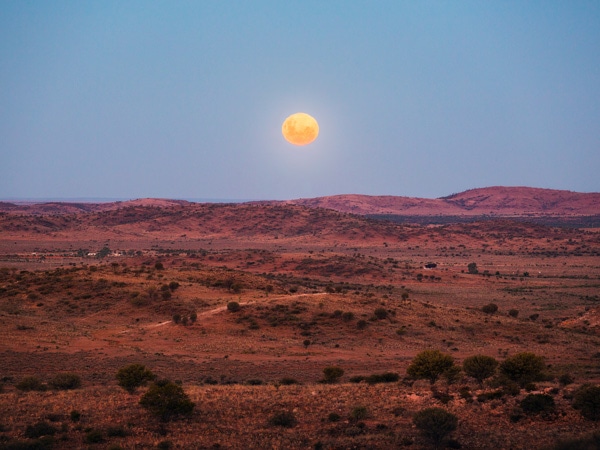
moon rising over Broken Hill
Watch the moon rise over Broken Hill. (Image: Destination NSW)

For me, it’s been a timely reminder of just how varied this wide, brown land is. But as we disembark and say our goodbyes within spitting distance of the Swan River, I can’t help feeling like my cross-country journey won’t be complete until I see the Indian Ocean.

The suburban train I board next has a markedly different feel – the espresso martinis have disappeared and the passengers have swapped Scrabble boards for smartphones. It means I’m the only one looking out at a line of Norfolk pines silhouetted against the slowly setting sun, and I can’t help but wonder how many views like this I’ve missed on my own commute home.
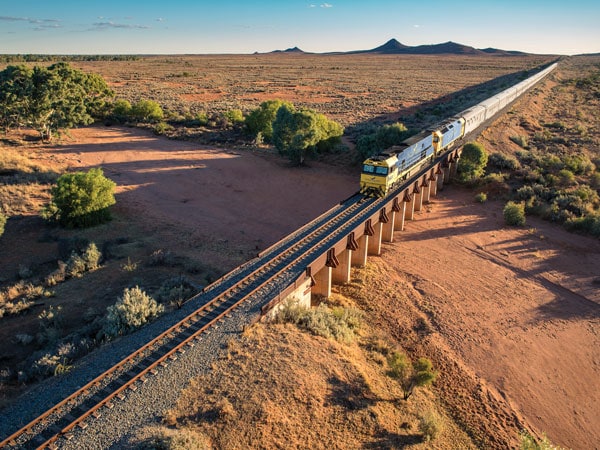
the Indian Pacific train passing through the elevated tracks above Broken Hill
The transcontinental crossing in the Indian Pacific is one of the world’s great train journeys. (Image: Journey Beyond)

Minutes later, I’m breathing in salt-laden air and watching the sun dip below the horizon at Bathers Beach in Fremantle. Saffron and crimson threads streak across the sky as several young women jump about in the water and seagulls eye a nearby family’s feast of fish and chips. What a classic Aussie scene, I think to myself. And it’s just one of dozens I’ve glimpsed on my journey across a truly lucky country.

More Journey Beyond train trips

The Indian Pacific has been travelling between Sydney and Perth since 1970, while The Ghan was extended to Darwin in 2004 and crosses Australia from north to south during the dry season.

In 2019, Australia’s newest iconic train journey launched and the Great Southern now travels 2885 kilometres between Adelaide and Brisbane via The Grampians, Canberra and Coffs Harbour.
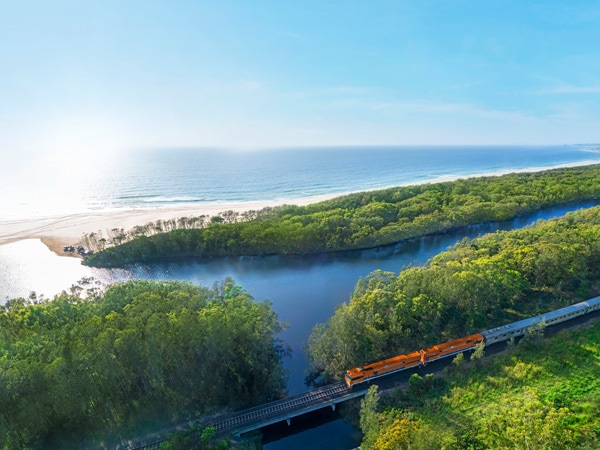
the Indian Pacific train traversing through the coastal town of Coffs Harbour
Travel in style through the coastal town of Coffs Harbour. (Image: Journey Beyond)

Upping the ante on its rail roster, Journey Beyond offers holiday packages, too. Bookings for its 2024 season are open now for sojourns such as Scenic Sip & Sail , which sees passengers alight the Indian Pacific to spend a day on Rottnest Island and take a seaplane to the Margaret River region for wine tastings and exploration.
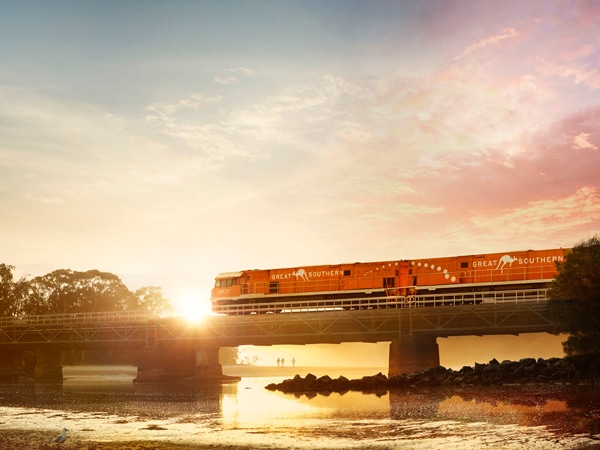
The Great Southern train crossing over the Boambee Creek Bridge, NSW
The Great Southern rumbles over Boambee Creek Bridge, NSW. (Image: Journey Beyond)

Its 15-day Ultimate Territory Tour includes a trip aboard The Ghan with extended touring to Uluru-Kata Tjuta, Kakadu and Litchfield national parks. The Adelaide Delight tour is another highlight, pairing the Great Southern with extra gastronomy excursions.
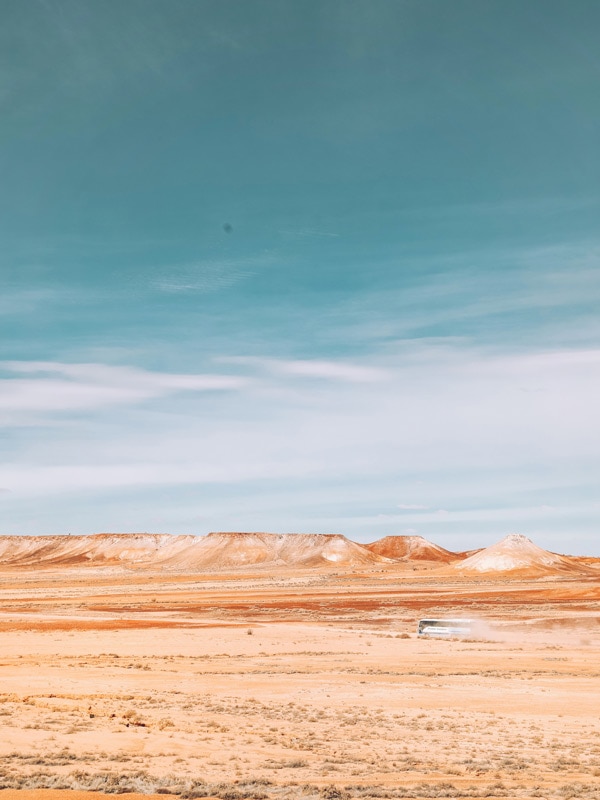
he ‘underground’ town of Coober Pedy during The Ghan Expedition
Tour the ‘underground’ town of Coober Pedy during a trip on sister train The Ghan. (Image: Elise Cook/ Journey Beyond)
Alexis Buxton-Collins
Alexis Buxton-Collins spent his twenties working as a music journalist and beer taster before somehow landing an even dreamier job as a freelance travel writer. Now he travels the world from his base in Adelaide and contributes to publications including Qantas, Escape, The Guardian and Lonely Planet. Alexis has never seen a hill he didn't want to climb and specialises in outdoor adventures (he won the 2022 ASTW award for best nature/wildlife story for a feature on Kangaroo Island). When he's not scouring South Australia for the newest wineries and hikes, he's looking for excuses to get back to spots like Karijini and Ningaloo.
See all articles
hero media

Meet the makers shaping Ballarat’s new era of creativity

Makers, bakers, artists, chefs, crafters – Ballarat and its surrounds are overflowing with creative spirits. All dedicated to keeping traditional skills alive for a city that is humming with artful energy.

Modern makers: a new generation of artists and artisans

“Keeping craft alive is a noble cause,” says Jess Cameron-Wootten, a charming and passionate master leathercrafter and cordwainer, who handmakes traditional leather boots and shoes in Ballarat’s old Gun Cotton Goods Store.

Ballarat was recognised in 2019 as a UNESCO Creative City of Craft and Folk Art, and today it’s a place where craft traditions converge with contemporary needs. Nothing quite captures this convergence as a visit to Wootten , the workshop and store of Jess Cameron-Wootten and his partner Krystina Menegazzo.

heritage buildings in Ballarat
Ballarat’s streets are lined with heritage buildings. (Image: Matt Dunne)

Jess’s father was an artisan bootmaker, or cordwainer. Now Jess and Krys and their small team of artisans continue the tradition, but with a modern spin. The company’s boots and shoes, made completely from scratch, are renowned for their quality and longevity. Wootten also craft shoes, bags, belts, leather aprons, wallets and more.

Cosy beanies, gloves, alpaca socks, “unbreakable” shoelaces and various other goods – many from local craftspeople and small-scale makers – fill the shop’s shelves. “We’re always happy to support a mate,” says Jess. “People love to see the workshop and where things are made. Our clients care about quality and sustainability,” Krys comments. The company slogan ‘Made for generations’ says it all.

Ruby Pilven’s ceramics at Ross Creek Gallery
Ruby Pilven’s ceramics at Ross Creek Gallery. (Image: Tara Moore)

For Ruby Pilven, craft is also in the DNA – both her parents were potters and with her latest porcelain ceramics, Ruby’s young daughter has been helping add colour to the glazes. “I grew up watching my parents in the workshop – I’ve always been doing ceramics,” she says, although her Visual Arts degree was in printmaking. That printmaking training comes through particularly in the rich layering of pattern. Her audacious colour, unexpected shapes and sudden pops of 12-carat gold are contemporary, quirky – and joyful.

You can see Ruby’s handcrafted ceramics, and work by other local and regional artists, at Ross Creek Gallery , a light-filled space surrounded by serene bushland, across from the mudbrick house her parents built in the 1980s. A 10-minute drive from Ballarat, it’s a tangible link to the region’s well-established craft traditions.

How Ballarat is preserving the past

artisans making crafts at the Centre for Rare Arts and Forgotten Trades, Ballarat
The Centre for Rare Arts & Forgotten Trades holds workshops to preserve crafts and skills.

While tradition is ongoing, there’s a danger that many of these specific type of skills and knowledge are fading as an older generation passes on. Step forward the Centre for Rare Arts and Forgotten Trades .

The seven purpose-built studios occupy a fabulous modern building adjacent to Sovereign Hill, with state-of-the-art facilities, enormous windows and landscape views across to Warrenheip and Wadawurrung Country.

artisanal works at the Centre for Rare Arts and Forgotten Trades, Ballarat
Check out artisanal works at the Centre for Rare Arts and Forgotten Trades.

Practising artisans run hands-on workshops. Fancy making your own medieval armour? Or trying your hand at blacksmithing, spinning wool, plaiting leather, weaving cane or craft a knife? Book a class and learn how. “It’s about creating awareness and also sharing knowledge and skills before they are lost,” explains Deborah Klein, the centre manager.

A city steeped in food and flavours

Chef José Fernandez preparing American streetfood at Pancho
Chef José Fernandez creates vibrant South American street food at Pancho. (Image: Ballarat Tourism)

One skill that hasn’t been lost is that of cooking. Ballarat’s burgeoning gastronomy scene runs the gamut from an artisan bakery (the atmospheric 1816 Bakehouse) to cool coffee shops, speakeasy cocktail bars and distilleries to fine-dining venues. But I’m still surprised to find Pancho , José Fernandez’s South American street food restaurant, serving fried cheese tequeños, fiery fish tacos, Argentinian grilled chicken.

The room is as lively as the food – a whirl of colour filled with gifted and thrifted paintings, photos, tchotchkes (trinkets), plants. There’s a Mexican abuela aesthetic going on here. Even before the music and mezcal kick in, it’s fun. Heads up on the drinks menu – an authentic selection of mezcal, tequila, South American wines and Mexican cerveza.

a cocktail at Itinerant Spirits, Ballarat
Enjoy a cocktail at Itinerant Spirits. (Image: Ballarat Tourism)

The spirit is willing, so after lunch we head towards the gold rush-era Ballarat train station and across the line to the old 1860s Goods Shed for Itinerant Spirits . At one end, a massive German copper still looms behind a wall of glass. The fit-out embraces deep olive-green tones, original bluestone walls, steamer trunks as coffee tables, heritage timber floors, oversized lamp shades and cognac-hued modernist leather seating.

the Itinerant Spirits Distillery & Cocktail Bar, Ballarat
The distillery operates from an old goods shed. (Image: Ballarat Tourism)

Gallivanter Gin, Vansetter Vodka and Wayfarer Whiskey – the key spirits distilled – star at the bar. The spirits are crafted using grains from the Wimmera Mallee region, and native botanicals foraged in the Grampians. Seasonal cocktails are inspired by local people and places (I loved The Headland, inspired by Sovereign Hill and flavoured with old-fashioned raspberry drops). Sample the spirits, and join a cocktail masterclass or a distillery tour. It’s a seductive setting – you’ll likely find yourself ordering a charcuterie platter or pizza as the evening progresses.

The Ballarat stay combining history and luxury

one of the rooms at Hotel Vera, Ballarat
The rooms at Hotel Vera have a contemporary style. (Image: Ballarat Tourism)

New lives for old buildings keeps history alive. Vera, Ballarat’s boutique five-star hotel, has taken it to the next level: it’s a palimpsest, a subtle layering of early 1900s and 1930s Art Deco architecture with a sleek new wing. There are seven spacious suites, each a dramatically different colour, with designer chairs, blissful bathrooms. High-end pottery and hand-picked artworks imbue the spaces with personality.

Vera’s intimate, award-winning restaurant, Babae, is subtly theatrical with sheer drapes and gallery lighting, its bespoke timber furniture and brass-edged marble bench setting the stage for food with a sharp regional focus. “We have goat’s cheese from a local supplier, handmade granola from local Vegas & Rose, truffles from nearby Black Cat Truffles, fresh food from our garden, and regional wines,” says joint owner David Cook-Doulton.

Celebrating the local makers, bakers, growers and producers, and the master chefs who work their magic is all part of the rich tapestry that links Ballarat’s history to its vibrant present.

A traveller’s checklist

Getting there

It’s 90 minutes from Melbourne, either on the Western Freeway, or hop on a V/Line train from Southern Cross Station.

Staying there

Hotel Vera is a centrally located Art Deco boutique hotel. Consider Hotel Provincial , which feels like a sleek country house, but with its own restaurant, Lola.

a contemporary room at Hotel Provincial, Ballarat
Hotel Provincial has country house vibes.

Eating there

dining at Mr Jones, Ballarat
The table is set at Mr Jones. (Image: Tony Evans/ Visit Victoria)

Culinary whiz Damien Jones helms Chef’s Hat winner Mr Jones Dining with quiet assurance. His modern Asian food is deceptively simple with deep, intense flavours. Low-key, laid-back ambience, lovely staff, thoughtful wine list.

Cocktails are definitely a thing in Ballarat. Reynard (fox in French) is foxy indeed, a clubby space with top-notch cocktails and small bites. Grainery Lane is extravagantly OTT with its massive 1880s bar, myriad chandeliers, brass gin still, Asian-inspired food and lavish cocktails.

dining at Grainery Lane, Ballarat
Dining at Grainery Lane.

Playing there

a laneway filled with artworks in Ballarat
An artful laneway in the city. (Image: Ballarat Tourism)

Check out local design legend Travis Price’s wall murals in Hop Lane with its colourful canopy of brollies, or in Main Street. The Art Gallery of Ballarat’s off-site Backspace Gallery showcases early-career artists in a stylish, contemporary space. First Nations-owned and run Perridak Arts connects people to place, bringing together art and crafts in this gallery/shop.

a woman admiring artworks at Perridak Arts Gallery
Perridak Arts is a First Nations-run gallery. (Image: Tony Evans)

The wineries of the Pyrenees are close at hand with their welcoming cellar doors and robust reds. Join a behind-the-scenes tour at the Centre for Gold Rush Collections .

Dalwhinnie Wines in the Pyrenees
Dalwhinnie Wines in the Pyrenees.

Don’t forget the giant bluestone Kryal Castle , ‘the land of adventure’, for a little medieval magic, and not just for the kids: get ready for Highland-style feasting, jousting, even overnight stays.