Before you go wandering around the vast expanses of the outback, you’re going to need a few good options on where to rest your weary head. Whether it’s five star comfort, bush camping or completely bizarre, these are a few of AT’s favourites.
Outback Luxury
Longitude 131º
Want a private view of the sun’s daily rituals at Uluru? Watch as it blazes over the rock while you sip your morning tea in bed. Longitude 131º has redefined camping, comprising of 15 tented sanctuaries that sit around 8km from the rock. This is six-star glamping in front of one of the world’s most iconic destinations. www.longitude131.com.au
Platinum on the Ghan
Leave the 4WD at home and glide through the Red Centre on one of Australia’s classic railway journeys, 3000km from Adelaide to Darwin on The Ghan. Celebrating its 80th birthday in 2009, The Ghan now also features an opulent Platinum Class that includes larger cabins, double beds, bigger ensuites and 24hr cabin service. This is a truly regal way to locomote through the outback – transportation and accommodation in one. www.gsr.com.au
Rawnsley Park Station
Overlooking the southern side of Wilpena Pound, Rawnsley Park is the ideal stepping-off point to explore the SA’s glorious Flinders Ranges. The area has become inspirational for poets and artists for its breathtaking landscape, and Rawnsley Park’s operators have made their accommodation eco-friendly, so there’s no need to worry about making too much of an impact. Lodgings include some brand new eco-villas, holiday units, caravan park and some of the best campsites in the Flinders. If you do want to get into the more luxuriant eco-villas, though, it’s best to book early as they sell out quite quickly. www.rawnsleypark.com.au
North Star’s Kimberley Wilderness Cruise
AT’s Ken Duncan rates the Kimberley Wilderness Cruise aboard the True North as perhaps THE premier outback travelling experience within Australia. Big words – but the small-group luxury vessel with the private helicopter, fine dining and elegant quarters certainly tends to back him up. The crew’s motto is pretty much “Do what you want, when you want." Just as long as you pay the $13k ticket price first. www.northstarcruises.com.au
Working stations
Home Valley Station
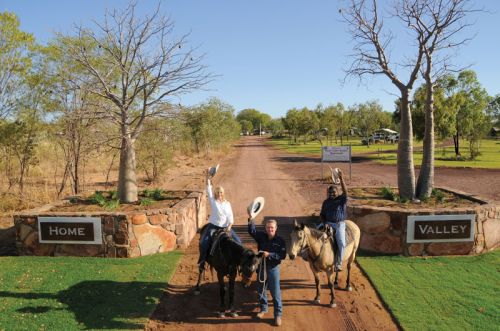
The newest calf on the block is the re-vamped and re-opened Home Valley Station, neighbour to the high-profile El Questro in the Kimberley. Owned by the Indigenous Land Corporation, Home Valley has an important TAFE academy attached for Indigenous students and trainees, as well as four levels of accommodation ranging from $15 per person to $420 a night, making it eminently accessible for all kinds of outback budgets. The gorgeous calf skin-clad Grass Castles are the luxury option, but even if you’re camping the swag of activities on offer (canoeing, swimming, bird-watching, mustering etc) aren’t out of bounds. www.homevalley.com.au
Need tips, more detail or itinerary ideas tailored to you? Ask AT.
AI Prompt
Wrotham Park Lodge
The famous station 300km west of Cairns only caters for 20 guests at a time in its ten luxury quarters, and comes fully equipped – you’ll even find binoculars on the bedside table, allowing you to enjoy your cliff-hanging view from high above the Mitchell River. If you’re ready for a little mustering on 600,000-odd hectares of land, there’s a great opportunity to do so here – or you can view the action from above in one of the spotter choppers. www.wrothampark.com.au
Turlee Station Stay
On the fringe of eerie Lake Mungo NP and within the World Heritage-Listed Willandra Lakes region, Turlee Station Stay is a classic farmstay run by the extremely hospitable Wakefield family. The working sheep and wheat station is light on for luxury, but makes up for it in wide open spaces and peaceful surrounds – just what you want from an outback experience. You can tag along with the stockmen, shear a sheep or finetune your bow and hunting skills. You can camp, swag it out in the shearing quarters, or hide out in a bush bungalow or a self-contained cottage – all of which are family friendly, pet-friendly and reasonably priced.
Weird and wonderful
Hoover House
It’s a trifecta of uniqueness that includes history, solitude and views. Hoover House takes its name from its first resident, Herbert Hoover, the yet-to-be President of the US. Then a young geologist, Hoover was sent to WA to oversee burgeoning mining operations in 1897 and chose to set up shop in Gwalia, 230km northeast of Kalgoorlie. His opulent house was built to oversee work, and today it sits atop of the precipice of an ever-expanding open cut gold mine. From the lawn chairs, Hoover House has the best possible ringside seats to views not regularly offered at other B&Bs: mine blasting. To top it all off, Gwalia is an abandoned ghost town. Most of the mineworkers live in nearby Leonora, leaving the restored township, museum and surrounding countryside to be explored in peace. www.gwalia.org.au
PJ’s Underground
Think underground accommodation, think, Coober Pedy? Not necessarily. The northern NSW town of White Cliffs, also an opal-mining town, is making a name for itself, and heading the list is PJ’s Underground. On the surface, White Cliffs retains a blend of baking ruggedness. Underneath, it hides dozens of art galleries and mine tours – and after a hard day in the sun, PJ’s is a welcome relief of creature comforts and boutique lodgings. Set in an old mine shaft that was scratched out over the course of a century, PJ’s walls and ceilings display all the bumpiness that a man with a pickaxe can afford it. The constant 22°C shields visitors from blistering days and icy nights, but the best bit, for the insomniacs out there, is the total darkness and complete silence that only cave sleeping can provide. (08) 8091 6626
Ooraminna Homestead
Ooraminna started its tourist life almost by accident, when a visiting film crew built a few cabins for shooting and left them nestled in the hills near Deep Well Station, 30min south of Alice Springs. Ooraminna’s Police Station and Wooden Slab Hut were built of basic stone and timber slats, retaining a rustic feel that’s increasingly lost in the outback. Scattered across the ranges with ample seclusion to enjoy cracking sunrises over the hills, Ooraminna also offers tours of the station at work, bushwalking tracks and bird watching to compliment the quiet. For the more adventurous spirit, AT recommends staying in the Police Station; it sleeps six, with two beds inside an actual cell. www.ooraminnahomestead.com.au
Outback Camping
To get an insiders’ perspective on outback camping, AT asked bush expert Allan Whiting for a few of his favourite remote homes away from home. In 30 years of trekking he’s had a few rough ones, including the infamous Beach Run at Cape York that requires you to race the tides across the ocean floor to reach your campsite (that one’s now banned following several vehicle losses).
Here’s Allan’s advice when it comes to true bush camping: “By ‘bush camp’, I mean an impromptu one, without any facilities, settled on at the end of a driving day. The ideal bush camp has a flat, uncluttered surface, pleasant views, shelter from the wind and is well off the track. For tranquil bush camping it’s hard to go past the Australian deserts – any of them. The time to visit is after the first frosts, when the most of the summer flies have died off. If you must go during fly seasons, use plenty of repellent or a hat net. The desert regions are normally warm during winter days, but frosty at night, so the right gear makes all the difference.
“The two best camp positions in deserts are on claypans and dune tops. Claypans are flat, free of debris and most are solid enough to anchor tent pegs. Even on the relatively busy Simpson Desert’s main east-west tracks there’s great camping to be had on the hundreds of firm claypans. Where the pans are small and separated by grassy patches it’s best to put just one tent on each and have one pan devoted to the evening campfire. On larger claypans there’s ample room for an overnight “tent city".
“On the topic of campfires, we always dig a shallow hole to house the fire and keep it quite small; wood is a precious resource in the desert and needs to be conserved.“Dune-top campsites are ideal on still nights and give you a room with a view. The ideal dune-top camp is away from the track, in a shallow depression on the crest. Getting there can be tricky if the sand is soft and it’s important not to drive over any vegetation en route.
“Desert nights are spectacular whether there’s moonlight or “only" starlight. A desert moonrise is unforgettable: the horizon brightens gradually, then a bright sliver of gold suddenly highlights the dune-top vegetation; a flattened ball of rose-gold lifts out of the blackness and heads skywards, picking out the desert detail as it rises.
“The only downside of a moonlit desert camp is that bright moonlight can make it hard to get to sleep! A moonless night is no disappointment, because the heavens twinkle with millions of stars in a blaze of white light that’s often strong enough to illuminate a campsite. It’s a good idea to take a star chart with you, so you can recline after dinner and check out the different constellations.
“Tucking into your tent or swag on a cold night in a desert campsite is bliss. The silence may be punctuated by the odd scuffle of tiny night foragers, or the distant howl of a dingo as you drift off to sleep under a twinkling canopy. It doesn’t get any better than this."
Weekly travel news, experiences
insider tips, offers, and more.
Want to see more stories from Australian Traveller in your Google search results?
- Click here to set Australian Traveller as a preferred source.
- Tick the box next to "Australian Traveller". That's it.

Australian Traveller
View profile and articles