Warts and all: Memoirs of an Australian Traveller

hero media

Australian Traveller started on a flight to Broome in 2004. Surprising then, that from the age of 14, all I wanted to do was get the hell out of Australia.

As far as I was concerned, life started once I crossed the Australian border and started exploring ‘the world’.

I was a fresh-faced, long-haired 18-year-old backpacker when I first travelled through Europe and the US. My round-the-world ticket cost $1800 and flew me via Colombo, Sri Lanka, on an Air Lanka jet where the rivets popped every time we took off and landed. But no matter.

I lived by the words of a weighty Let’s Go Europe guide that weighed a ton. It led me to the most flea-bitten, cheap accommodation I could afford. I survived a mate almost dying in Zermatt, a crazy Viennese slum lord, homeboys and bed bugs in NYC and several memory-impairing visits to Amsterdam. I survived my youthful wanderlust, in other words. Just.

I returned from my gap year not knowing that’s what I had done. Back then you merely ducked uni for a year and went travelling. Most people thought it strange and exotic and said things like, “Wow, you’re adventurous, aren’t you?" I just thought it was a better use of my time than studying.

I took a job in publishing with the hope of using it to fund my travel. It worked.

The boss deported me to Singapore for 18 months, then London for two and a half years. I hated Singapore and loved London.

The summer holidays in Italy were glorious – long days in Florence, the Tuscan coast, Rome and even a week-long sojourn in Venice. It was everything I had always wanted. I didn’t want to leave.

Unfortunately, I returned to Australia earlier than I had hoped to (thanks, boss), this time with a de-facto English girlfriend in tow.

To kick off the Australian leg of our relationship, I booked us a holiday in Broome. It was May 2004.

Flying over Roebuck Bay, I looked down and for the first time, saw the amazing aquamarine water lapping up against the pindan soil of Outback Australia. Why had I never been here?

I was embarrassed. I had seen the world and not seen my own country. Worse – I had never wanted to see my own country.

As the Virgin Blue flight bounced onto the tarmac, my brain synapses seemed to be aligning in one heightened moment. An idea lit up my brain, like a child on red cordial: Australian Traveller. A magazine for those who’ve travelled the world but not their own backyard. People like me. I was electrified by the idea.

I pitched the idea to my flatmate Nigel the night we returned from Broome. He asked one question: “is the web address available?"

And so, I became a website owner.

We spent the next six months having a few hundred beers and trying to figure out why people smarter than us had not yet sold their houses to fund the launch of a domestic travel magazine. I could tell you why now. It’s a lot of effort.

In what could be considered a miracle, we launched the magazine on 25 May 2005. We were mates, and now business partners.

On that day the Aussie dollar was buying 76 US cents, John Howard was two years away from Kevin ’07, Australia had held the Ashes for 16 consecutive years and Gwen Stefani’s Hollaback Girl was on top of the charts. Social media was studying journalism at a uni with a decent student bar.

The launch was crazy – we never expected to get death threats. Someone hated us for publishing ‘the 10 ugliest towns in the country’, so much so that they emailed, promising to kill us if they lost a single booking! I was touched they thought we were so powerful.

Readers loved the magazine. Australia as a destination was resting on its post-Olympic and Rugby World Cup bottom whilst Kiwi luxury lodges were the hot topic in antipodean travel.

We were also lucky to have some powerful friends, with former Deputy Prime Minister Tim Fischer being our founding columnist. True to his great passion, almost every destination featured by Tim in two years of columns included a train somewhere.

His role as Chairman of Tourism Australia at the time helped. Having a beer after we published issue #4, Tim was his usual honest self. “Congratulations boys, that’s three more issues than anyone ever expected."

2006 was a breakthrough year. Our first annual 100 – ‘100 Things To Do Before You Die’ is still our best-selling issue of all time.

We followed that up with our first Outback issue, another cracker sale – and the first time I had returned to the countryside that had inspired me into this crazy venture. Shooting the cover on the Mundi Mundi plains, I felt I was living under ‘the big sky’ for the first time.

That year, a lot of relationships started and ended. The English girlfriend decided Australia was a great place to visit but ‘old Blighty’ was probably a better place to live. I didn’t agree but was in love with other things soon enough.

I had never met Aboriginal people who only spoke their native language until I went to Garma. At Cape Arnhem, I was blown away and it dawned on me that most people’s mysticism is the same.

My new girlfriend didn’t like that I was out of contact for the whole 10 days, however. We moved in together when I got back.

For me, qualia started a new era in Australian travel, the first world-class luxury lodge to take it to the Kiwis… And me. I took my now live-in girlfriend there eight weeks after the opening.

That stay wasn’t all smooth sailing. The activities guys had dropped us off for a romantic picnic on our own beach but forgot to bring the picnic, the umbrella or water… let alone any champagne. The staff arrived just when we started to think panic would be the only solution.

My live-in girlfriend cried when we left qualia. (“I’ll never ever get to stay at a place like this again.") We went back for five nights on our honeymoon. She didn’t cry when we left that time – we were headed for Longitude 131.

True to my reformed travelling self, our entire honeymoon was spent in Australia.

Since that moment, Luxury Lodges of Australia have become all the rage. I took my wife to Wolgan Valley Resort & Spa the day after our first son was officially conceived via IVF. She declared it the greatest bed she has ever slept on. “Even better than qualia."

Now when I meet people and they ask, “How long have you been at Australian Traveller?" I only ever say, ‘from the beginning’.

They immediately want to know my favourite place. The answer is always the same. “Depends."

It depends on what you like, what you want and how you like to travel – for there is only one certainty, as far as I can see. That around every corner I’ll be surprised and delighted by yet another piece of this amazing country.

Need tips, more detail or itinerary ideas tailored to you? Ask AT.

AI Prompt

Want to see more stories from Australian Traveller in your Google search results?

  1. Click here to set Australian Traveller as a preferred source.
  2. Tick the box next to "Australian Traveller". That's it.
Quentin Long
Quentin Long is the Co-Founder and Managing Director of Australian Traveller Media. Quentin is a sought-after travel media commentator. He is Australia’s most trusted source for travel news and insights, having held weekly radio segments across the country since 2006, and regularly appearing on Channel 9’s Today and A Current Affair programs from 2010. Don't ask him his favourite travel experience as that's like asking him to choose a favourite child. However he does say that Garma Festival is the one travel experience that changed him the most.
View profile and articles
hero media

Taking the route less travelled along the Great Ocean Road

The Great Ocean Road has captured the hearts of Australians with its astounding scenery since 1932, but going off-course can enrich your experience with untouched nature, foodie delights and charming towns. 

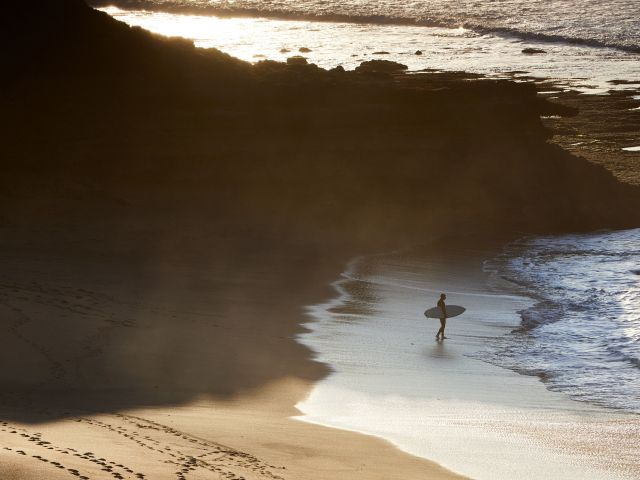
It’s a chilly 16 degrees. My husband pulls on a steamer and jogs – as all seasoned surfers do – into the water. We’re at Bells Beach, the legendary break on Victoria’s Surf Coast that’s home to the Rip Curl Pro, the world’s longest-running event in competitive surfing. Each year, over the Easter long weekend, up to 40,000 people descend on the region for the event. Today, though, we have the beach almost to ourselves, and the less-than-favourable temperature doesn’t deter my husband from surfing this famous break.  

Bells Beach
Bells Beach is known for its epic surf break and is at the start of the Great Ocean Road. (Image: Tourism Australia)

Torquay to Anglesea and Aireys Inlet 

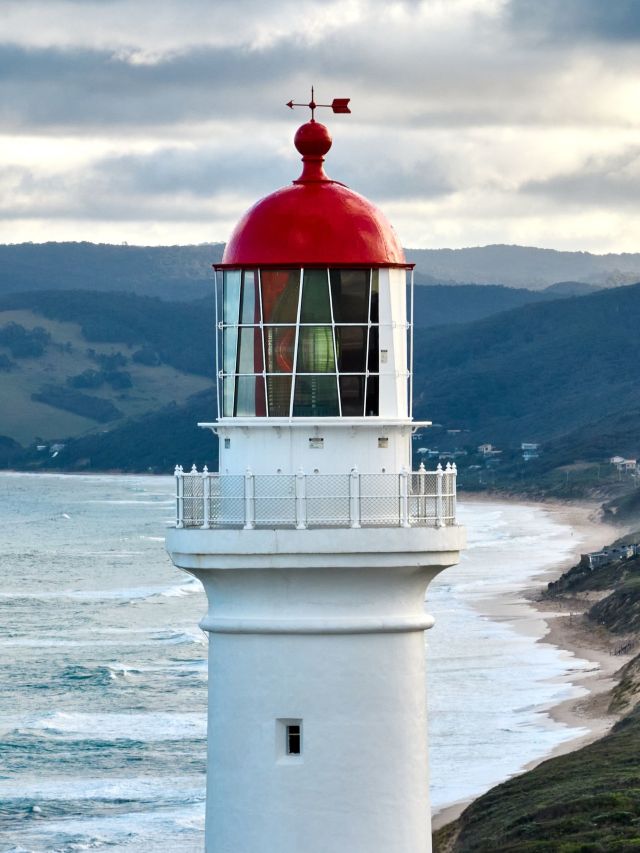
Split Point Lighthouse
The red dome of Split Point Lighthouse in Aireys Inlet. (Image: Tourism Australia)

The nearby surf town of Torquay marks the starting point for the Great Ocean Road. Unfolding our map, which we have marked out with a highlighted route for our children to follow, we set off for lesser-known Anglesea, a chilled-out town 20 minutes south of here. Its wide, sandy beach is a gentler swimming option for our young family. Groms can learn to surf here with Go Ride a Wave, which also runs stand-up paddle boarding on the Anglesea River.  

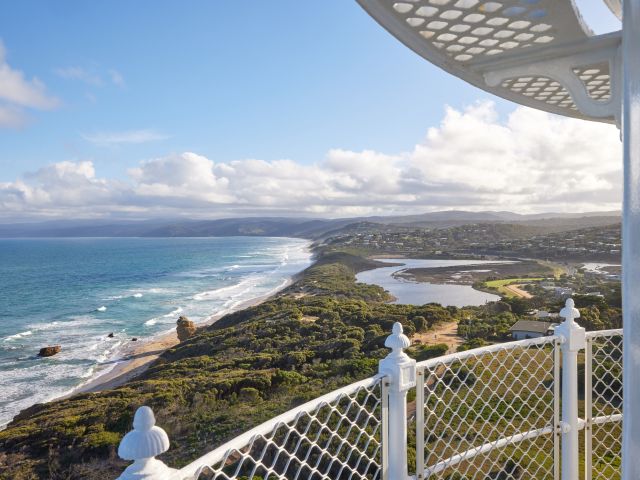
Split point lookout
The lighthouse overlooks the Shipwreck Coast. (Image: Tourism Australia)

After a couple of nights in Anglesea, we hit the road again, first stopping at Aireys Inlet. Here we stretch our legs at Split Point Lighthouse, which was made famous by the 1990s television series Round the Twist, before driving under the Memorial Arch that welcomes us, officially, to the Great Ocean Road.  

This 243-kilometre coastal road was built by returned First World War servicemen and serves as a permanent memorial to those who fought and died during the war. Carved into rock using hand tools and horse-drawn carts, it was a huge engineering feat and provided much-needed access to isolated coastal communities. 

Lorne to Birregurra 

Lorne is a delightful beachside stop for lunch and browsing boutique stores. It’s also the gateway to Great Otway National Park, which comprises a varied landscape of old-growth forests, cool-temperate rainforests, heathy woodlands and rugged coast. With the highest rainfall in Victoria, the region is home to many waterfalls – 10 of which are within 10 kilometres of Lorne.  

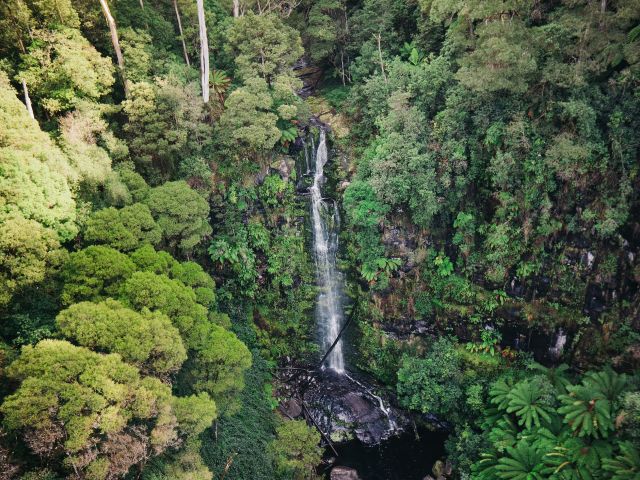
Turning slightly off the main drag, we wind along a gum-shaded road to Erskine Falls. Here, our son leads the way through the hyper-green rainforest and down 200-plus stairs to the cascade that drops 30 metres into a lush fern gully. We hop over large boulders to get closer to the falls, enjoying the entire place to ourselves; it’s worth the return climb.  

From Sheoak Falls Picnic Area, there are walking trails to Henderson Falls, Phantom Falls, Won Wondah Falls and Kalimna Falls, some of which follow an old timber tramway from forest-logging days, which only came to an end in 2008.  

Erskine Falls
Erskine Falls is one of many falls within a day trip of Lorne. (Image: Visit Victoria)

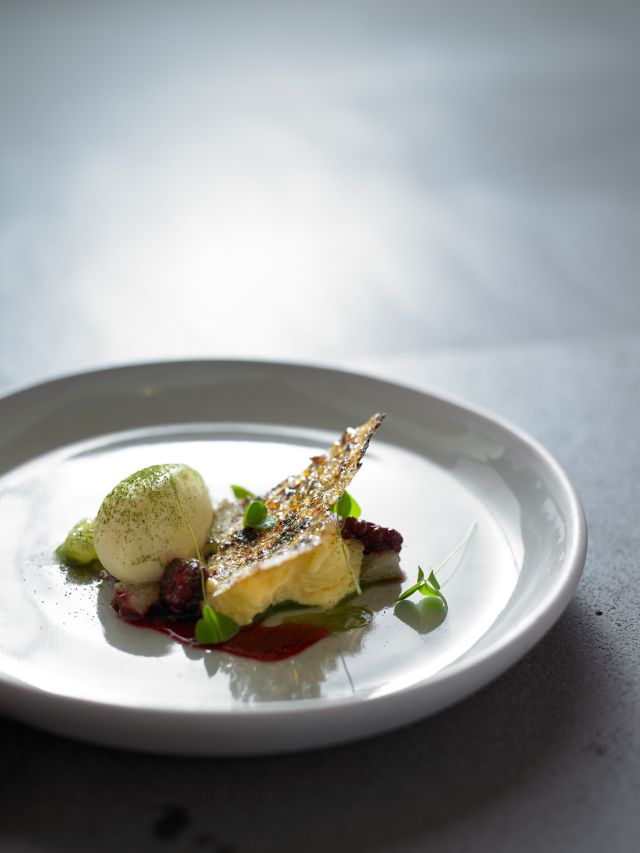
You can follow your appetite north to the town of Birregurra, which is part of the Otway Harvest Trail that connects farm gates, markets, wineries, breweries and distilleries. It’s home to three-hatted modern Australian restaurant Brae, helmed by celebrated chef Dan Hunter, set among native gardens and an organic farm, and Otways Distillery, which produces small-batch spirits using local produce and botanicals.  

Brae restaurant
Brae is a three-hatted restaurant in Birregurra. (Image: Tourism Australia)

Apollo Bay to The Otways 

Back on track, the cliff-hugging stretch between Lorne and Apollo Bay is breathtaking. At Teddys Lookout, we overlook the winding road ahead and St George River spilling into the ocean. We spend languid days in Apollo Bay, a buzzy seaside town that boasts a three-kilometre-long, crescent-shaped beach with a backdrop of rolling green hills. One evening, as the sun sets, we take the steep 10-minute walk to Marriners Lookout, which affords panoramic views of the ocean, hinterland and town.  

A 15-minute drive along the road, Maits Rest is a lush rainforest gully that has been protected since the early 20th century. Wandering along the 800-metre boardwalk, we inspect the delicate moss-covered forest floor and the gnarled roots of 300-year-old myrtle beech trees, then crane our necks to see their canopies, some 50 metres above us. It’s therapy in nature.  

Cape Otway to the Twelve Apostles 

Twelve Apostles
One of the famous Twelve Apostles, limestone sea stacks that rise from the Southern Ocean. (Image: Ben Savage)

The southernmost tip of Cape Otway is a delightful detour, home to the 1848-built Cape Otway Lightstation, the oldest surviving lighthouse on mainland Australia. We climb the narrow winding staircase to the gallery deck, explore the keepers’ quarters and telegraph station, and enjoy a coffee and some ‘famous’ scones at the charming onsite cafe.    

It’s a pinch-me moment to finally see the Twelve Apostles in person. This unmistakable cluster of limestone stacks rising abruptly from the sea were never 12, however. When coined this in the 1890s as a marketing ploy, there were only nine; today, only seven remain after two collapsed in 2005 and 2009. We admire these Aussie icons from the viewing platform, in awe of Mother Nature’s ever-evolving artwork.  

The Grotto
The Grotto is another natural attraction within Port Campbell National Park. (Image: Carmen Zammit)

Edging the wild Southern Ocean, this part of the coast – dubbed Shipwreck Coast – is made up of many sea-carved natural wonders including London Bridge, The Grotto and Gibson Steps. After exploring the lookout trails of Loch Ard Gorge/Poombeeyt Kontapool – its English name taken from the site of the 1878 shipwreck – we nestle into the sandy beach encircled by towering sandstone cliffs, as our children splash about on the water’s edge, and soak it all in.  

Port Campbell to Timboon 

Timboon Fine Ice Cream
Timboon Fine Ice Cream is part of a regional foodie trail. (Image: C McConville)

Just north of Port Campbell National Park, the region of Timboon is part of the 12 Apostles Food Artisans Trail, filled with purveyors of delicious foodstuffs such as Timboon Fine Ice Cream, Timboon Railway Shed Distillery and Apostle Whey Cheese. As an antidote to the indulgence, the 20-kilometre Poorpa Yanyeen Meerreeng Trail is a self-guided ride or walk between Port Campbell and Timboon through tall forests, over historic bridges and past sparkling lakes and farmland with grazing cattle.  

Warrnambool to Port Fairy 

Warrnambool building
A 19th-century building in Warrnambool. (Image: Peter Foster)

In Warrnambool, a town rich in maritime history, we take the four-kilometre Thunder Point Walk that traces the coast. The kids squeal when an echidna shuffles out from beneath the wooden boardwalk, and we stop to admire a seal lazing on a rock at the port.  

Further along, the streets of quaint fishing village Port Fairy are lined with 19th-century cottages, old stone churches and Norfolk pines. Follow the historic walking trail to see some of the 60-plus National Trust buildings. Port Fairy is also home to Port Fairy Folk Festival (6-9 March), one of the country’s longest-running music and cultural festivals. You could time your road trip with the event for a fittingly celebratory end to any journey.  

The Great Ocean Road can easily be done in three days, but we’ve spent a week on the road. The highlighted line on our now creased and well-worn map doesn’t follow the famous route precisely. It has sprouted branches in many directions, leading us to untouched rainforest and charming rural towns filled with culinary delights, and where we experienced some of our most memorable moments on the Great Ocean Road.    

A traveller’s checklist 

Staying there

Oak & Anchor
The Oak & Anchor in Port Fairy.

The Monty is a highly anticipated, newly refurbished motel with a chic Palm Springs-inspired aesthetic set across the road from the Anglesea River. Basalt Winery in Port Fairy grows cool-climate wines such as pinot noir and Riesling in rich volcanic soil. Stay among the vines in its tiny home, complete with a kitchen, lounge area and outdoor firepit. 

The Oak & Anchor Hotel has been a Port Fairy institution since 1857. Cosy up by the bar in winter or bask in the sunshine of the Lawn Bar in summer. The rooms are beautifully boutique with considered details, such as luxe baths for sinking into post-road trip. 

Eating there

The Coast in Anglesea is a modern Australian restaurant focused on local ingredients. Grand Pacific Hotel has been a local landmark in Lorne since 1879 and recently underwent a restoration. It serves a mix of traditional pub and Italian fare alongside ocean views.  

Graze is a cosy 40-seat dining room in Apollo Bay with a modern Australian menu complemented by regional wines. Apollo Bay Distillery offers tasting flights, a gin blending masterclass and serves woodfired pizzas.