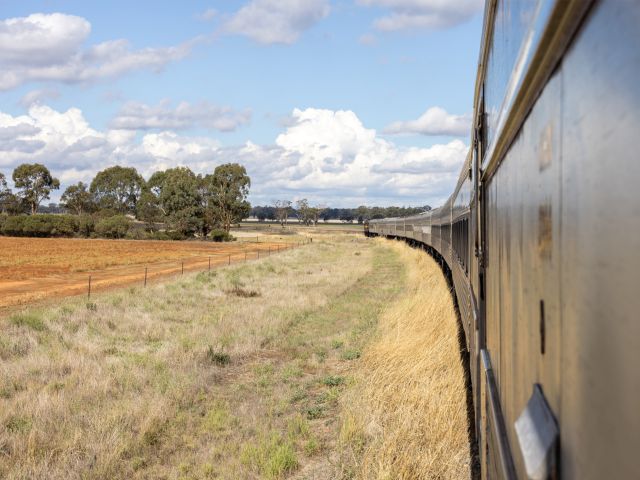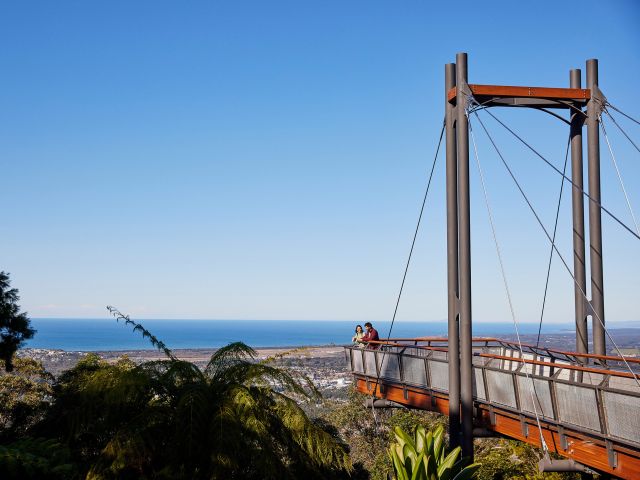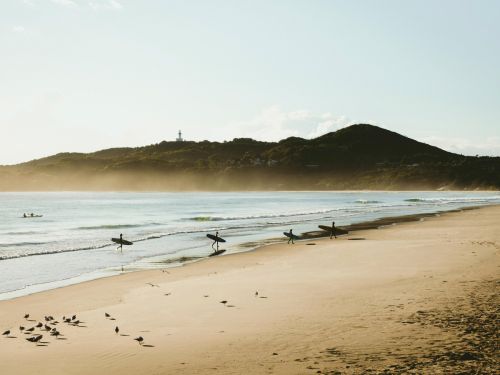
Whether you’re into building sandcastles or catching waves, Byron Bay has a beach for you.
When it comes to great beaches, Byron Bay is no slouch. In fact, the far North Coast town is probably the poster child for Australian beach culture. With its long powdery stretches of sand facing north, south and east, and its beautiful blue-green waters, having a surf or swim is one of the best things to do in Byron Bay. In addition to the glittering mix of beaches for surfing, swimming or soaking up the sun, you can turn your back on the sea and head inland to find cascading waterfalls with clear pools to cool off.
1. Main Beach
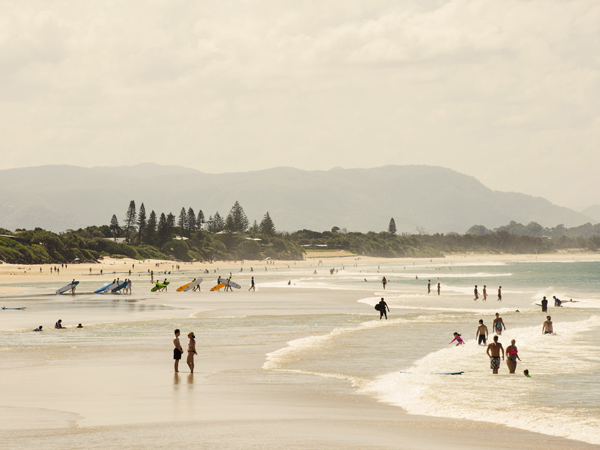
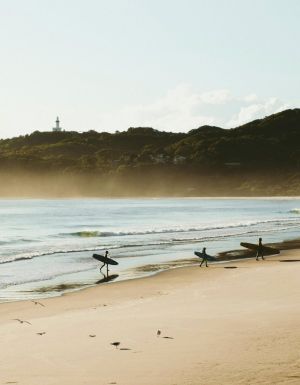
Main Beach is the closest beach to the township of Byron Bay, making it a popular spot for families as it’s patrolled every day of the year. To the left is Belongil Beach and the striking silhouette of Mount Warning (Wollumbin), to the right is Clarkes Beach and then the Pass and iconic Cape Byron Lighthouse.
One of the best things about this beach is the people-watching: observe bronzed surfers padding down the beach to catch a wave; teens taking selfies, preening and dancing and practising their best duckface; and hippies with man buns furiously beating on their bongo drums at nearby Apex Park.
2. The Pass
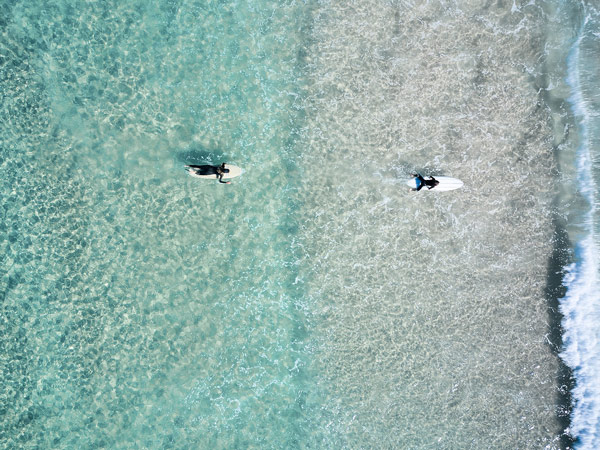
The Pass is a point break between Clarkes Beach and Wategos. Climb up to Fisherman’s Lookout to get an aerial view of the line-up and everyone jostling for their turn to take off on this perfect right-hander. The wave attracts a mix of soul surfers (long-boarders) and novices and is best left to the professionals when there’s a swell running. The good news is, it’s a broad break and there is a wide expanse of sand along the shoreline. The Pass is patrolled by lifesavers for only a few months of the year. Find an idyllic shady place to flop and drop and swim between the flags.
3. Tallow Beach
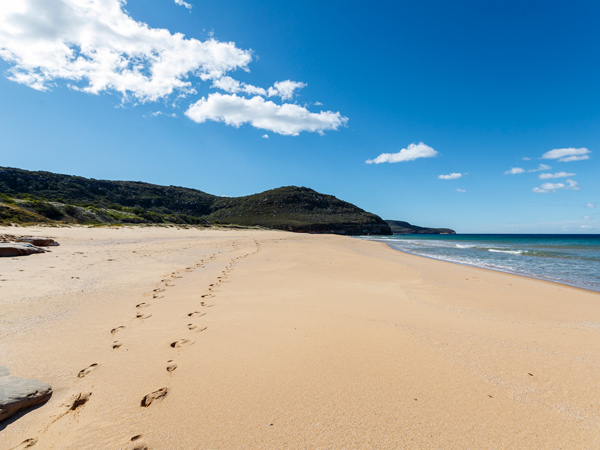
If you’re a mad-keen experienced surfer or a strong swimmer, you can go for a paddle at Cosy Corner, which is protected from northerly winds. Tallow Beach is best suited to experienced swimmers who converge in one of three patrolled areas: Cosy Corner, Suffolk Park or Broken Head, which are nice and sheltered when a northerly wind is blowing. Access to the beach is via Clifford Street in Suffolk Park. If you manage to walk the seven-kilometre stretch to Broken Head Beach, you can do as the local naturalists do and strip off in the designated ‘clothes-optional’ beach.
4. Wategos Beach
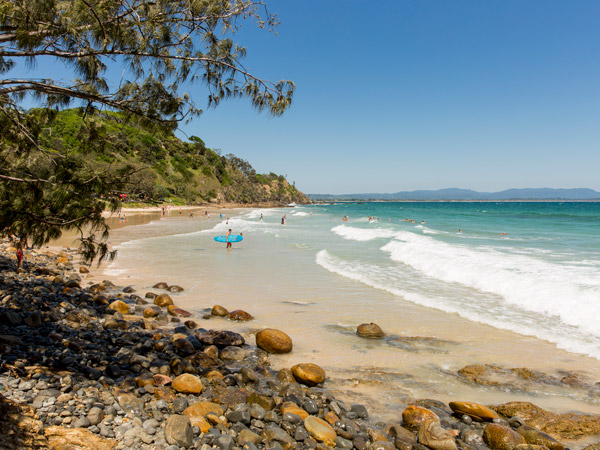
Wategos Beach is a pretty little cove that is close to the most easterly point in Australia. This picturesque patch dotted with pandanus palms is very protected making it popular with both long-boarders and swimmers. Named after a local Indigenous family, Wategos runs into Little Wategos, a 150-metre-long strip of beach near the tip of Cape Byron, which only exists in certain conditions when the sand accumulates over the rock shelf as it moves around the headland. When the tide is right, Little Wategos is lovely and sheltered for sunbathing and swimming. Be one of the first people in Australia to admire the sunrise when you hit Wategos Beach for a swim in the pre-dawn light.
Need tips, more detail or itinerary ideas tailored to you? Ask AT.
AI Prompt
5. Belongil Beach
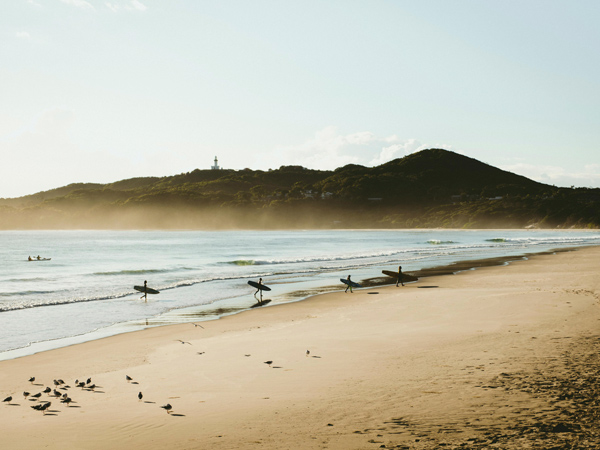
Take a left on the long stretch of beach to the left of Byron Bay’s town centre to get to Belongil Beach, which is home to ‘The Wreck’, a popular swimming and snorkelling spot. The Wreck is actually the rusted remains of the SS Wollongbar which ran aground in stormy seas in 1921. A small part of the abandoned hull remains embedded in the sand here and it has created an underwater ecosystem that is home to abundant marine life. The best place to swim at Belongil Beach is at the southern end nearest to Byron Bay when the beach is patrolled.
6. Torakina Beach, Brunswick Heads
This soft sweep of sand to the left of the southern break wall at Brunswick Heads is nirvana for beaching families. The water is crystalline, calm and perfect for wading, there’s even a trim of shade to snag if you arrive before everyone else descends. It’s a popular spot, so if the sun is shining, the small shore is quickly and tightly packed with an array of colourful beach umbrellas. Do note, the carpark does fill up quickly, so a walk may be required.
7. Clarkes Beach
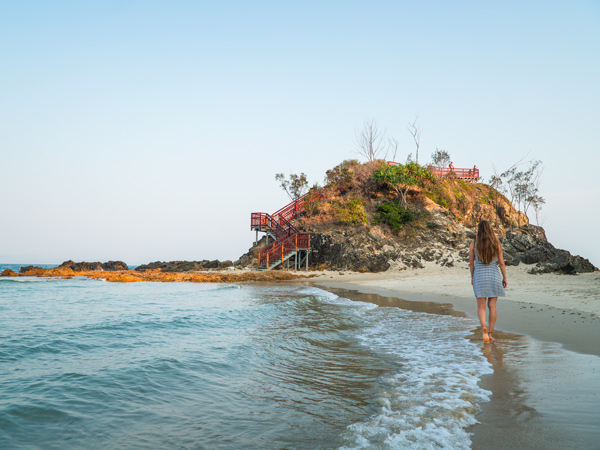
Head down to Clarkes Beach at dawn and wait for the sky to change colour and the sea to turn silvery and smooth. The next beach along from Main Beach heading in the direction of the Cape Byron Lighthouse is very popular with families and surfers. As the sky lightens, you might see surf instructors organising their classes for the day and helping novices heft their surfboards down to the shore.
From Clarke’s Beach, you can clamber onboard a Byron Bay Sea Kayak Tour in the hope of seeing dolphins, whales, and turtles. Return to Clarke’s Beach under a cloudless sky to swim off the sandbar and paddle in the tidal pools. This beach is patrolled over summer and has numerous grassy areas equipped with picnic tables.
8. Minyon Falls
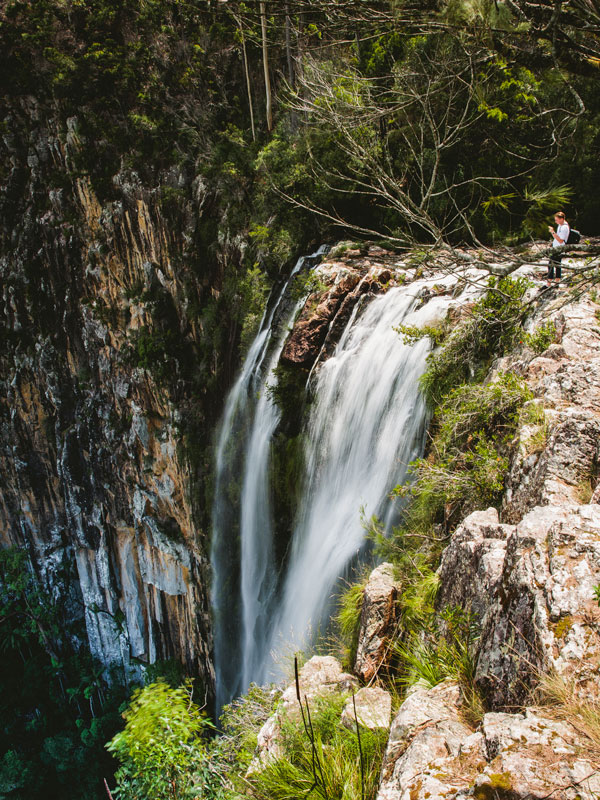
Motor out to Minyon Falls in Nightcap National Park if you want to see another side of the Byron Shire. Sure, you can appreciate this fairy tale landscape by undertaking a short, easy stroll to the lookout from the car park. But active types will find it well worth the effort of hiking for three or four hours to the boulders at the base of Minyon Falls for a magical swim in the pool, which is like a blue-green jewel in the dappled light. Minyon Falls is about a 50-minute drive from the Byron Bay town centre. After heavy rains, expect to see the water roaring down for about 100 metres between the rocky ridges in the cliff face. Bring a packed lunch and plenty of water.
9. Simpsons Creek, Brunswick Heads
If the beaches are blown out or too packed, the azure, serpentine bends of Simpson Creek which flows into Brunswick River offers gentle bathing. At high tide, you’ll see sun-bronzed teens jumping from the bridge into the clear waters below. While the riverside is mostly tricky to access, there’s a miniature beach at Terrace Park where you can slip in.
Weekly travel news, experiences
insider tips, offers, and more.
10. Broken Head Beach, Broken Head
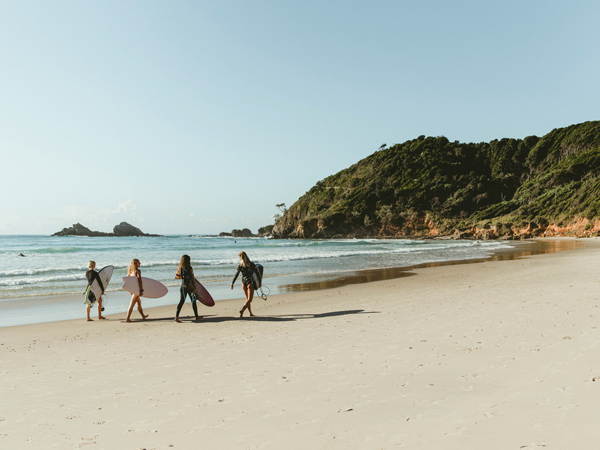
This pretty stretch of beach unfurls south of Suffolk Park and is shouldered to the south by a protective headland. You can take the lovely Three Sisters Walking Track up here to check out the oceanic vistas and maybe spot a whale or two. Pack lunch to enjoy in the grassy picnic area, bring your fishing rod and make a day of it. Keep in mind that parking is limited, so arrive early or be prepared for a walk.
11. Christmas Beach/Harry’s Hill Beach, Brunswick Heads
No one can agree on what to call this curve of paradise. Some call it Harry’s Hill Beach, some Christmas Beach and others simply call it Heaven. The latter is perhaps most fitting for this idyllic and secluded north bank of the Brunswick River. To get here, you’ll need to take a rigorously pot-holed dirt road, then wander through the rainforested North Head Walking Track until the shimmering aquamarine water is revealed below the canopy. Across the way, you’ll spot the huddle of beach umbrellas at Torakina and congratulate yourself for taking the more difficult but deeply rewarding alternative.
12. Lake Ainsworth, Lennox Head
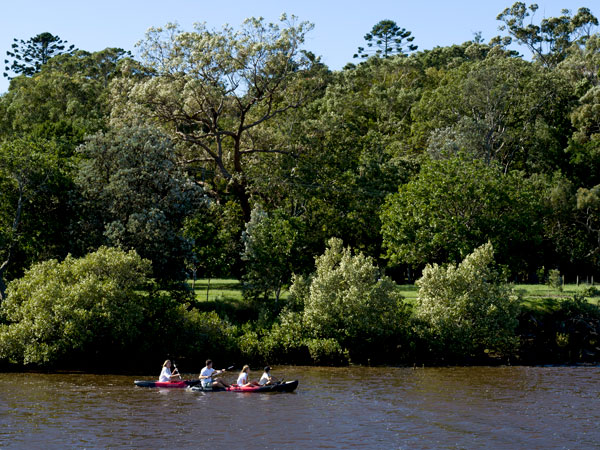
While this swimming spot is located in the Ballina Shire, it makes our list for its uniquely still and dark waters. That might sound a little on the scary side, but Lake Ainsworth is hemmed by tea trees, which stain the freshwater with their rich tannins. It looks black from the sure, but once you swim out into the warm waters, the colour is more like Coca Cola or black tea. Grassy picnic areas hem the lake and if you start craving the refreshing saltwater, the beach is just across the way. A 20-minute drive south to Lennox Head, it makes for a spectacular day trip.
13. Cudgera Creek, Hastings Point
Also a skip and a hop from Byron, but this time in a northerly direction in the Tweed Shire, this swimming spot where Cudgera Creek meets Hastings Point Beach is stunning. Obligingly shallow on the shoreline for kids, but dropping away to a channel that flows to the sea, this mostly gentle flow is great for paddleboarding and kayaking. Take care, though, the currents can be strong in the channel and despite plenty of people jumping from the bridge at high tide, it’s a dangerous idea.
14. South Golden Beach
This long stretch of sand that winds, uninterrupted, all the way up to Pottsville Beach in the Tweed Shire is a lesser-visited Byron haunt. Its northerly locale means that you’ll mostly find locals here and plenty of space to set up your beach brolly without any neighbours popping your bubble. It can be exposed to the elements here and is unpatrolled, so check the conditions before you go. When the wind is low, this is the place for sun-bleached, semi-isolated beauty and proper surf. When you’ve had your fill of the waves, head off the beach and grab a burger from the cute takeaway shop, Mrs Birdy.
Originally written by Carla Grossetti with updates by Lara Picone
Want to see more stories from Australian Traveller in your Google search results?
- Click here to set Australian Traveller as a preferred source.
- Tick the box next to "Australian Traveller". That's it.