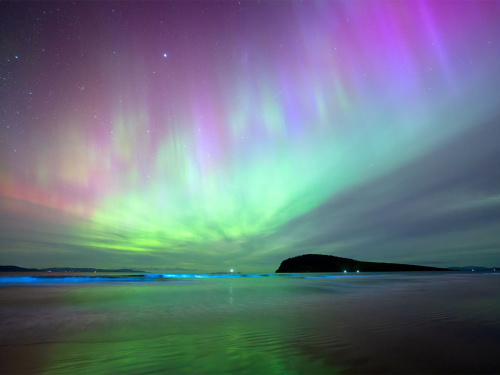
The northern lights get all the love when it comes to natural light phenomena but did you know Australia has its own light show – the aurora australis?
Fifteen years ago Margaret Sonnemann was driving from Launceston to Hobart when she noticed something in the sky that made her pull over in shock.
This was Margaret’s first glimpse of the southern lights. Back then, there was no portal available to discuss this amazing natural phenomenon. Today her Facebook group, Aurora Australis Tasmania, has more than 300,000 members, but the fact that Tasmania might be the best vantage spot in the world to view the southern lights remains largely unknown.
“Australians are so privileged to be able to see the southern lights," Margaret said, and astronomers predict that in 2024/2025 solar activity will likely be at its strongest. Here’s everything you need to know about when and where to see the southern lights.
What are the southern lights?
The aurora australis, or southern lights, happens when the sun releases a massive burst of solar wind and magnetic fields into space, also known as CME (coronal mass ejections).
These solar winds carry particles that interact with the earth’s magnetic field, colliding to produce energy releases in the form of auroras.
“Auroras are more frequent and brighter during the intense phase of the solar cycle when coronal mass ejections increase the intensity of the solar wind," says Margaret Sonnemann, author of The Aurora Chaser’s Handbook.
Given that Earth’s magnetic field is closest to its surface at the North and South poles, Antarctica and Tasmania are the best spots for seeing the southern lights given their close proximity to them.
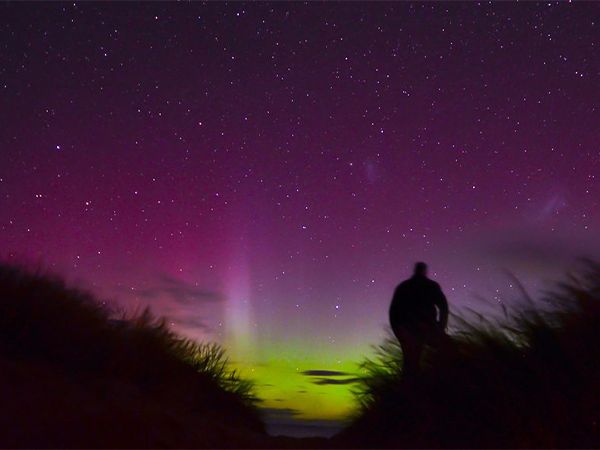
What can you expect?
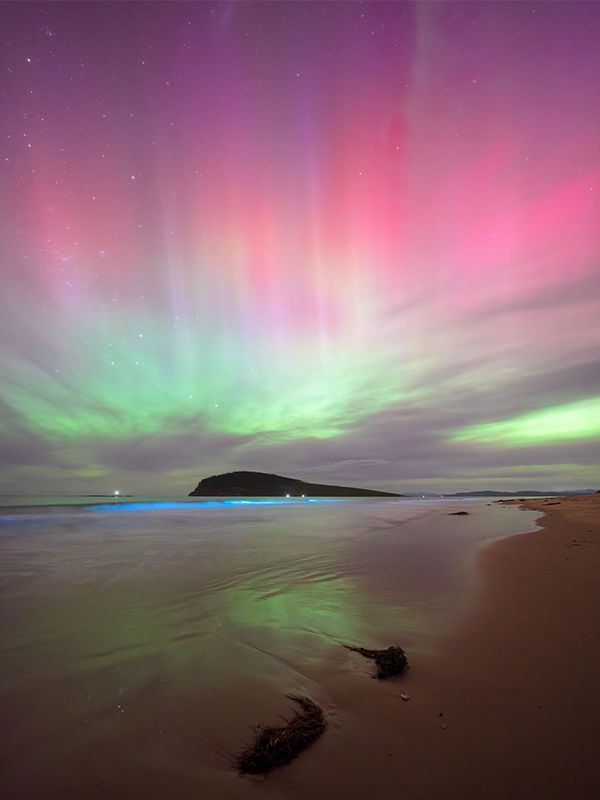
If you Google pictures of both the southern and northern lights you will see images of skies full of rich greens and vivid blues, or wild swirls of reds and purples. But often this is not what the naked eye can see.
“To the naked eye, an aurora will look more like a white flickering light," says James Garlick, who has been photographing the southern lights for years, with one of his photos even featured on an Australian postage stamp. “It could be mistaken for a cloud. It’s not until you do a long exposure with the camera that the colours are revealed."
Matt Glastonbury (see first photo at the top of this post), another avid southern lights photographer, revels in the way they move through the night sky.
“They are like dancing curtains of light across the sky," he says. “The size of them is incredible – beams of light are shooting right up into the atmosphere. It is really magical to see them moving around right in front of you."
Best spots to see the southern lights
In short, “all over Tasmania," says Margaret Sonnemann.
The main obstructions to viewing the southern lights are large mountain ranges, trees and city (and light) pollution. There are, however, some places that photographers favour due to their landscape qualities.
Photographer Paul Fleming prefers South Arm Peninsula, 40 kilometres south east of Hobart, for his aurora views. “There are lots of beaches and still, wide shallow bays. It’s a good spot for nice reflection shots with waves crashing in the foreground."
Matt Glastonbury has two favourite spots: Dodges Ferry, about 40 kilometres east of Hobart, and Cockle Creek, on the southern tip of Tassie, 120 kilometres south-west of Hobart. “Both of those places have little light pollution," he says. “The less of that you get the better."
The reason the northern lights are often talked about more than the southern lights, is because there are far more vantage points accessible to see the northern lights, such as Greenland, Iceland, Norway, Northern Canada and Russia – when you’re talking about seeing the southern lights, it’s a little harder.
The reason for this is the location of the land down south, as in, there isn’t much of it. The spots with the best vantage points have no land – just water – which makes it difficult! However, there are a few spots that will show off this natural phenomenon with gusto, the trick is to be as far south as possible, which is why Tasmania is such a good bet.
Need tips, more detail or itinerary ideas tailored to you? Ask AT.
AI Prompt
Where to see the southern lights in Tasmania
SOUTH ARM PENINSULA
Just a 40-minute drive from Hobart, South Arm Peninsula is a popular destination for aurora photographers. Offering excellent south-facing views combined with little light pollution, this viewpoint also boasts still bays, perfect for reflections. Expect a plethora of people given its proximity to the city and seaside paradise vibes. Head to Clifton Beach or Calvert’s Beach for ideal viewing locations.
BRUNY ISLAND
A favourite weekend getaway for Tasmanians, Bruny Island is also a short drive (and ferry trip) from Hobart, but feels like worlds away with its abundant wildlife, rural atmosphere and expansive beaches. For the best views of the southern lights, climb the stairs at The Neck and point your camera towards the south. Even if you miss the lights, you’ll still be pleasantly surprised by the vast ocean views and starry sky. There are plenty of camping options (many of them free), including a privately owned campground with glamping, and aside from auroras, one of the town’s main attractions is its foodie scene – don’t miss a visit to the Bruny Island Cheese Co.
SATELLITE ISLAND
Famous for its star-gazing, visitors to Satellite Island (off the coast of Bruny Island) need to rent the whole island to experience a stay here, but some might say it’s worth it, and your chances of spotting an aurora when the conditions are right are pretty promising. If not, you get your own private island with expansive skies for gazing. Stays start at $1950 a night for two guests (extra guests $300 per person with a maximum of eight) with a two-night minimum stay.
COCKLE CREEK
Sitting upon the pristine Recherche Bay, at the most southerly point of Tasmania in Southwest National Park, Cockle Creek boasts some pretty spectacular scenery with its sandy beaches contrasted against snow-capped mountains. Given its southerly location, it may even be the best place in Tasmania to catch an aurora. It’s just a two-hour drive from Hobart, but it feels like forever from civilisation. You can camp at Recherche Bay Nature Recreation if you don’t mind roughing it, or there are many accommodation options at nearby Ida Bay. You’ll get some decent views from the bridge at Cockle Creek, but if you want the real magic take the 2.5-hour hike (one-way) to South Cape Bay.
CRADLE MOUNTAIN
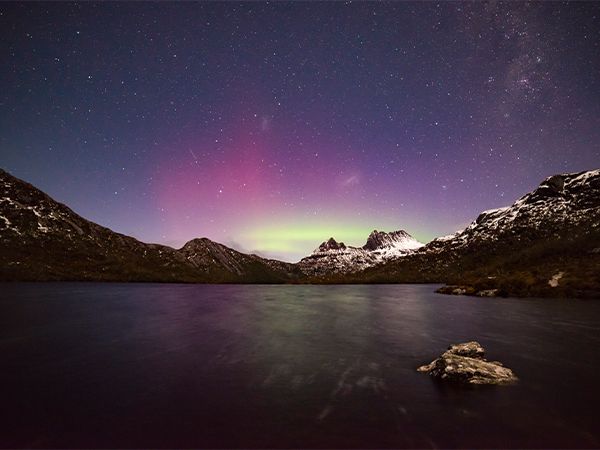
Nestled in the heart of Lake St. Clair National Park, Cradle Mountain boasts some seriously social-media-worthy views and an abundance of natural delights and wildlife. Although beautiful, the mountain peaks and fairy-tale forests will obstruct those aurora views, so you’ll want to head to Cradle or Dove Lake to settle in for the show. Accommodation options are few, so make sure to book in advance. If you want to stay inside the park, book a cabin at Waldheim, a rustic option with everything you need. Or, for a real treat check out Peppers, and make sure to include a soak at its Waldheim Alpine Spa.
Where else to see the southern lights
Victoria
If you live in Victoria, you’re in luck, as there are some of the best southern lights viewing points here. You’ll want to head out of Melbourne and far south to either Phillip Island, Grampians National Park or Point Lonsdale.
New Zealand
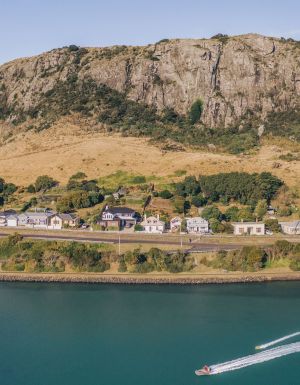
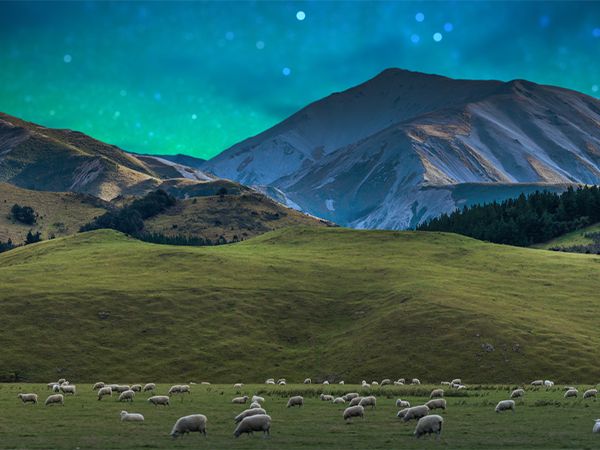
There are a number of popular places for southern light searching in New Zealand. Christchurch, Lake Tekapo and Queenstown are popular – and Queenstown records the most sightings of the lights in all of New Zealand. It’s such an Aurora hotspot that, just like Tasmania, they have their own Facebook group. But if you’re keen to completely escape the light pollution and enjoy a ferry ride, Stewart Island is the most southerly point, and hence a popular choice for real aurora aficionados. A huge percentage of the island is covered by Rakiura National Park meaning ‘the land of the glowing skies’ – so it really doesn’t get much better than this.
QUEENSTOWN
There are a few places in New Zealand that have proven to be fruitful when it comes to spotting the southern lights. The city of Christchurch, the small village of Lake Tekapo and Stewart Island. However, no place records more sightings of the southern lights in New Zealand than Queenstown. Several times throughout the year, the city is awash with the brilliance of the bright lights in the sky caused by aurora australis.
When’s the best time to see the lights?
Theoretically speaking the equinox (in September) should be the best time for viewing the southern Lights, but this isn’t always the case. Since the Aurora is based on sunspots and massive bursts of solar winds, scientific predictions can be unreliable.
Unlike the Northern Hemisphere, which is subject to extreme seasonal light changes, the southern lights can be viewed from Tasmania all year round. It is worth noting (and to some a tad obvious) that the lights can only really be seen at night time, therefore winter is ideal, given daylight savings in Tasmania can stretch the light until 10pm.
Weekly travel news, experiences
insider tips, offers, and more.
The best weather conditions to view the lights
Unsurprisingly, it’s best to view or photograph the lights on a clear, dark night. If you can position yourself looking away from the city, you’ll limit the artificial light, lowlight and air pollution that can affect how vivid the lights look to the naked eye.
Even moonlight can affect how clearly you see the Aurora, so a night with a full moon is probably not ideal.
You also won’t be able to see the light show on an overcast night, as Auroras happen in the upper atmosphere, meaning any cloud cover will cover the show!
How to photograph the lights
Ditch the iPhone. Sorry Apple, but in the case of bright lights at night time, it doesn’t cut it. You’re best to have a professional camera with a wide-angle lens (ideally f2.8 or faster) and a tripod to keep your shots steady. The camera sensor and long exposure will likely reveal a lot more light and colour than you can see with the naked eye!
Choose a spot looking south and ideally away from city lights. Doing this will help to avoid light pollution and flare from the city lights. Shoot in raw format, ideally.
Adjust the exposure to 10 to 30 seconds (any longer and you’ll start seeing stars as trails).
How to know when an aurora australis is coming
For smartphone applications, Matt Glastonbury suggests Star Walk, an interactive astronomy guide.
Aurora Forecast has several real-time maps of the atmosphere and shows how much it is hitting the Earth at any given time
Spaceweather.com includes a visual representation of plasma coming out of the sun.
Stay tuned in to pages with members who are incredibly invested in the Aurora Australis, and courteously update fellow members with news of an incoming lights show. The Aurora Australis Tasmania Facebook group is often how many photographers find the lights with members posting real-time alerts.
What else to do in Tasmania while you’re there
Tasmania is fast becoming one of the food and wine capitals in the country. While you’re there, be sure to spend a night in the Henry Jones Art Hotel. Situated perfectly in Hobart city centre, you’ll be close to everything happening nearby, like the famous Salamanca Markets – or the Farm Gate Market if you’d like to do it less like a tourist and more like a local.
It’s also worth taking a road trip to Cradle Mountain, where you can take part in an invigorating walking holiday among the picturesque landscape, or visit the renowned National Park. Check in with the local wilderness and set up camp in one of the Park’s onsite cabins.
If food and wine are more your thing, you can’t go past beautiful Launceston. Jump in your car and drive through Tasmania until you reach your destination, where you’ll be delighted to find that Launceston and the Tamar Valley have over 30 vineyards to choose from. The region, famed for its cool-climate wines, is now also home to a growing number of beer and cider producers, such as Boag’s Brewery and Red Brick Cider House.
If it’s a great, hearty meal you’re after you can’t go past Launceston’s Black Cow Bistro, which specialises in the finest Tasmanian beef from local producers. The Black Cow Wagyu fillet is our recommendation time and time again.
It is also the perfect state for a long, indulgent road trip. Spend seven days taking in some of the best highlights of Tasmania along this road trip route that loops from Launceston to Cradle Mountain, Hobart, Coles Bay and back to Launceston (with plenty of great stops and detours along the way.
Live in Melbourne? Read our guide on where to see the southern lights in Victoria.
Originally written by Steve Madgwick and updated by Jessica Humphries and Rachael Thompson.
Want to see more stories from Australian Traveller in your Google search results?
- Click here to set Australian Traveller as a preferred source.
- Tick the box next to "Australian Traveller". That's it.

Steve Madgwick
View profile and articles