Ken Duncan’s Panorama: Dipsticks of the Outback

hero media
An outraged Ken Duncan prepares to wage war on a growing threat to the pristine nature of our precious outback icons: idiots with spray cans, textas and – sometimes – chainsaws. Dipsticks of the Outback, you have been warned . . .

There’s no better feeling than getting in your car and heading off into the bush for an adventure. When you hit the road it doesn’t matter what you’ve left behind or forgotten to do; you’ll deal with it. The cries of life’s urgency dwindle with the kilometres travelled and you begin to unwind as the view ahead opens to endless horizons. Yes! Going bush is like a magic formula – as the odometer goes up, the stress comes down.

So what is it about the outback that helps us unwind? I believe it’s the space, and in Australia we have plenty of it. That vastness helps you put your life into perspective. It gives you a chance to empty your in-tray. It’s an opportunity to clear your head, breathe fresh air and relax.

We’re blessed to live in such a diverse country and I believe our outback is one of our greatest medicinal treasures. It’s far more than red dirt and desert. It’s hard for me to imagine how travelling through Australia’s open country could not positively change any person. Lately, though, I’ve started to realise that there’s a strange breed of yobbo that feels the outback is there for them to trash and leave their branding on. They don’t allow the bush to wash over them – they want to leave their mark on it instead.

These people feel a need to leave their names emblazoned on anything they can, as though they’re some big explorer whose name will ring out for posterity. They’re like dogs, leaving their scent to mark their territory without realising what dipsticks they are. I call them “dipsticks", as a dipstick is used to check the level of something – and these sorts of people must have very low levels of brain activity. They need to have the paddles of life turned up to full power and applied to their heads.

As you can probably tell, this kind of graffiti is really starting to get under my skin. People (and I use the word loosely) have spray-painted their names on The Devil’s Marbles and all sorts of outback icons. We as Australian travellers need to take a stand, as it’s getting out of hand. This is our backyard. We need to start facing up to the vandals who do these things and tell them they’re dipsticks who need to get a life and show some respect. As a photographer, I’m at a loss as to why people feel the need to deface things. Some recent examples have finally tipped me over the edge. It’s time to really try and bring this epidemic to light and deal with it. We need to turn the tide of this disease.

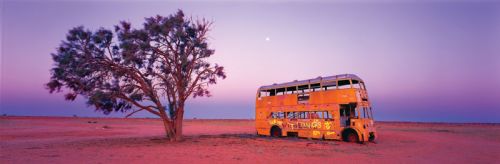
Near Cameron’s Corner, where the NSW, Qld and SA borders meet, there’s an old yellow double-decker bus that was used as an out-camp for cattle workers, called Jack Camp. Talk about the last bus stop. When I first saw it, there was no graffiti – but over the years dipsticks have felt the need to add their names. While standing there recently, ready to take a new photo of the bus, I was pondering the worst of the fresh graffiti, a scrawled name: “Wishbone". I was thinking, “What would possess someone to do that?" And guess what? I got my answer. At that very moment, a guy pulled up in his Ute with the big aerials, driving lights, bull bar and fluffy dice on the rear-view mirror, and jumped out with his girlfriend. He headed over to the bus and said proudly, “Look, darling, there’s my name. Wishbone. I did that – isn’t it great?" His girlfriend just giggled nervously, not really knowing what to say. They were both right near me and I overheard this profound dialogue. I couldn’t believe I had actually now met the owner of the graffiti.

Wishbone looked over at me, clearly so proud of his ability to spell his name, and announced once more, “That’s me," awaiting my approval.

I like to be as friendly as I can, but I just looked at him and said: “If you did that, then you are a dipstick. Why did you do it?" The poor fellow just looked at me with a vacant stare – obviously not the sharpest tool in the shed.

My latest run-in with graffiti is courtesy of a guy called Gaz, in Victoria’s High Country in Alpine National Park. This is the land of legends, the High Country cattlemen and the Man from Snowy River. It’s part of our history. I was looking for new High Country huts and found Howitt Hut – and there, on the door, a person by the name of Gaz had spray-painted his name. I put Gaz up there as the King of the Dipsticks. What was he thinking with this effort?


Hundreds of visitors have written their names on the walls of the hut over the years. They have no right to (unless they were a real part of its history) and it has gotten out of hand. In some places the walls are so crammed with writing that there’s not a spare space to be seen!


I then went to look at another place in the same area called Miller Hut. When I got there, again Gaz had beaten me. This time he really outdid himself. He’d used a chainsaw to write his name in letters 30cm high on the old log walls of the hut. I could not believe anyone could be so insensitive. How could he think this was normal behaviour? How many beers did Gaz have to come up with this dumb idea? Where were his friends, who should’ve told him what a dipstick he’d be if he did something as stupid as defacing a part of our Australian history? People like Gaz don’t travel alone; they usually like an audience.

Would you want to invite this guy to your place for dinner? Imagine it: while you’re in the kitchen preparing the meal, Gaz gets out his chainsaw and carves his name in your walls, because he wants to be part of your history. Maybe he could even do it as a parting gesture on your fence. I’d be less than impressed if Gaz left his calling card in my home – and he would certainly be history.

The saddest part is that Gaz is not alone. When I started looking closer, I saw that others had used their chainsaws on the old wood of the High Country huts. There was Max, and Alan, and the list goes on. Shame on you all. I hope someone who knows you sees this article and lets you know you are now in the Dipsticks Hall of Fame. You are dumb enough to add your own names to it. But be real brave next time, dipsticks, and try writing it on a park ranger. That will probably put you on the road to healing.

We all want to enjoy our outback adventure and the great space and freedom we have. We do not want to be reminded of the self-indulgence of humanity. It’s not meant to be “look at me"; it’s meant to be look at the scenery. Yes, it’s my space, it’s yours, it’s our children’s – but it’s not an advertising space for dipsticks.

On a positive note, thank God it’s not too late and the world has so many beautiful people who do the right thing. We all just need to make sure we stand up to the Gazzes and give them a hand to see themselves – even if they do have a chainsaw.

hero media

Explore historic wine towns and sculpture trails on a 3-day self-guided Murray River cruise

    Ricky FrenchBy Ricky French
    Slow down and find your rhythm on a Murray River journey through time and place. 

    Trust is a funny thing. It seems not that long ago that my mother was insisting on pouring the milk into my cereal bowl, because she didn’t trust me not to slosh it over the table, and yet here I am on the Murray River at Mildura in far north-west Victoria, being handed the keys to a very new and very expensive luxury houseboat. 

    After a crash course in how not to crash, I’m at the wheel of the good ship Elevate – pride of the All Seasons fleet – guiding her upstream past red-ochre cliffs as pelicans glide above the rippled river and kookaburras call from reedy banks. There’s a brief moment of breath-holding while I negotiate a hairpin turn around a jagged reef of skeletal, submerged gum trees, before a cheer rings out and calm descends as the timeless river unfurls in front of us.    

    Murray River
    The Murray River winding through Yarrawonga. (Image: Rob Blackburn)

    Setting sail from Mildura 

    Murray River birds
    Home to a large number of bird species, including pelicans. (Image: The Precint Studios)

    A journey along the Murray River is never less than magical, and launching from Mildura makes perfect sense. Up here the river is wide and largely empty, giving novice skippers like myself the confidence to nudge the 60-tonne houseboat up to the riverbank where we tie up for the night, without fear of shattering the glass elevator (the boat is fully wheelchair accessible) or spilling our Champagne.  

    My friends and I spend three days on the water, swimming and fishing, sitting around campfires onshore at night, and basking in air so warm you’d swear you were in the tropics. The simplicity of river life reveals an interesting dichotomy: we feel disconnected from the world but at the same time connected to Country, privileged to be part of something so ancient and special.  

    Stop one: Echuca  

    19th-century paddlesteamers
    A historic 19th-century paddlesteamer cruises along the Murray River. (Image: Visit Victoria)

    The six-hour drive from Melbourne to Mildura (or four hours and 20 minutes from Adelaide) is more than worth it, but you don’t have to travel that far to find fun on the river. Once Australia’s largest inland port, Echuca is the closest point on the Murray to Melbourne (two hours 45 minutes), and you’ll still find a plethora of paddlesteamers tethered to the historic timber wharf, a throwback to the thriving river trade days of the 19th century. The PS Adelaide, built in 1866 and the oldest wooden-hulled paddlesteamer operating in the world, departs daily for one-hour cruises, while a brand-new paddlesteamer, the PS Australian Star , is launching luxury seven-night voyages in December through APT Touring.  

    The town is also a hot food and wine destination. St Anne’s Winery at the historic Port of Echuca precinct has an incredibly photogenic cellar door, set inside an old carriage builders’ workshop on the wharf and filled with huge, 3000-litre port barrels. The Mill, meanwhile, is a cosy winter spot to sample regional produce as an open fire warms the red-brick walls of this former flour mill.  

    Stop two: Barmah National Park 

    Barmah National Park
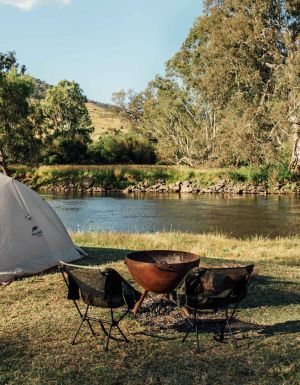
    Camping riverside in Barmah National Park, listed as a Ramsar site for its significant wetland values. (Image: Visit Victoria/Emily Godfrey)

    Just half-an-hour upstream, Barmah National Park is flourishing, its river red gum landscape (the largest in the world) rebounding magnificently after the recent removal of more than 700 feral horses. The internationally significant Ramsar-listed wetland sits in the heart of Yorta Yorta Country, with Traditional Owners managing the environment in close partnership with Parks Victoria. Walkways weave through the forest, crossing creeks lined with rare or threatened plants, passing remnants of Yorta Yorta oven mounds and numerous scar trees, where the bark was removed to build canoes, containers or shields.  

    The Dharnya Centre (open weekdays until 3pm) is the cultural hub for the Yorta Yorta. Visitors can learn about the ecological significance of the Barmah Lakes on a 90-minute river cruise, led by a First Nations guide, or take a one-hour, guided cultural walking tour along the Yamyabuc Trail.  

    Stop three: Cobram 

    Yarrawonga MulwalaGolf Club Resort
    Yarrawonga Mulwala Golf Club Resort. (Image: Visit Victoria)

    Continue east to Cobram to find the southern hemisphere’s largest inland beach. Swarming with sun-seekers in summer, the white sand of Thompson’s Beach is shaded by majestic river red gums and dotted with hundreds of beach umbrellas, as beachgoers launch all manner of water craft and set up stumps for beach cricket. But the beach is at its most captivating at sunset, when the crowds thin out, the glassy river mirrors the purple sky, and the canopies of the gum trees glow fiery orange. 

    The region is also home to some fine resorts and indulgent retreats. Yarrawonga Mulwala Golf Club Resort has two riverside championship golf courses, luxury apartments and self-contained villas. While not strictly on the Murray, the historic wine town of Rutherglen is rife with boutique (and unique) accommodation, including an exquisitely renovated red-brick tower in a French provincial-style castle at Mount Ophir Estate. Fans of fortified wines can unravel the mystery of Rutherglen’s ‘Muscat Mile’, meeting the vignerons and master-blenders whose artistry has put the town on the global map for this rich and complex wine style.  

    Stop four: Albury-Wodonga 

    First Nations YindyamarraSculpture Walk
    First Nations Yindyamarra Sculpture Walk is part of the Wagirra Trail. (Image: Carmen Zammit)

    Follow the river far enough upstream and you’ll arrive at the twin border cities of Albury-Wodonga. The Hume Highway thunders through, but serenity can be found along the five-kilometre Yindyamarra Sculpture Walk – part of the Wagirra Trail that meanders through river wetlands just west of Albury in Wiradjuri country. Fifteen sculptures by local First Nations artists line the trail, conveying stories of reconciliation, enduring connection to culture, local Milawa lore and traditional practices. It feels a long way from Mildura, and it is, but the pelicans and kookaburras remind us that it’s the same river, the great conduit that connects our country. 

    A traveller’s checklist  

    Staying there

    New Mildura motel Kar-rama
    New Mildura motel Kar-rama. (Image: Iain Bond Photo)

    Kar-Rama is a brand-new boutique, retro-styled motel in Mildura, with a butterfly-shaped pool and a tropical, Palm Springs vibe. Echuca Holiday Homes has a range of high-end accommodation options, both on the riverfront and in town. 

    Playing there

    BruceMunro’s Trail of Lights in Mildura
    Bruce Munro’s Trail of Lights in Mildura. (Image: Imogen Eveson)

    Artist Bruce Munro’s Trail of Lights installation, comprising more than 12,000 illuminated ‘fireflies’, is currently lighting up Mildura’s Lock Island in the middle of the Murray. Murray Art Museum Albury (MAMA) is a hub for contemporary art, with a rotating roster of exhibitions, and is a major outlet for young and First Nations artists. 

    Eating there

    Mildura’s diverse demographic means it’s a fantastic place to eat. Andy’s Kitchen is a local favourite, serving up delicious pan-Asian dishes and creative cocktails in a Balinese-style garden setting. Call in to Spoons Riverside in Swan Hill to enjoy locally sourced, seasonal produce in a tranquil setting overlooking the river.