Is this Australia’s most beautiful festival?

hero media
It may not be as famous as Denver’s Red Rocks Amphitheatre, but a small resort hidden in the East MacDonnell Ranges is just as deserving of the name and reputation.


On one side of me a hijab-clad dominatrix leads her partner around on a chain, while on the other a glittering gold pharaoh dances wildly. Techno is blaring from a set of speakers but I can barely see the DJ through the haze pouring from a smoke machine and the reflected glare of the desert sun.


This is not a mirage, it’s the Saturday pool party at Wide Open Space and I’ve never been so aware of the complete lack of sequins in my wardrobe. When the music ends a line of revellers snakes up the hill behind the pool, their costumes flashing in the sunlight like fireflies.


There are some incredible outfits but the pick of the bunch is undoubtedly a trio of fiery orange frill-necked lizards created by Sydney artistic collective Deep Sea Astronauts. They show none of the shyness of their reptilian counterparts, strutting around and sticking their blue tongues out as they flash their broad frills.


They are just one of the many unexpected delights of Wide Open Space, a festival that takes place at the Ross River Resort. Approximately 80 kilometres east of Alice Springs, the ‘resort’ is little more than a few buildings clustered on either side of a broad, sandy river bed but for a few days it hosts an ephemeral republic of dancers and dreamers dedicated to celebrating inclusivity.
Wide Open Spaces Festival, Alice Springs, Northern Territory
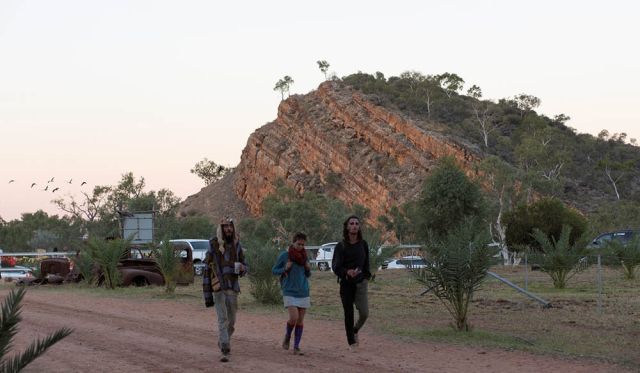
Arriving at Wide Open Space Festival, Alice Springs

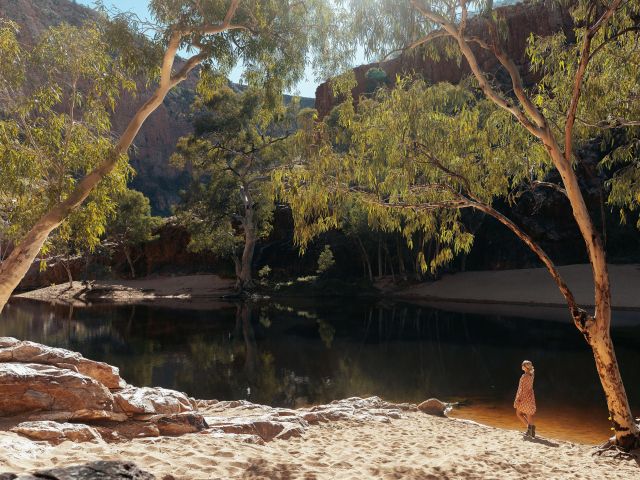
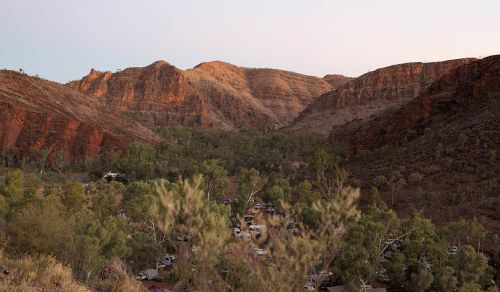
Escarpments of bright red rock studded with dry grasses rise steeply around the site, and the sheltered gorge is a spectacular setting for a program of music, cabaret, panels and workshops that is best described as eclectic.


Apakatjah take their name from a pejorative Luritja word for a person of mixed race heritage and their lyrics talk about being caught between two cultures. But their message is one of acceptance, and this extends to the catchy music that blends reggae, rock and even heavy metal influences.


Other acts include Quebecois psych rock sleaze funk with caustic social commentary and a very modern girl group whose choreographed dance moves and chanted vocals underpin fun, danceable songs that tackle issues like privilege and gender inequality.


Between musical acts, a sound tech delivers a deadpan comedy set as free range children roam around. In the shaded workshop area, a seated group learns traditional basket weaving techniques while a flash mob of bright blue and green fish dances their way around the site in a school.


Panels discuss the state of the arts in the Northern Territory and the ongoing impact of The Intervention on Indigenous communities.


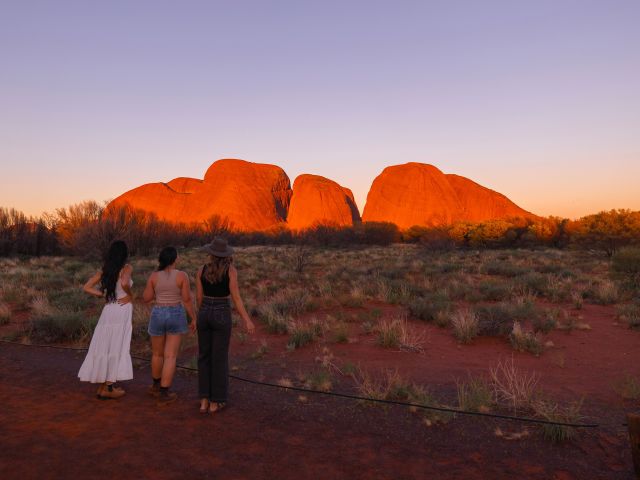
At several points during the festival, Arrente traditional owners lead ceremonies that help us connect to country but Wide Open Space also has plenty of traditions that are all its own. The most spectacular is the sunset ceremony on the final evening, which gives us a literal overview of the festival site from a hilltop vantage point.


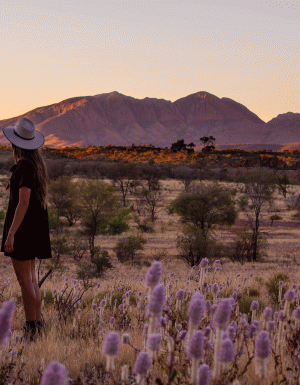
The tiny cluster of stages, tents and campervans pales into insignificance with the view over the other side; a flood plain crowded with trees is a burst of life in this desert landscape and leads up to a long ridge of sawtooth peaks.


Closer at hand, hundreds of dusty and bedraggled festivalgoers are lit up by the setting sun in a symphony of colour. We crowd together to make room as more arrive and when someone reaches the summit with a bass drum held aloft, a band strike up a tune. Those of us who’ve attended choir rehearsal each morning start to sing the three part harmonies to Whitney Houston’s I Want To Dance With Somebody.


I have no idea who chose the song, but the setting and sense of community combine to make it a euphoric moment. As we finish, cheers and whistles ring out and high fives are exchanged. The costumes are a little worse for wear and the crowd weary but I am grinning incessantly, as are most of the people around me. A man who looks like a cross between Mad Max and Carmen Miranda turns to me.


“This has got to be the most beautiful festival in the country" he says, and it’s hard not to agree.

Need tips, more detail or itinerary ideas tailored to you? Ask AT.

AI Prompt

Wide Open Space, Alice Springs

Get information on tickets and upcoming dates, visit wideopenspace.net.au

Check out our pick of NT festivals and events and Parrtjima – A festival of light.

Images via Ross McNaughtan

For more information on festivals & things to do in the NT, visit the official Northern Territory website at northernterritory.com

Alexis Buxton-Collins
Alexis Buxton-Collins spent his twenties working as a music journalist and beer taster before somehow landing an even dreamier job as a freelance travel writer. Now he travels the world from his base in Adelaide and contributes to publications including Qantas, Escape, The Guardian and Lonely Planet. Alexis has never seen a hill he didn't want to climb and specialises in outdoor adventures (he won the 2022 ASTW award for best nature/wildlife story for a feature on Kangaroo Island). When he's not scouring South Australia for the newest wineries and hikes, he's looking for excuses to get back to spots like Karijini and Ningaloo.
View profile and articles
hero media

Discovering East Arnhem: Australia’s most unique and rewarding corner

    Joanne Millares Joanne Millares

    Hard to reach and harder to forget, East Arnhem offers something rare in modern travel: the chance to slow down and experience Country on its own terms.

    The sky feels bigger in East Arnhem . It stretches wide and uninterrupted above rouged earth, stringybark woodland and beaches so empty they seem to belong to another era. The coastline curves for kilometres without a footprint and the horizon runs on forever.

    For comedian Lou Wall, the scale of the place was the first thing that hit them.

    “The sheer openness,” they say. “The sky feels infinite and the land stretches out endlessly. It’s pretty breathtaking visually.”

    But the physical landscape is only part of the story. The real reward isn’t only the scenery but the shift in perspective the journey brings. Visitors stop trying to tick off the destination and a real engagement takes over.

    “It made me never want to travel again,” Wall jokes. “In that I never wanted to leave East Arnhem.”

    Getting there

    Aerial shot of East Arnhem’s coastline as cars trace the curve of the shore.
    Sail along the remote coastline on an expedition cruise.

    Reaching East Arnhem is part of the adventure. Travellers typically fly into Gove Airport near Nhulunbuy via Darwin or Cairns, or arrive by expedition cruise along the remote coastline. Others make the journey overland along rutted dirt roads that cut through East Arnhem’s small pockets of monsoon forest.

    However you arrive, there’s a distinct feeling of crossing into somewhere different. Permits are required to visit the region, reflecting the fact that this is Yolŋu land where communities and traditional owners maintain deep cultural connections to Country.

    The extra planning becomes part of the experience. By the time visitors arrive, they understand they’re entering a place not just of respect, but also patience and curiosity.

    At one with nature

    East Arnhem’s  landscapes leave a strong imprint. For Wall, one place in particular still lingers in their memory: Ngalarrkpuy , also known as Lonely Beach, near Bawaka Homeland.

    “I genuinely felt like I was living inside an Instagram filter,” they say. “One of the most stunning feats of nature I’ve ever seen. The water was so clear I swear I could see even the fish smiling.”

    Across the region, natural experiences unfold at a slower pace. Fishing, beachcombing and island hopping reveal the rhythm of the coastline. The tides shape daily life and the vastness of the landscape makes even simple moments feel downright cinematic.

    For visitors with limited time, Wall says the Bawaka Homeland experience is unmissable.

    “I just left and I’m already planning when I can get back there.”

    The sense of remoteness is part of the appeal. In a country where many beaches are crowded and well-trodden, East Arnhem’s coastline still feels wonderfully wild.

    Immersing in local culture

    A visitor spends a meaningful moment alongside Yolŋu guides, gaining insight into their deep cultural knowledge and connection to the land.
    Experience authentic moments with the locals.

    Culture is woven through every experience in East Arnhem. Visitors have the opportunity to spend time on Country with Yolŋu guides and knowledge holders who share stories and traditions that have been passed down for generations.

    For Wall, one of the most powerful moments came during a conversation with a Yolŋu elder.

    “I got to meet a traditional elder, Mayalil, in Nhulunbuy,” they say. “Listening to her talk about her home made the land feel alive in ways I couldn’t have imagined.”

    The region is also home to internationally recognised Aboriginal art centres where artists shape works deeply connected to land and family knowledge.

    Music carries the same cultural energy. East Arnhem has produced globally recognised artists such as King Stingray and Baker Boy, blending Yolŋu language, storytelling and contemporary sound.

    Wall experienced this musical spirit first-hand.

    “A jam session around the fire was it for me,” they say. “Letting the deep joy and history of their music wash over me…  and meeting a few of the King Stingray musicians was unreal.”

    These moments of human connection often become the most memorable part of a visit.

    Spotting local wildlife

    An aerial view of the beach shows tiny figures lined up across the white sand, moving as if in a rhythmic dance.
    Step into a world where nature reigns.

    The wildlife of East Arnhem adds another layer to the experience. The region is home to an extraordinary range of animals, from waterbirds and turtles to dugongs, dolphins and the formidable saltwater crocodile.

    Wall admits they didn’t actually spot a croc during their visit.

    “Devastatingly, I didn’t see one,” they laugh. “But with all the stories from the locals I definitely gained a healthy respect for caution.”

    Some of the most memorable wildlife encounters can be surprisingly small., At Banubanu Beach Retreat on Bremer Island, Wall remembers walking along the beach one morning and watching it come alive.

    “As you walk through the sand you see hundreds of crabs scurrying into their holes as you pass by,” they say. “Such a small thing, but it was completely magical.”

    Moments like this reveal the quieter rhythms of East Arnhem, where even the smallest creatures seem to play a part in the landscape.

    Visitors who make the journey soon learn the most important travel tip of all.

    “Go in open-minded with a sense of curiosity,” Wall says. “Be prepared to ditch your plans. The land and the locals will guide you on an adventure no spreadsheets could ever compete with.”

    And most importantly, they add, don’t rush.

    “The land and people deserve your time and attention. You’ll be all the better for slowing down.”

    For more information on visiting East Arnhem, head to eastarnhem.com.au .