It’s been called the spiritual heart of Australia and a journey here has the potential to reshape everything you think you know about the country you call home.
In theory, an Uluru itinerary that spans three days seems like sufficient time to see a giant rock in the Red Centre of Australia. But in fact the awe that an immersive trip to Uluru and the surrounding landscape inspires offers just a tiny taste of the profound gains experienced on a trip to the Red Centre. With that in mind, I give you my very top tips for extracting as much of the magic of Uluru in three days as possible with the following itinerary.
Day one
Sydney to Uluru
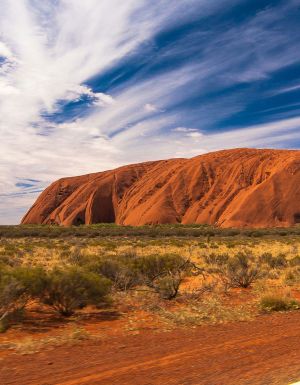
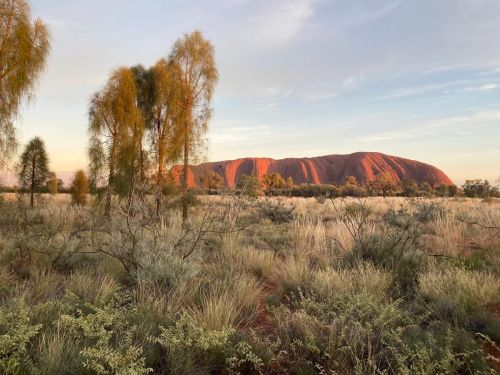
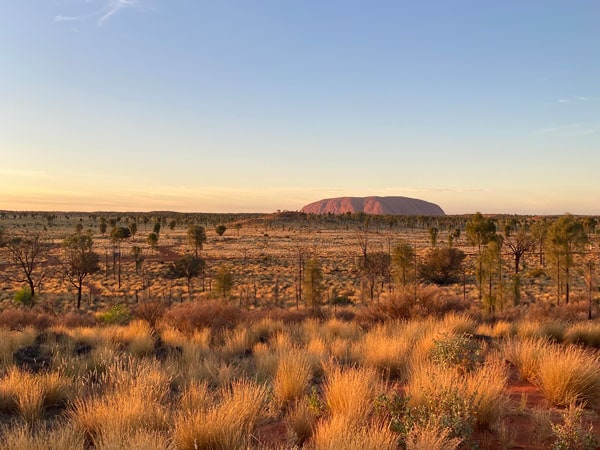
My first glimpse of Uluru is out of my plane window, during the 3.5-hour flight from Sydney. Seeing the iconic monolith from above, sprawled out like a slumbering giant, takes my breath away. Both Uluru and the equally fascinating form of Kata Tjuta/Mt Olga literally loom large over the landscape.
The first thing I learn about Uluru is that it’s a chameleon. Over the course of the day its colour changes often; less to blend in, more to stand out. Over the coming days, Uluru spins the colour wheel from a lush lavender hue, to deep shades of red, orange, brown and violet, with those changing hues intensifying my wonder of the natural world.
Check in to Desert Gardens Hotel
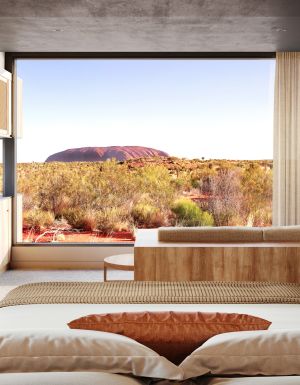
I’m spending the next two nights at Desert Gardens Hotel – which means I get to soak up the views of Uluru direct from my own private balcony.
There are several accommodation options near Uluru, but the beauty of staying at Voyages Ayers Rock Resort is that it offers a collection of accommodation to suit a variety of budgets and styles of travel including Emu Walk Apartments, Lost Camel Hotel, Sails in the Desert, Ayers Rock Campground, Outback Pioneer Hotel & Lodge, Longitude 131, and the Desert Gardens Hotel.
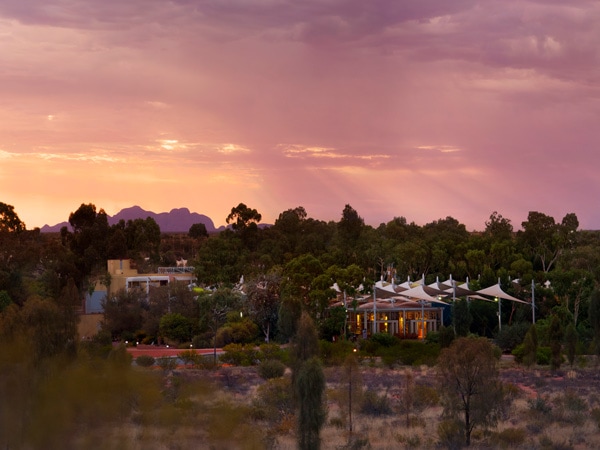
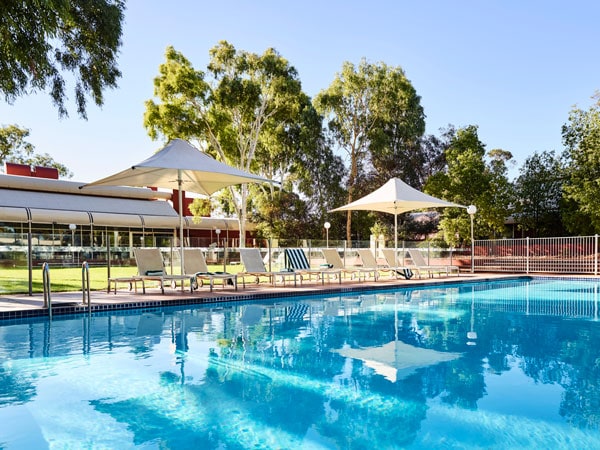
The resort acts as a mini town with a petrol station, supermarket, post office, specialty shops, several restaurants, a swimming pool, tennis and volleyball courts, and the star of the resort, the new Gallery of Central Australia (GOCA) – more on that later.
Dine under the stars at Tali Wiru
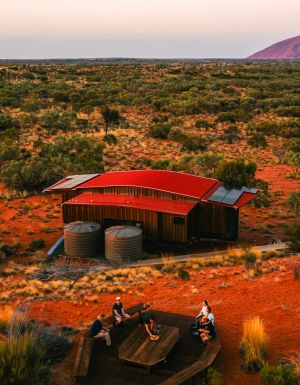
What I quickly learn from my first foray into this far-flung corner of the Northern Territory is that experiences here are all timed around dawn and dusk. I get my first taste of this as I join 20 strangers for a short drive down a dirt road towards Uluru. We stop short of the monolith, pile off the bus and follow the faint sound of a didgeridoo up an ochre-coloured sand dune.
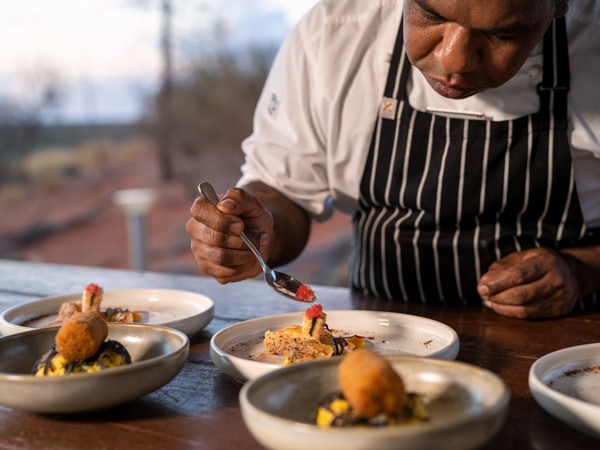
We’re here for an award-winning dune-top dining experience known as Tali Wiru (one of several standout dining experiences to try near Uluru) – meaning ‘beautiful dune’ in the local Anangu language Pitjantjatjara. Now in its 10th year, the experience includes a four-course degustation paired with premium Australian wines. The menu is created and served by an Indigenous team who expertly weave native ingredients into each dish – think desert lime, saltbush and quandong.
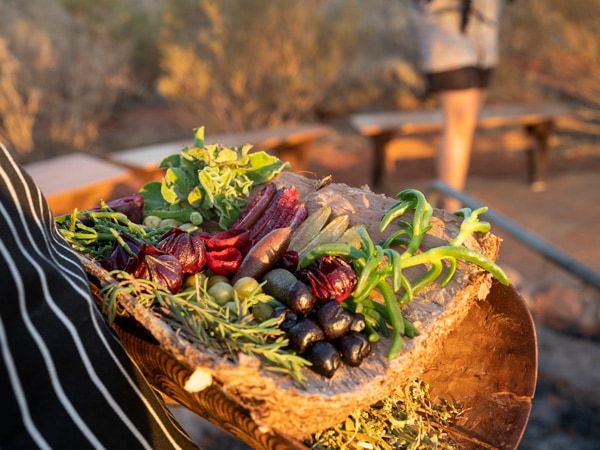
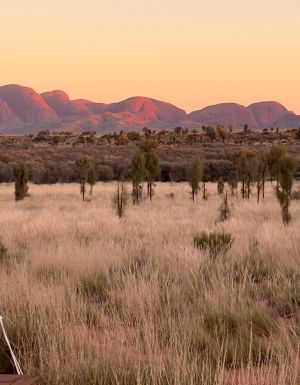
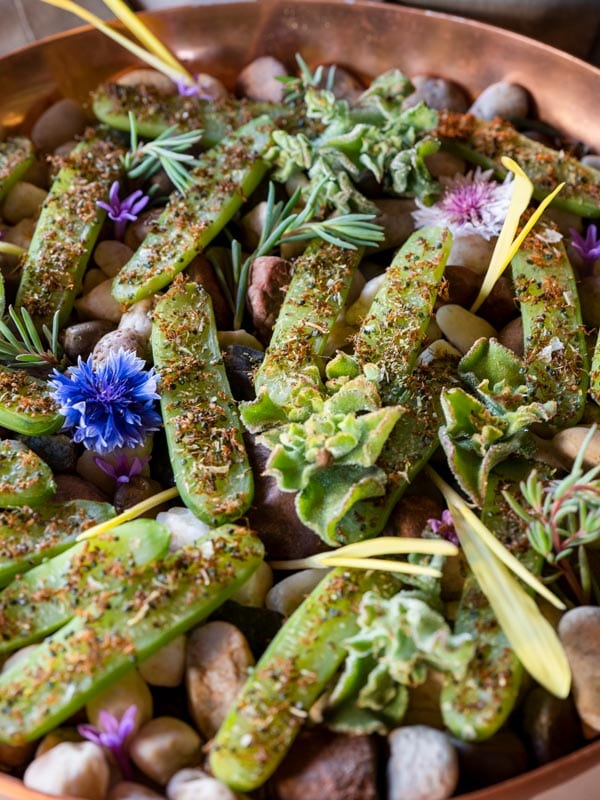
At the very top of the dunes, I gain an entirely different perspective of Uluru. It’s now tinted a deep shade of purple. As I sip on sparkling wine and bite into a gin-compressed cucumber sprinkled with crunchy green ants and celery salt, I spy the distant domes of Kata Tjuta and watch as the sun sets for the day.
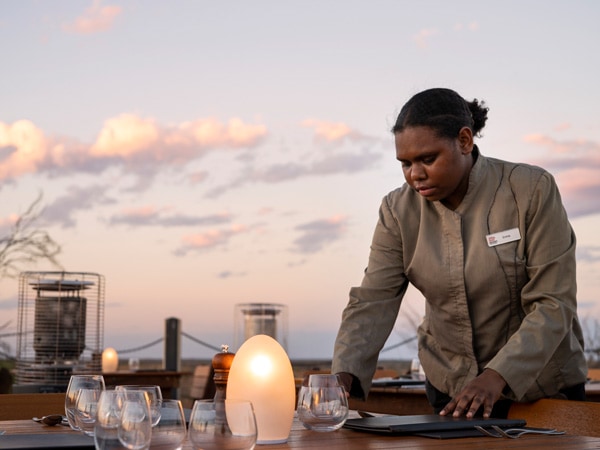
The open-air restaurant’s dining area is set with wooden tables and chairs, lit by egg-shaped lanterns – and, by the time our mains are served, also a broad brush stroke of the Milky Way. A freestanding fireplace is on standby for cooler evenings.
On the menu this evening is Port Lincoln kingfish sashimi with pickled muntries, torched scampi, quandong coulis and native warrigal greens. I choose the wagyu beef fillet with aged king brown mushrooms for my main followed by the desert lime brûlée with wattleseed meringue for dessert.
As we sit in the stillness of the desert at night, we’re treated to a stargazing talk then guided back down the dune to sit beside the firepit, sip hot chocolate and listen to a final talk before we board the bus back to the resort for bed.
The details
The Tali Wiru experience includes return hotel transfers, a didgeridoo performance, sparkling wine and canapés, a four-course dinner paired with premium Australian wines, and an Indigenous guide on hand to share culture, history, and spirituality. All up, this immersive and profoundly moving experience is $385 per person.
Top tip: Don’t wear white pants or white shoes. The red sand likes to come home with you.
Need tips, more detail or itinerary ideas tailored to you? Ask AT.
AI Prompt
Day two
Uluru Highlights Tour with SEIT Outback Australia
I rise before dawn to make my way to the hotel lobby for a three-hour guided tour of Uluru with SEIT Outback Australia. The vast form of Uluru is just starting to reveal itself when our bus pulls into the carpark.
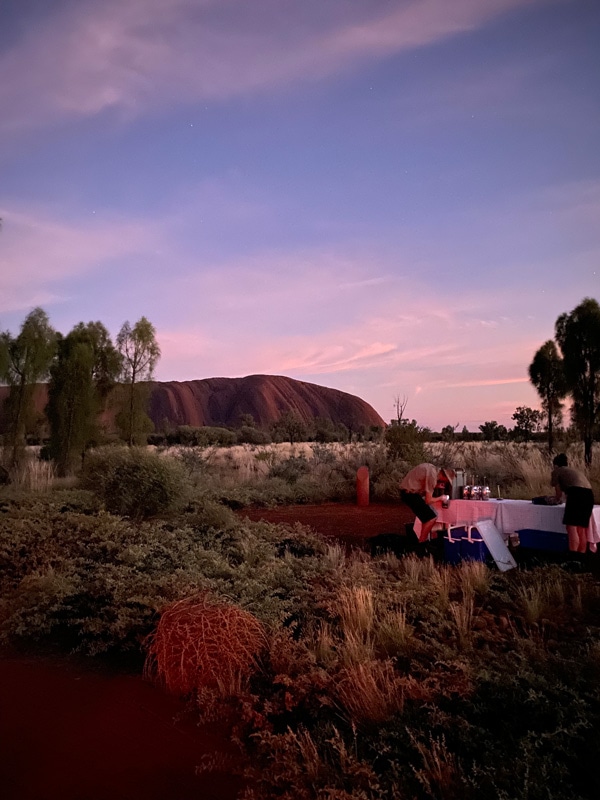
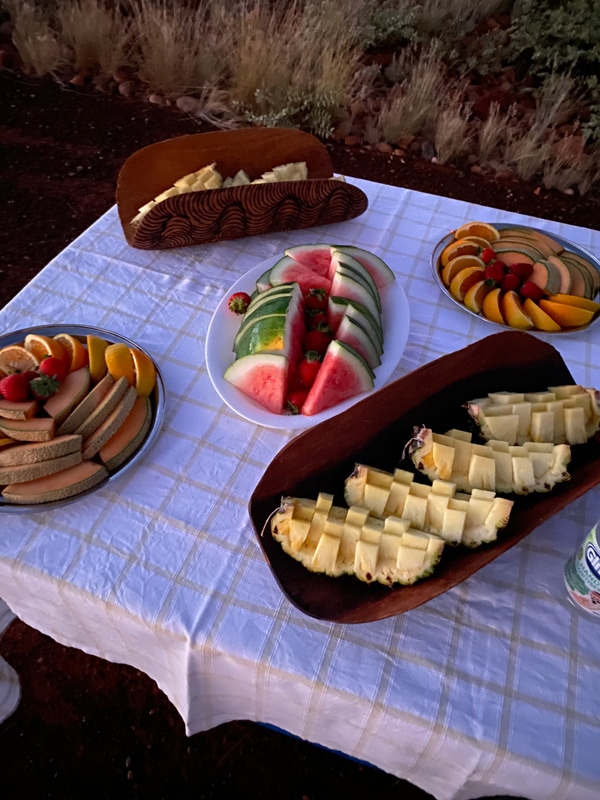
Our guides get to work setting up an outback picnic breakfast complete with fruit platters, banana bread, muesli, and yoghurt. While slowly sipping my coffee, I watch in awe as Uluru reveals today’s dress code: a deep brown ochre.
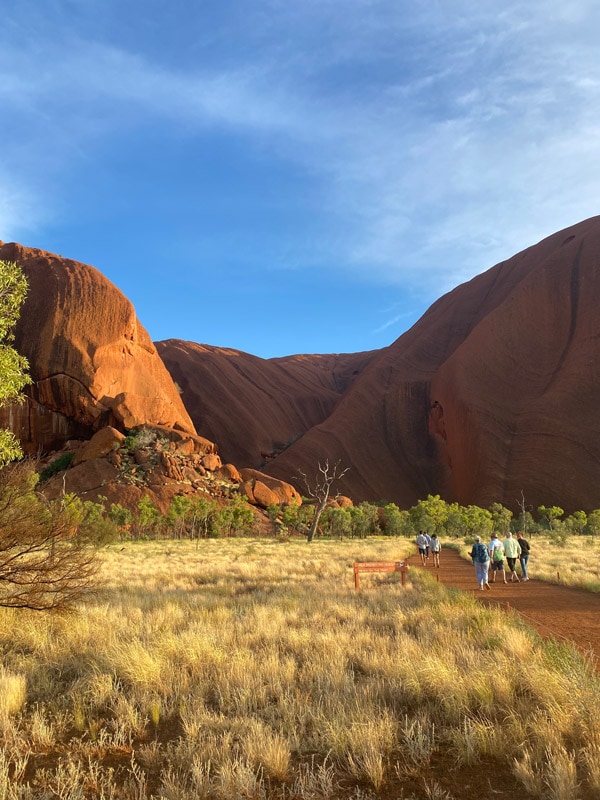
The next part of the tour is within Uluru-Kata Tjuta National Park – the Kuniya Walk around the base of Uluru. Ken, our Indigenous guide, generously shares one of Uluru’s most dramatic Creation stories, the deadly battle between Kunia (the python woman) and Liru (the poisonous brown snake man). It’s a story that is still playing out on the surface of Uluru today; told through the markings etched into its curves and crevices over time, formed in its shape and in the rock art that adorns the caves.
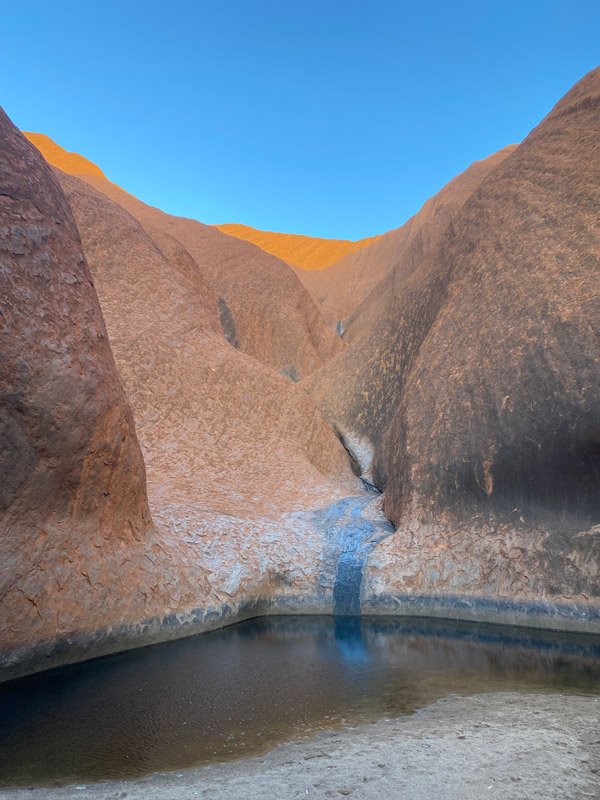
A hush falls over the group as the trees thin to reveal the Kapi (water) Mutijulu waterhole. It is here, Ken tells us, that the spirit of Minyma Kuniya combined with her nephew’s spirit and together they became Wanampi (water snake). The dark grey water pools beneath the smoothed red edges of Uluru that tower above us; it’s known to transform into a waterfall after rain. But today it is still. And calm. It’s a scene so tranquil and textured it resembles an oil painting.
When Ken was small, he used to join his father on the tours he led. It’s a tradition he is intent on continuing with his two-year-old daughter Shalene who he holds as he speaks. Despite the pain of the past, Ken says his generation is waking up to the importance of teaching each other and others their culture.
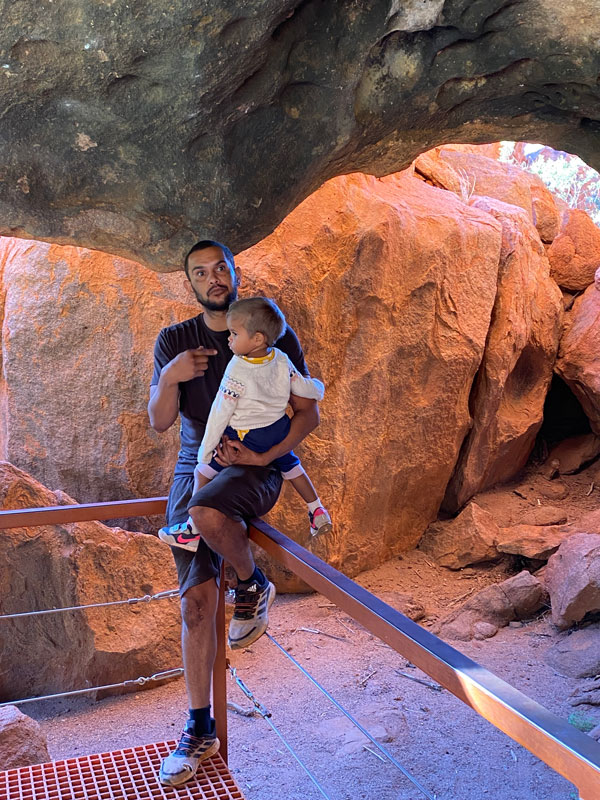
Back on the bus, the tour continues after a short drive to the other side of Uluru where we learn the story of the Mala people along the Mala Walk to Kantju Gorge.
The details
The three-hour Uluru Highlights tour with SEIT includes a guide, sunrise at Uluru, an outback picnic breakfast and pick up and return from Ayers Rock Resort. Prices start from $138 per adult, $110 per child, $60 per infant for car seat hire.
This is just one of many ways you can experience Uluru up close. You can also cycle or walk its perimeter, admire it from above on a scenic flight, or join a Segway tour. You can find our top picks in our previous article on the best things to do at Uluru.
Tip: The flies are minimal during the autumn and winter months at Uluru, but I recommend packing a fly net to cover your face. These can be purchased in the hotel lobby.
Gallery of Central Australia
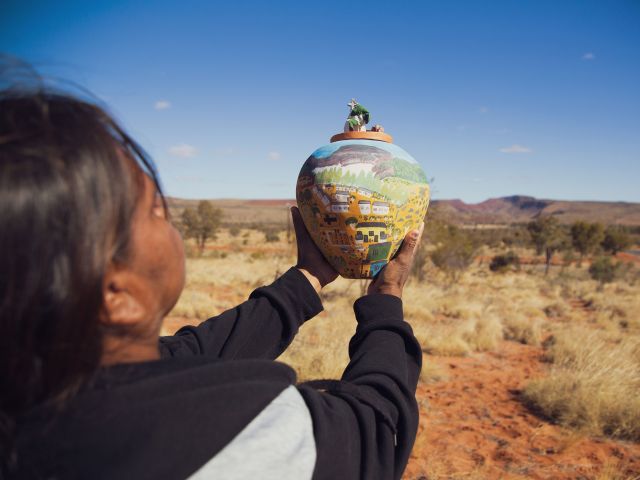
The Gallery of Central Australia (GoCA) exclusively displays more than 350 artworks by emerging and established Central Australian Indigenous artists. By collaborating with the art centres across the Northern Territory, South Australia and Western Australia, the gallery is working to provide a space for Indigenous communities to share their stories and culture (Tjukurpa) through art.
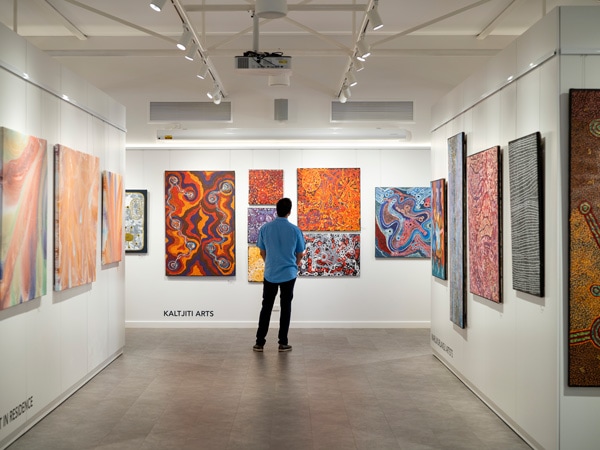
It’s an exciting recent addition to Voyages Ayers Rock Resort. One that has been four years in the making for Voyages Indigenous Tourism Australia; fuelled by passion and a vision to see artists living on Country directly supported through the sale of their works.
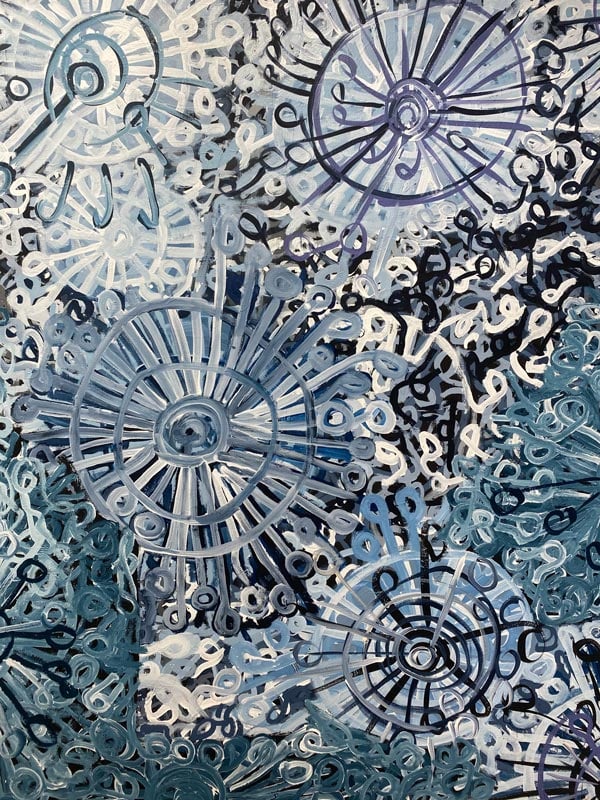
I see the vibrant storytelling of Indigenous artists come alive as I walk around the inaugural exhibition. The current collection includes works of art on canvas as well as a series of Punu (traditional Anangu wood carvings), sculptures, and pieces designed and crafted in local Indigenous communities. All these works are available for purchase and provide direct economic support for the artists.
The details
GoCA is located adjacent to Desert Gardens Hotel. It is open seven days a week from 9am to 5pm and presents a daily tour at 10.30am to visitors. There is no admission fee.
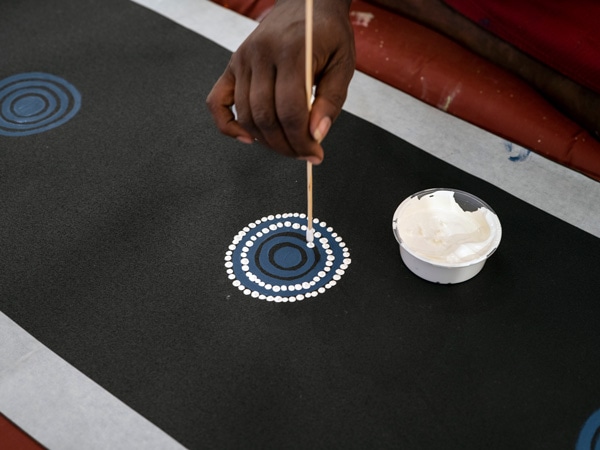
Tip: Check GoCA’s website to time your visit with its Artist In Residence program to experience the unique opportunity to observe an artist at work and learn about their processes and the significance of their work.
Weekly travel news, experiences
insider tips, offers, and more.
Day three
Field of Light Sunrise Tour with AAT Kings
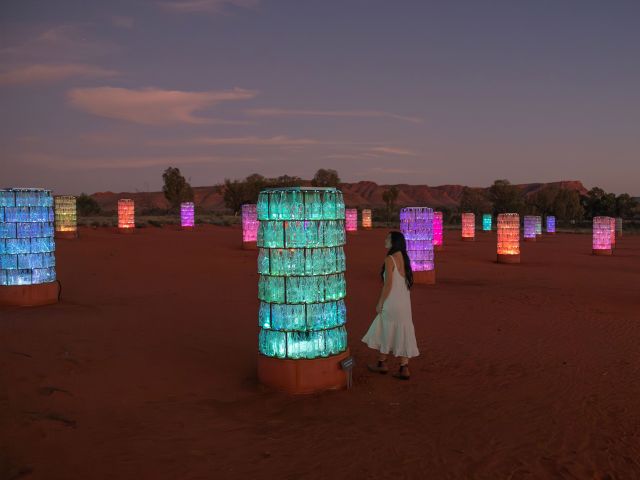
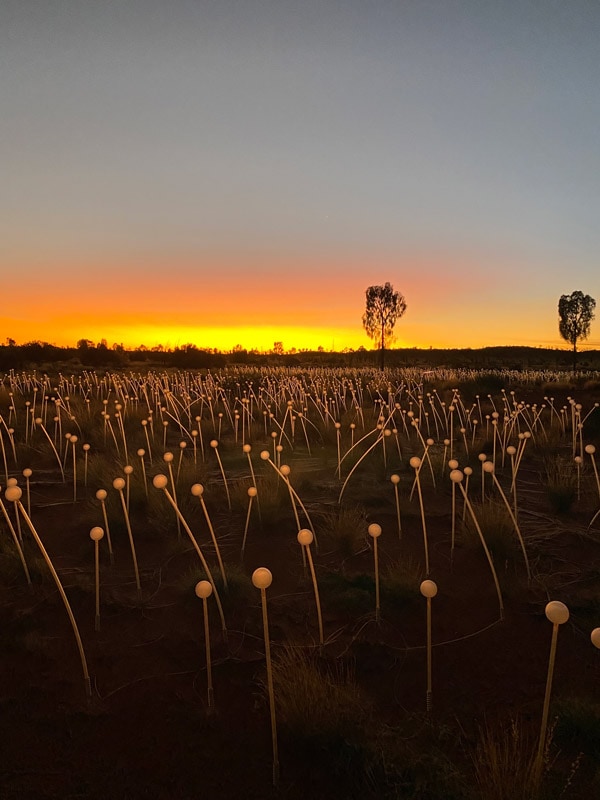
A decade of one of Australia’s most iconic light installations. As night falls in the Red Centre, 50,000 glowing stems illuminate the desert in Field of Light – a breathtaking artwork by Bruce Munro inspired by the magic of Uluṟu.
The silence is palpable when we arrive at the dune-top lookout. The stars are quickly scrubbed clean from the night sky by the first hint of morning light. The heaving shape of Uluru appears on the horizon and a field of flower-like lights cover the ground beneath it like a blanket.
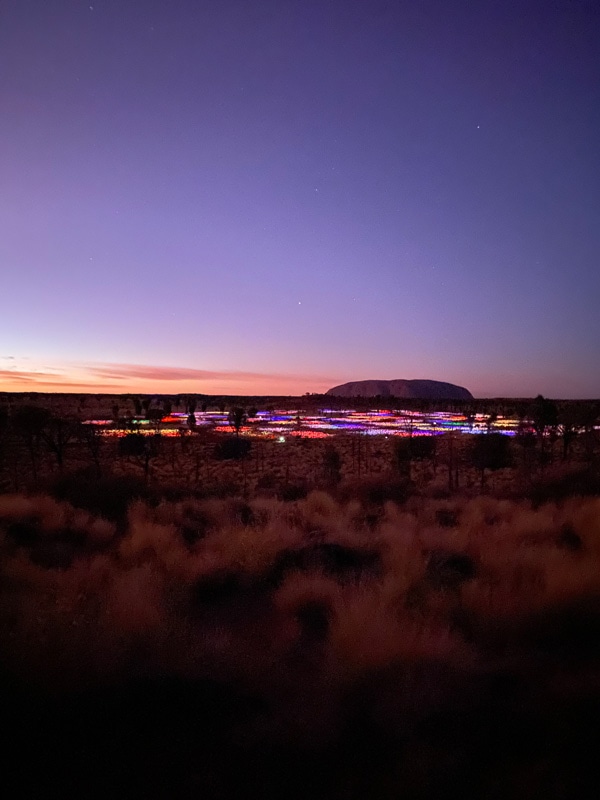
Witnessing the internationally acclaimed artist Bruce Munro’s Field of Light at sunrise is the equivalent of stumbling upon a fairy garden as a child – it seems magical, mysterious and its existence completely impossible. Yet, I’m walking along a sandy-red trail that weaves its way past 50,000 frosted glass bulbs set atop delicate stems, each aglow in shades of violet, red, blue, and white. It’s an affecting sight.
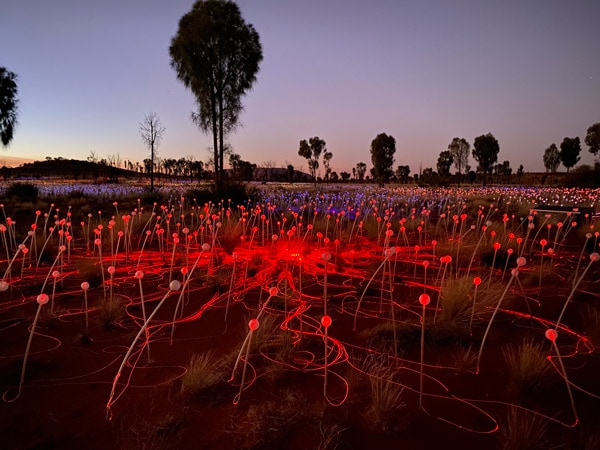
The immersive installation, inspired by Munro’s trip to Uluru three decades ago, is his largest to date. Seeing it up close, admiring the contrast of this work of art planted in such a remote desert area with Uluru in the distance, is an affecting sight.
The details
The AAT Kings sunrise tour includes return hotel transfers, a knowledgeable tour guide to answer questions and a warming cup or tea, coffee, or hot chocolate from the lookout after you complete the trail at your own pace. Prices start from $75 per adult and $40 per child.
Tip: Once the sun is up and the Field of Light dims for the day, you can get a photo from the dunes with yourself and Uluru in the background. Book in advance to avoid missing out on this incredible experience.
Uluru to Sydney
Back at the resort, and still on a high from the Field of Light tour, I head to Mangata Bistro & Bar for a buffet breakfast and morning coffee. There isn’t a lot of time before my return flight to Sydney but if you have the time, I recommend a swim in the resort pool or walk to the Town Square for some last-minute shopping for a souvenir or purchase an artwork from GoCA to take home. Not only will it be a constant reminder of your time here, but you’ll be supporting the beautiful work of Australia’s talented artists of Central Australia to ensure their voices are heard.
The writer travelled as a guest of Voyages Indigenous Tourism Australia.
Want to see more stories from Australian Traveller in your Google search results?
- Click here to set Australian Traveller as a preferred source.
- Tick the box next to "Australian Traveller". That's it.