Explore Victoria’s little-known Silo Art Trail

hero media
Get ready to marvel at the large-scale murals along the Silo Art Trail in Victoria.

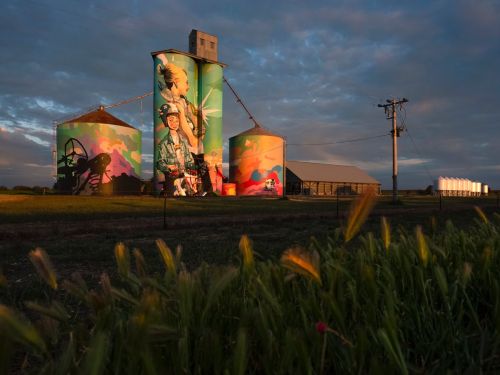
Stretching over 200 kilometres, Victoria’s Silo Art Trail is Australia’s largest outdoor gallery (and one of 100 Amazing Road Trips).

Conceived after the success of the first silo artwork in Brim in 2016, the trail recognises and celebrates the Wimmera Mallee region through a series of large-scale mural portraits that have given new life to the 80–90-year-old grain silos.

The project saw a team of renowned artists from Australia and across the world visit the region, meet the locals and transform each grain silo into an epic work of art; each one telling a unique story about the host town.

DAY ONE: Melbourne to Rupanyup

Rupanyup

Located about three hours from Melbourne, Rupanyup is the ideal first stop for your Silo Art Trail road trip.

Rupanyup’s silo art is the work of Russian mural artist, Julia Volchkova, who turned her attention to the town’s youth and their great love of team sport. Capturing the spirit of community and providing an accurate insight into rural youth culture, the work features the faces of Rupanyup residents and local sporting team members, Ebony Baker and Jordan Weidemann, who are dressed in their sports attire (netball and AFL, respectively).
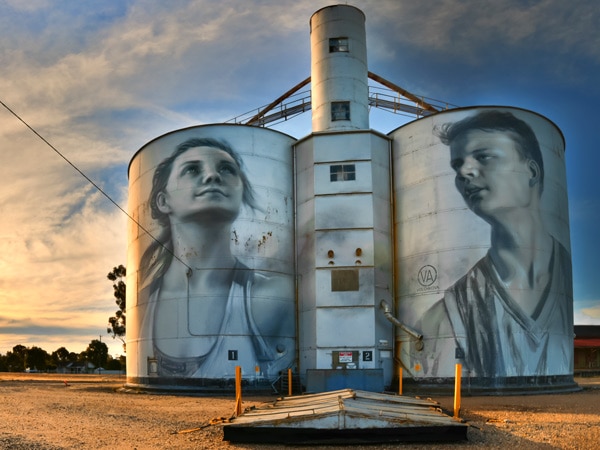
Rupanyup silo art by Julia Volchkova of Ebony Baker and Jordan Weidemann. (Image: Visit Victoria/Anne Morely)
Julia Volchkova depicted Rupanyup locals Ebony Baker and Jordan Weidemann on the silos. (Image: Visit Victoria/Anne Morely)


Must-see

Georgia Goodie artwork, Rupanyup

As a side project of the Silo Art Trail, Melbourne street artist Georgia Goodie painted two murals in Rupanyup, each one depicting firefighters. The first mural is at a house that was damaged by fire in September 2016, while the other adorns the town’s old shire office building.
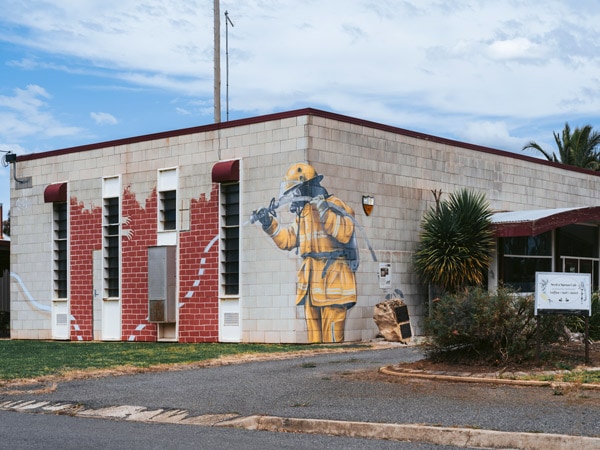
A mural of a firefighter on the Rupanyup old shire office building by Melbourne street artist Georgia Goodie. (Image: Visit Victoria/Anne Morely)
Head to the Rupanyup old shire office building to see Melbourne street artist Georgia Goodie’s firefighter murals. (Image: Visit Victoria/Anne Morely)

Stay

The Shack is a rustic and homely rural retreat. The two-bedroom cottage offers panoramic views of farm paddocks, dams, gum trees and the Grampians, the perfect place to rest after a day of exploring.

DAY TWO: Rupanyup to Sheep Hills, Goroke, Kaniva and Brim

Sheep Hills

Melbourne-based artist, Adnate found inspiration for his mural on the Sheep Hills silos in 2016 when he developed a friendship with the Barengi Gadjin Land Council in north-west Victoria.

Adnate depicted Wergaia Elder, Uncle Ron Marks, and Wotjobaluk Elder, Aunty Regina Hood, alongside two young children, Savannah Marks and Curtly McDonald to celebrate the richness of the area’s Indigenous culture.

The night sky represents elements of local dreaming and the overall image signifies the important exchange of wisdom, knowledge and customs from Elders to the next generation.

Spending four weeks with the community in late 2016 to conceive and complete the mural, Adnate sought to shine a spotlight on the area’s young Indigenous people and highlight the strong ancestral connection they share with their Elders.
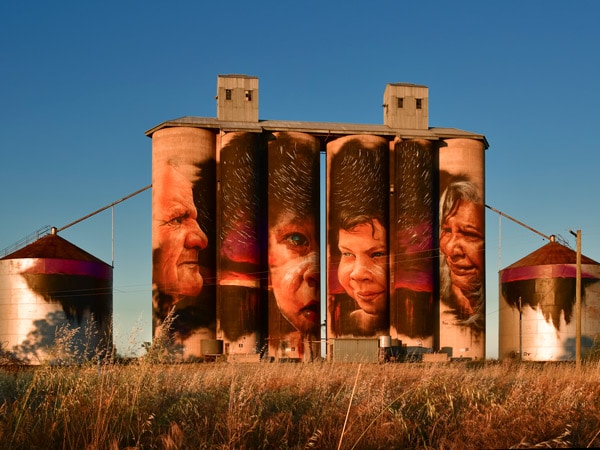
Silo Art at Sheep Hills by Adnate depicts Wergaia Elder, Uncle Ron Marks, Wotjobaluk Elder, Aunty Regina Hood, with children, Savannah Marks and Curtly McDonald. (Image: Visit Victoria/Anne Morely)
Adnate shines light on the strong ancestral connection young Indigenous people share with their Elders. (Image: Visit Victoria/Anne Morely)

Goroke

Artist Geoffrey Carran was heavily inspired by the birdlife in West Wimmera Shire when creating the Goroke silo art.  The word Goroke is the local Aboriginal word for magpie, so the native bird was a natural choice. Geoffrey then expanded the idea to include other native birds, including a kookaburra and galah.
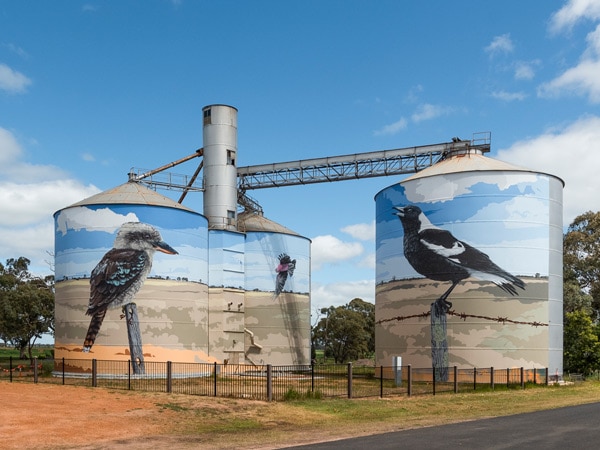
Geoffrey Carran silo art in Goroke of a magpie and kookaburra. (Image: Visit Victoria/Anne Morely)
The word Goroke is the local Aboriginal word for magpie. (Image: Visit Victoria/Anne Morely)

Kaniva

The artwork was painted by David Lee Pereira and pays tribute to the nearby Little Desert and its diverse flora and fauna. It is home to more than 600 species of native plants, 220 species of birds and 60 native mammals and reptiles.

The design features the Australian Hobby bird, which is smaller than other falcons, and is one of six Australian members of the family ‘Falconidae’. To the left of the bird is the plains sun orchid, with the salmon/pink sun orchid on the right.
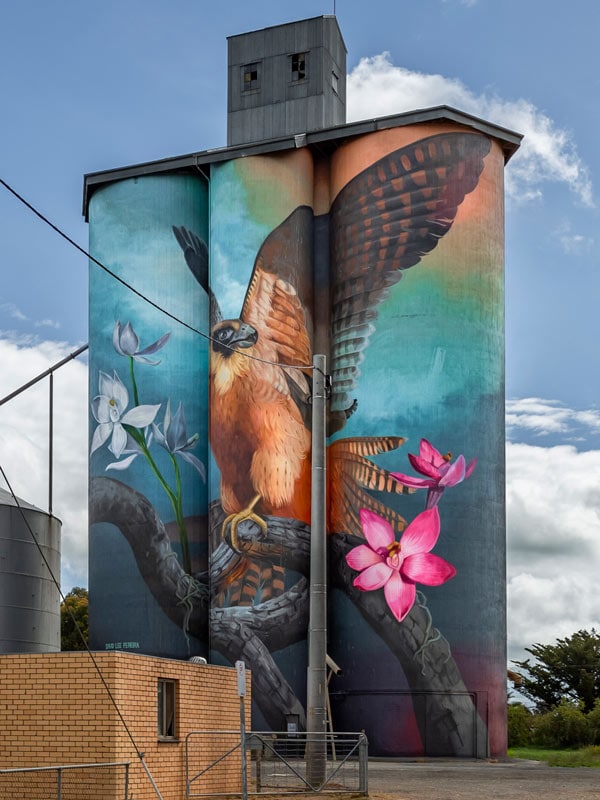
The Australian Hobby bird, and a plains sun orchid painted by David Lee Pereira on the Kaniva silos. (Image: Visit Victoria/Anne Morely)
The Australian Hobby bird is smaller than other falcons. (Image: Visit Victoria/Anne Morely)

Need tips, more detail or itinerary ideas tailored to you? Ask AT.

AI Prompt

Brim

Guido van Helten’s iconic Brim mural was the first silo artwork to appear in Victoria, and after gaining widespread local and international attention, its success shone a spotlight on the Wimmera Mallee region and inspired the establishment of the Silo Art Trail.

Completed in early 2016 van Helten’s mural depicts a multi-generational quartet of female and male farmers. Rendered across the four silos, van Helten’s subjects bear expressions that exemplify the strength and resilience of the local farming community.

The figures are both central and peripheral, present and absent, and the work explores shifting notions of community identity at a time when rural populations face both immense economic pressure and the tangible consequences of climate change.
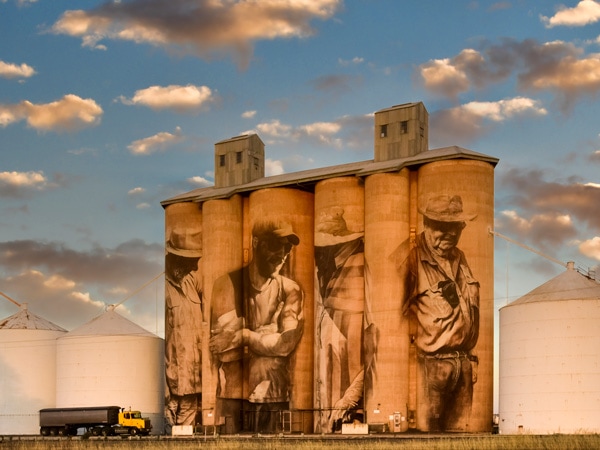
Guido van Helten's silo art in Brim depicts a multi-generational quartet of female and male farmers across four silos. (Image: Visit Victoria/Anne Morely)
Guido van Helten’s Brim mural was the first silo artwork to appear in Victoria. (Image: Visit Victoria/Anne Morely)

Must-see

Nine kilometres north of Brim on the Henty Highway is the Netting Fence, constructed in 1885 to stop rabbits invading the Mallee from the south and to keep the dingos to the north. The fence is also the division between the Wimmera and the Mallee regions.

Stay

Brim has a stunning free campsite, which can be powered (or not!) called Reddas Park Camping Area.

DAY THREE: Brim to Rosebery, Albacutya and Patchewollock

Rosebery

Before commencing work in Rosebery, Melbourne artist, Kaff-eine spent time in the Mallee assisting fellow artist Rone on his Lascelles silo project. Kaff-eine’s artwork depicts themes that she says embody the region’s past, present and future.

The silo on the left captures the grit, tenacity and character of the region’s young female farmers, who regularly face drought, fires and other hardships living and working in the Mallee.

The silo on the right portrays a quiet moment between man and horse, who are relaxed and facing downward, indicating their mutual trust, love and genuine connection.
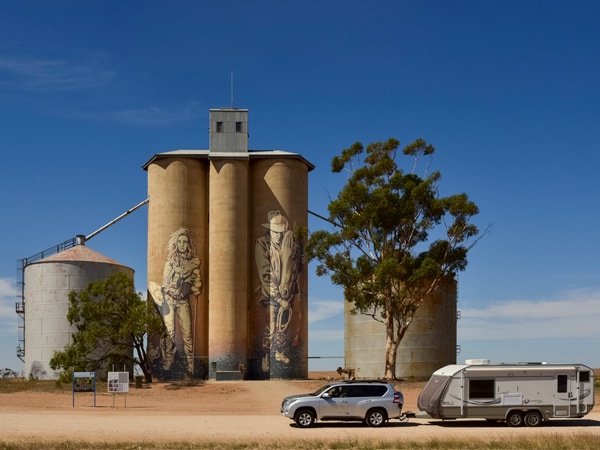
Kaff-eine's Rosebery silo on the left shows a young female farmer, and the silo on the right portrays a quiet moment between man and horse. (Image: Visit Victoria/Anne Morely)
Kaff-eine’s artwork depicts themes that embody the region’s past, present and future. (Image: Visit Victoria/Anne Morely)

Albacutya

Ten kilometres north of Rainbow lies the quirky, colourful and more modern take on Silo Art at Albacutya Silo.

Melbourne artist Kitt Bennett was inspired to, “create an artwork that tells a story of growing up in the country as a youth. I have fond memories of exploring the bush and looking for yabbies under rocks in creeks with my parents. Reflecting on this weird and wonderful time as an adult is something that brings me a lot of happiness."
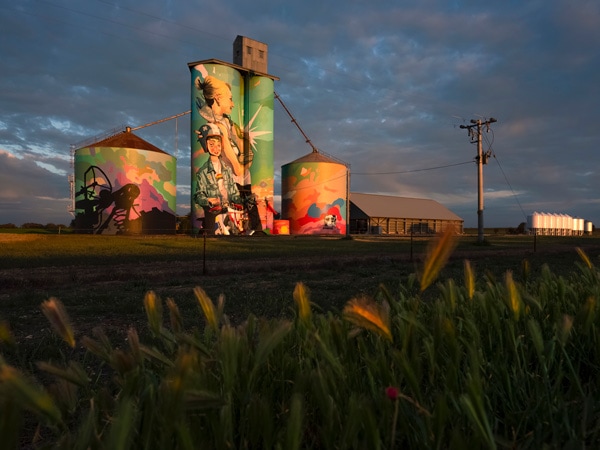
The Albacutya Silo by Kitt Bennett shows bright colours telling the story of growing up in the country. (Image: Visit Victoria/Anne Morely)
The Albacutya Silo by Kitt Bennett is a more modern take on silo art. (Image: Visit Victoria/Anne Morely)

Patchewollock

To prepare for his Patchewollock mural, Brisbane artist, Fintan Magee booked a room at the local pub to immerse himself in the community and get to know its people. When he met local sheep and grain farmer, Nick “Noodle" Hulland, Magee knew he had found his muse.

The rugged, lanky local exemplified the no-nonsense, hardworking spirit of the region. Perhaps more importantly though, Noodle had just the right height and leanness to neatly fit onto the narrow, 35-metre-high canvas of the twin silos. Hulland’s solemn expression, sun-bleached hair and squinting gaze speak to the harshness of the environment and the challenges of life in the Wimmera Mallee.
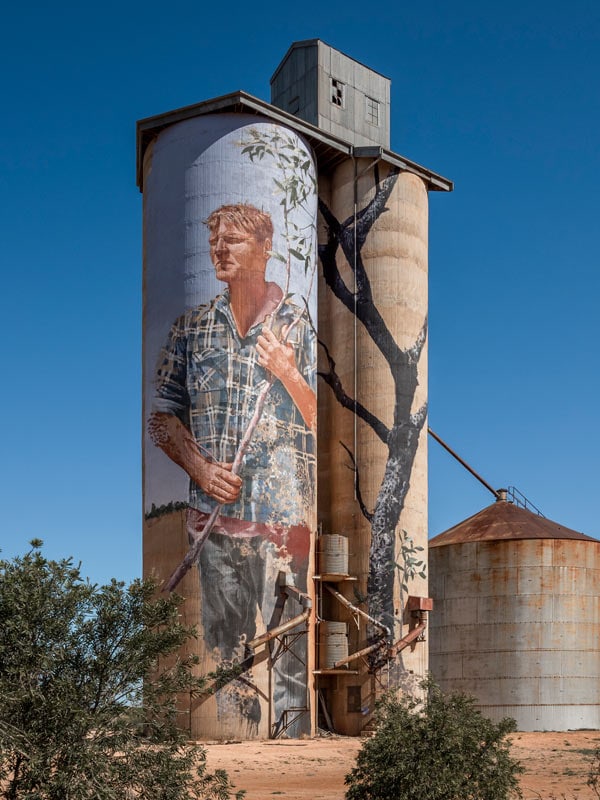
Fintan Magee painted Nick “Noodle
Brisbane artist, Fintan Magee met his silo art subject at the local pub. (Image: Visit Victoria/Anne Morely)

Must-see

Lake Albacutya

Lake Albacutya is one of a series of terminal lakes on the Wimmera River, which form the largest land-locked drainage system in Victoria.

Weekly travel news, experiences
insider tips, offers, and more.

The Big Mallee Fowl

The Big Mallee Fowl, constructed almost entirely from painted corrugated iron, is one of the most obscure of Australia’s Big Things. Make sure you stop by when you’re in Patchewollock!
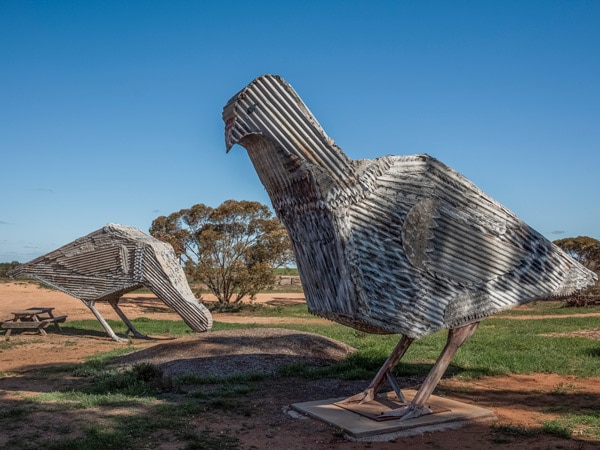
The Big Mallee Fowl in Patchewollock. (Image: Visit Victoria/Anne Morely)
The Big Mallee Fowl is a lesser-known “Big Thing" in Australia. (Image: Visit Victoria/Anne Morely)

Stay

Just 20 minutes out of Patchewollock is Pine Plains Lodge. With glorious sunrises, lingering sunsets, clear night skies and stars so close you can almost touch them, it is the perfect place to cosy up next to the fire after a big day sightseeing.

DAY FOUR: Patchewollock to Lascelles and Sea Lake

Lascelles

In order to capture the true essence of Lascelles, Melbourne-based artist, Rone knew that he had to learn about the town from those who were deeply connected to it. He depicts local farming couple Geoff and Merrilyn Horman, part of a family that has lived and farmed in the area for four generations.

Rone says that he wanted the mural to portray his subjects as wise and knowing, nurturing the town’s future with their vast farming experience and longstanding connection to the area.
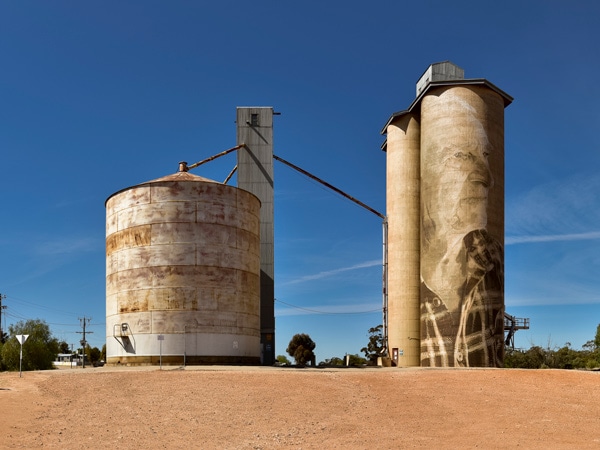
Lascelles silo art by Rone depicts local farming couple Geoff and Merrilyn Horman. (Image: Visit Victoria/Anne Morely)
The mural portrays Geoff and Merrilyn Horman as wise and knowing. (Image: Visit Victoria/Anne Morely)

Sea Lake

Joel Fergie and Travis Vinson painted the silo artwork at Sea Lake as a celebration of the still and silence found in outback Victoria, and the associated feelings of wholeness and freedom. The young girl, swinging from a Mallee Eucalyptus, looks over Lake Tyrrell and reflects on her Indigenous heritage.

The Indigenous name ‘Tyrille’ means ‘space opening to the sky’ as the colours of dusk and dawn are reflected in the shallow saline bowl. The Boorong People were known to have more knowledge of astronomy than any other tribe, and their stories are rich in culture and connection to the lake. The artwork aims to connect and bring the viewer closer to some of the relatively ordinary and overlooked elements of the outback landscape and allows viewers to see these elements from a new perspective.
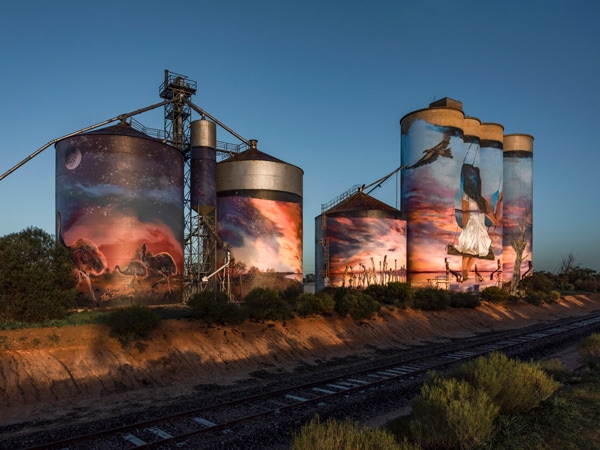
Joel Fergie and Travis Vinson painted the silo artwork at Sea Lake of a young girl, swinging from a Mallee Eucalyptus, looking over Lake Tyrrell and reflecting on her Indigenous heritage. (Image: Visit Victoria/Anne Morely)
The Boorong People were known to have more knowledge of astronomy than any other tribe, and their stories are rich in culture and connection to Lake Tyrrell. (Image: Visit Victoria/Anne Morely)

Must-see

Lake Tyrrell

A visit to Lake Tyrrell, Victoria’s largest salt lake, is a must while in Sea Lake. You’ll get a once in a lifetime insta pic, plus the 120,000-year-old lake is regarded as one of the best places in Australia for stargazing, with the dark and endless skies providing the perfect environment.
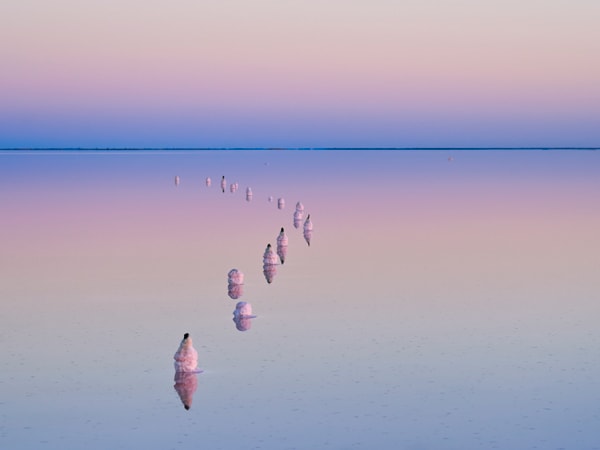
Pinks and purples reflect off Lake Tyrrell is Victoria's largest salt lake. (Image: Visit Victoria/Anne Morely)
Lake Tyrrell is the ultimate stargazing spot. (Image: Visit Victoria/Anne Morely)


Stay

Sea Lake has a range of different stays to suit your needs, whether camping is your vibe or you’d prefer to relax in a hotel.

DAY FIVE: Sea Lake to Melbourne via Nullawil

Nullawil

Artist Sam Bates (Smug) painted the Nullawil silo of a kelpie sheepdog and a farmer on the concrete canvas. The soft-coated black and tan Kelpie was depicted with a sheen on his coat, a shiny black nose, a spark in his brown toned eyes and fine grey whiskers above his semi drooped mouth.

As a “nod" to the history of Nullawil the registration disc has a “galah" and “stick" engraved on it. The name of the town is derived from two Aboriginal words, “Nulla" which means killing stick, and “Wil" derived from the term “willock" meaning Galah.

After visiting Nullawil, it’s back home to Melbourne!
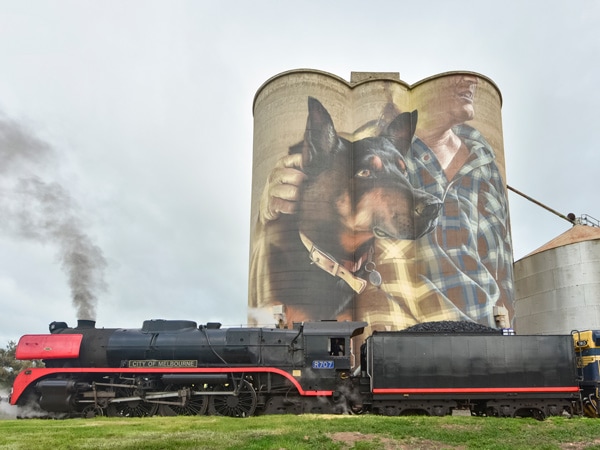
Artist Sam Bates (Smug) painted the Nullawil silo of a kelpie sheepdog and a farmer on the concrete canvas. (Image: Visit Victoria/Anne Morely)
The name of the town is derived from two Aboriginal words, “Nulla" which means killing stick, and “Wil" derived from the term “willock" meaning Galah. (Image: Visit Victoria/Anne Morely)

Want to see more stories from Australian Traveller in your Google search results?

  1. Click here to set Australian Traveller as a preferred source.
  2. Tick the box next to "Australian Traveller". That's it.
Emily Murphy
Emily Murphy is Australian Traveller's Email & Social Editor, and in her time at the company she has been instrumental in shaping its social media and email presence, and crafting compelling narratives that inspire others to explore Australia's vast landscapes. Her previous role was a journalist at Prime Creative Media and before that she was freelancing in publishing, content creation and digital marketing. When she's not creating scroll-stopping travel content, Em is a devoted 'bun mum' and enjoys spending her spare time by the sea, reading, binge-watching a good TV show and exploring Sydney's vibrant dining scene. Next on her Aussie travel wish list? Tasmania and The Kimberley.
View profile and articles
hero media

7 reasons to book a long weekend on the Mornington Peninsula

(Image: Supplied)

    Jade Raykovski Jade Raykovski
    A place of spectacular coastlines and rolling vineyards, the Mornington Peninsula is just an hour from Melbourne, yet feels like a world away.  

    Victoria’s Mornington Peninsula is often voted the number one short stay in Australia, and for good reason. From its beautiful coastline and scenic trails to exceptional food and wine, it’s the perfect escape any time of year, but especially as the weather grows cooler.  

    Picture afternoons relaxing in the soul-warming hot springs. Evenings by a cosy fireplace, sipping one of the region’s renowned Pinot Noirs and tucking into a delicious meal made from local produce. Now stop imagining, and start planning; here’s why the Mornington Peninsula should be your next long weekend adventure.  

    1. It’s easy to get to 

    An aerial view of Pt. Leo Estate on the Mornington Peninsula.
    Spend a long weekend on the Mornington Peninsula. (Image: CMcConville)

    At only an hour’s drive southeast of the city, the Mornington Peninsula offers unbeatable convenience. If you’re taking the Eastlink tollway to Peninsula Link, look out for eclectic roadside artwork such as Callum Morton’s high-rise hotel (hint: you can’t check in). 

    2. The coastline is stunning

    Mount Martha Bathing Boxes
    Stay in colourful, iconic beach huts along the coast.

    The Mornington Peninsula separates Port Phillip Bay to its west and Western Port Bay to its east, making it the only place in Victoria you can see a sunrise over one bay and sunset over another. 

    Its spectacular coastline varies from sandy swimming and surf beaches to dramatic rocky cliffs. Mt Martha Beach, known for its colourful beach huts and calm clear waters, was named in Tourism Australia’s Top 10 beaches for 2026. Nearby, Arthurs Seat Eagle offers gondola rides to the peninsula’s highest point, where you can enjoy breathtaking vistas. 

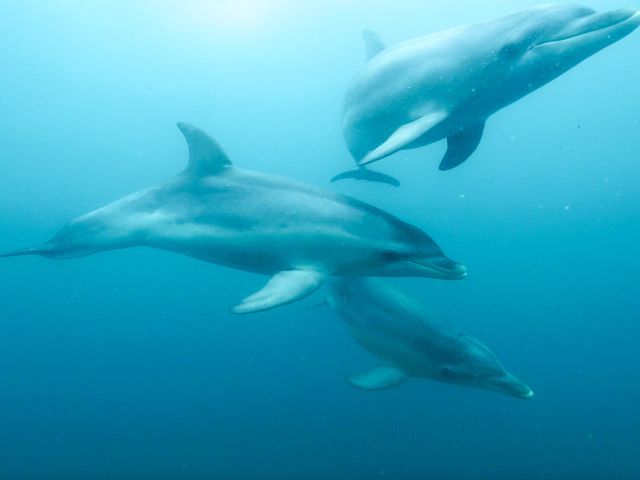
    For a different perspective from the water, embark on a once-in-a-lifetime experience swimming with the bay’s resident dolphins, or catch a ride with Searoad Ferries from Sorrento to Queenscliff (the tip of the opposite Bellarine Peninsula). Pop into their new Sorrento terminal for sweeping views from its floor-to-ceiling windows and a bite to eat at Mediterranean restaurant ONDA. 

    3. Taste exceptional food and wine

    Crittenden restaurant mornington peninsula
    Treat yourself to the restaurant at Crittenden.

    While the Mornington Peninsula is now synonymous with cool climate wines like Pinot Noir and Chardonnay, it was originally renowned for apple production. There are many orchards still in operation, like fifth-generation Mock Red Apple; taste craft ciders (the Mulled Spiced Cider is a must in winter), and don’t miss the famous apple pie. 

    Of course, it would almost be a sin not to dine at a winery restaurant, or at least try a local wine. Stop at Foxey’s Hangout for casual share plates and a glass of Chardonnay on the deck; or for a more formal affair, the light-filled restaurant at Paringa Estate offers a fine dining set menu on weekends, with picturesque estate views. 

    Pt. Leo Estate has no less than three separate dining experiences to choose from, ranging from a wine terrace to contemporary fine dining, all sourcing seasonal Victorian and local Mornington Peninsula produce, and offering stunning vistas over Western Port Bay.  

    And opened in 2025, the restaurant at Crittenden celebrates regional produce with a modern Australian menu that pairs beautifully with their sustainably crafted estate wines.

    4. Plenty of ways to enjoy the great outdoors

    A quiet moment on the green as he prepares for the perfect swing.
    Tee off at world-class golf courses with stunning coastal views.

    Bring your hiking boots, because from beachside strolls to breathtaking cliffside walks, the Mornington Peninsula boasts incredible scenic trails for all fitness levels.

    The Red Hill Rail Trail follows the old railway line between Merricks and Red Hill, while the Bushrangers Bay Walking Track is the go-to trail for rugged coastal scenery, linking Cape Schanck and the Boneo Road picnic area (part of the longer Two Bays Trail). 

    The region is also home to several national parks providing plenty of opportunities to connect with nature, whether it’s a walk, picnic, or simply admiring the local flora and fauna. Golf lovers will rejoice with gorgeous courses such as the world-class Moonah Links or Flinders Golf Club, one of Victoria’s oldest golf courses.

    5. Lean into wellness and relaxation

    From an aerial view, a woman drifts peacefully across still, crystal-clear water.
    Unwind in mineral-rich hot springs and soak in total relaxation.

    Soaking in one of the Mornington Peninsula’s mineral-rich hot springs is a must in the cooler months. Alba Thermal Springs and Spa is the newer addition, with 25 contemporary geothermal pools, a sauna and steam room set amongst elegant coastal landscaping. Book a Night Owl session to watch the sunset from the pools, and extend your visit with a spa treatment or dining at their restaurant.  

    Across the road, the Peninsula Hot Springs offers two main bathing areas, cafes and a spa in a natural bush setting. The Bath House comprises over 70 bathing and wellness experiences, including their iconic Hilltop Pool, a reflexology walk, and Nepalese mineral showers; while the Spa Dreaming Centre is a serene adults-only sanctuary.  

    6. Get a culture fix

    Visit the Southern Hemisphere’s largest privately owned sculpture park at Pt. Leo Estate during long weekend on the Mornington Peninsula.
    Discover inspiring art across galleries and sculpture parks. (Image: Chris Conville)

    Wander the Southern Hemisphere’s largest privately owned sculpture park at Pt. Leo Estate, glass of red in hand, or pop into the Mornington Peninsula Regional Gallery to view one of their seasonal exhibitions. Seawinds Garden is also home to a sculpture collection by William Ricketts, surrounded by exotic and indigenous gardens.  

    If you’re more of a history buff, book a tour of the Cape Schanck Lighthouse, or spend an afternoon at Point Nepean National Park. Here, you can explore walking trails through the traditional country of the Bunurong people, learn the history of the old Quarantine Station and discover military forts and tunnels. 

    7. Gorgeous accommodations

    Lancemore Lindenderry Red Hill
    Check into Lancemore Lindenderry Red Hill.

    The Mornington Peninsula’s standout accommodations are an experience in themselves. Escape to The Sanctuary at Alba Thermal Springs and Spa, a luxe retreat perched in the dunes above the springs. Or indulge in the dramatic luxury of Jackalope Hotel, home to a vine-facing pool and spa and the chef-hatted Doot Doot Doot. 

    For a dose of European country charm, stay at Lancemore Lindenderry Red Hill, set amongst lush gardens and vines with a cellar door and chef-hatted restaurant. Or for more contemporary, yet still charming, surroundings, the InterContinental Sorrento Mornington Peninsula is a historic hotel reimagined as a luxe coastal stay with European flair, including a pool deck and on-site bathhouse. 

    Start planning your long weekend at visitmorningtonpeninsula.org